
Livraison le jour même ou le lendemain

Qualité garantie

Débloquez vos offres de bienvenue: Livraison GRATUITE | Jusqu'à -80 % | 30 jours d'essai gratuits à JoyPlus
Téléchargez l'application
Choosing a black silicone sealant for the bathroom might seem trivial, yet it's a detail that can make or break your room's aesthetic. As matte black fixtures and accessories become a staple in our interiors, a flawless black seal provides that final, modern, and elegant touch. But be warned? not all black sealants are created equal. A poor-quality product will quickly lead to discoloured, mouldy, or peeling seals, wasting all your effort and money.
As the Head of Product Curation at Joybuy, my mission is to help you navigate the options to make the right choice. Here's a breakdown of the pitfalls to avoid and the essential criteria for finding the ideal cartridge.
Before you grab the first cartridge you see, be aware of these common mistakes that can prove costly in the long run.
To ensure a durable, professional-grade finish, pay close attention to these three points on the packaging.
This is arguably the most important technical criterion.
Always check the sealant's compatibility with the materials in your bathroom or for your black kitchen silicone seal.
For a wet room, a "sanitary" label or the presence of fungicidal agents is non-negotiable. A good anti-mould sealant contains biocides that inhibit the growth of spores and fungi. This protection is all the more crucial because the dark colour tends to mask the early signs of mould, delaying your response.
A quality product must guarantee a colour that remains stable over time. Look for mentions of resistance to UV rays and common cleaning products. A black silicone cartridge from a reputable brand, like Rubson black sealant, is typically formulated to maintain its deep black colour and not fade when exposed to detergents.
Rather than an endless list, we've chosen to match specific products to clear needs, based on our performance and durability criteria.
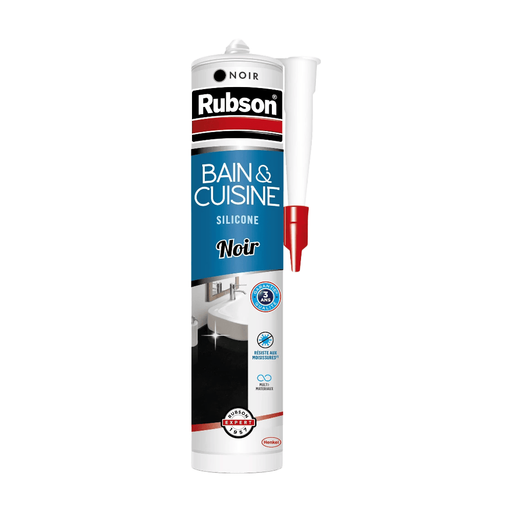
Who is it for? For anyone who wants a durable, designer finish in their bathroom or kitchen. Its "intense black" shade was developed to perfectly match current interior design trends.
This product is an acetic-cure sanitary sealant, specifically reinforced with fungicidal agents. It directly counters pitfall #1 (mould) and #2 (discolouration) thanks to its specialised formula for wet rooms.
Its reinforced anti-mould formulation ensures long-lasting protection. The "No Cutter" system with a pre-cut nozzle simplifies application for a clean, fast result.
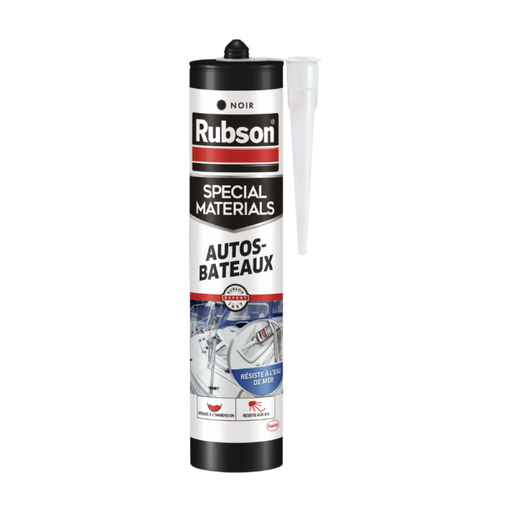
Who is it for? For DIYers tackling demanding scenarios: sealing a joint between a shower tray and a metal frame, waterproofing around wood or rubber elements in the bathroom, etc.
This sealant is designed for multi-material adhesion (metal, glass, rubber, wood) and extreme resistance (seawater, UV, temperature fluctuations). It avoids pitfall #3 (poor adhesion) on unconventional surfaces.
Its high resistance to external aggressors and its flexibility make it a reliable solution for applications where a standard sanitary sealant might reach its limits.
We have curated a complete selection of products that meet our selection criteria and current standards.
As a general rule, it is advisable to wait at least 24 hours before exposing the seal to water. This allows the sealant to "skin over" (cure on the surface) and begin to polymerise. For a full "deep" cure, which guarantees maximum waterproofing and resistance, a period of 48 to 72 hours may be necessary. Always refer to the specific instructions on the black silicone cartridge.
No, not necessarily. Its smooth surface is just as easy to clean as a white sealant. However, limescale deposits (which are white) are much more visible against a black background. To maintain its deep colour, regular cleaning with a soft sponge and a pH-neutral cleaner is recommended. Avoid scouring powders or abrasive sponges that could scratch the surface of the seal.
No, this is a mistake you should never make. To guarantee a perfect bond and a long-lasting bathroom waterproof seal, it is imperative to completely remove the old sealant. Use a utility knife and a specific silicone remover to perfectly clean and degrease the surface before applying the new sealant. Layering new sealant over old only creates a weak point that will inevitably peel away.