
Livraison le jour même ou le lendemain

Qualité garantie

Débloquez vos offres de bienvenue: Livraison GRATUITE | Jusqu'à -80 % | 30 jours d'essai gratuits à JoyPlus
Téléchargez l'application
A black 60 cm wall-mounted cooker hood can give a small kitchen a fresh new look while keeping smoke, grease and cooking odours at bay. But a stylish front panel alone isn’t enough to make the right choice. You need to scrutinise the stated extraction rate, noise level, installation method and filter maintenance before comparing prices.
Here are the main pitfalls to avoid and the features to check when choosing a slanted hood for a flat, an open-plan kitchen or a family home in the UK.
The extraction rate shown in m³/h is usually a maximum value, measured under very specific conditions. It doesn’t necessarily reflect the actual rate you’ll get once the hood is connected to ducting, a bend or an external outlet.
For a small kitchen or an open-plan space, a stated extraction rate of 580 m³/h is a useful benchmark. However, you still need to check that it’s compatible with the duct diameter, the length of the run and the number of bends.
In extraction mode, the hood pushes odour-laden air and steam outside. This means you need a wall outlet or suitable ductwork. Recirculation, on the other hand, returns filtered air to the room and is handy when an external connection isn’t possible.
This mode usually requires a charcoal filter, which needs replacing depending on how often you cook. A hood that works in both configurations offers more flexibility, provided the necessary accessories are included.
Always check the noise level in decibels, especially at maximum power. A hood rated at 64 dB at maximum won’t be silent on full power, even if it’s noticeably quieter on a lower speed. In an open-plan kitchen, this factor can make a real difference day to day.
A width of 60 cm suits most standard hobs. The hood should cover the cooking area properly without getting in the way of wall units or reducing visibility.
The Ciarra model shown here measures 595 mm wide and 305 mm deep, with an adjustable height of 633 to 900 mm. Before ordering, measure the distance between your hob and the ceiling, then check you have enough space to fit the decorative chimney properly.
A hood with a charcoal filter is handy in recirculation mode, but this type of filter isn’t always washable. The model shown uses two CBCF055 charcoal filters, while its aluminium grease filter can be cleaned.
To keep extraction working well, wash the grease filter roughly every two to four weeks, depending on your cooking habits. Regular frying and slow-cooked dishes will clog it faster.
The Ciarra model’s spec sheet shows an A+ energy rating, an annual consumption of 16 kWh/year and a power rating of 86.5 W. These figures make it easier to compare appliances, even though actual consumption depends on how long you use it, the speed selected and whether you use the lights.
A cooker hood with LED lighting also improves visibility over the cooking area. Here, the two built-in lamps shine directly onto your food, while the touch-sensitive glass control lets you adjust the ventilation and lighting.
The selection includes just one model that directly matches the search for a black 60 cm wall-mounted cooker hood. However, it can suit several different profiles, each with different priorities depending on the installation and cooking habits.
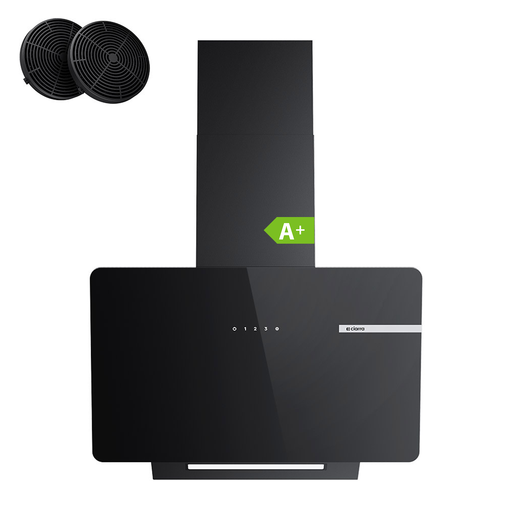
Why this choice suits this profile: its width of nearly 60 cm, wall-mounted installation and touch controls make it easy to equip a first kitchen.
Its two ventilation modes are clearly stated, and the washable metal filter reduces the consumables you need to buy in extraction mode.
Stated maximum extraction rate of 580 m³/h, LED lighting, A+ energy rating and a 24-month guarantee.
Why this choice suits this profile: its black glass panel, slanted design and SensorTouch control fit naturally into a contemporary kitchen.
The spec sheet details the dimensions, maximum noise level of 64 dB and stated annual consumption, rather than relying solely on looks.
Black glass, touch controls, adjustable height and integrated LED lighting.
Why this choice suits this profile: its extraction and recirculation modes allow it to adapt to different housing layouts.
The aluminium filter can be washed regularly, while the charcoal filters are identified by their part number, making replacement straightforward.
Multi-layer filtration, stated maximum extraction rate of 580 m³/h and mounting kit included.
We’ve put together a full, real-time updated selection of products that meet these exacting criteria as well as European safety regulations.
Yes, a hood around 60 cm wide generally suits a hob of the same width. Still, measure your hob, the surrounding cabinets and the available height before ordering.
External extraction is best when a suitable duct can be installed. Recirculation is simpler in a flat without a dedicated outlet, but it means you’ll need to maintain and regularly replace the charcoal filters.
Compare the maximum level in decibels rather than relying on the word ‘quiet’ alone. An appliance rated at 64 dB at maximum may still be acceptable on a lower speed, but the noise also depends on the ducting and the room layout.