For a coffee-and-dessert table
You’re looking for sweet biscuits that are easy to serve with coffee, tea or desserts, and want to tell cereal Digestives apart from shortbread or classic petit-beurre biscuits.


For your coffee-and-dessert table, choose cereal Digestives or sweet shortbread, depending on what you plan to serve; save savoury shortbread for the drinks reception. Before serving the biscuits, compare the nutritional information per 100 g, ingredients and allergens, then check the pack size, date and storage instructions on each packet. The Nutri-Score can provide an additional point of reference if shown, but it isn’t compulsory.
You’re looking for sweet biscuits that are easy to serve with coffee, tea or desserts, and want to tell cereal Digestives apart from shortbread or classic petit-beurre biscuits.
You’re also planning to serve savoury biscuits and want guests to be able to tell at a glance which ones are savoury and which are for the sweet table.
You need to identify the ingredients and allergen information for each product, and keep those details accessible during the meal. A ‘gluten-free’ or ‘no added sugar’ claim meets a specific need, not every dietary restriction.
First, decide whether the biscuits will go with dessert or be served with drinks. Then compare packets for the occasion you have in mind, without mistaking the name ‘Digestive’ for a promise of digestive benefits.
| What matters | What to check | Who this matters to |
|---|---|---|
| The role of sweet biscuits | Product name, ingredients and format: cereal Digestives, shortbread or petit-beurre biscuits. | If I’m putting together a coffee-and-dessert table, I want to choose a sweet biscuit that guests will recognise as part of the selection. Around 33% of consumers would make this their top priority. |
| Keeping savoury and sweet separate | The recipe for each savoury biscuit and serving them on separate platters. | For a drinks reception followed by dessert, I want to make sure no one mistakes savoury shortbread for a sweet biscuit. This would be the main concern for around 25% of consumers. |
| Nutritional information | Values per 100 g and the ingredients list; the Nutri-Score, if it appears on the packet. | Before choosing several recipes, I’d like to compare their sugar, fat and other nutritional values on a like-for-like basis. Around 25% of consumers would put this comparison first. |
| Allergens and dietary restrictions | Listed allergens, ‘may contain’ statements and the precise meaning of any ‘free from’ claims. | If a guest has told me about a dietary restriction, I need to be able to identify the exact product and let them check its packaging. This would be a priority for around 17% of consumers. |
In France, the DGCCRF states that nutritional declarations are generally mandatory on prepacked foods, while displaying the Nutri-Score is voluntary. So there’s no need to rule out a packet simply because it doesn’t carry this logo.
The DGCCRF confirms that this logo is voluntary in France. Its absence doesn’t mean you can skip checking the nutritional information, nor is it enough on its own to assess whether a biscuit meets requirements.
To compare recipes, check the values per 100 g, ingredients and allergens. Use the Nutri-Score as an additional guide when it’s shown.
The McVitie’s Digestive sold by Carrefour is a cereal biscuit made with ingredients including wheat, sugar and palm oil. Its name doesn’t prove it has digestive benefits.
Choose it for its recipe and the role you want it to play on the sweet table, after comparing its label with those of other biscuits.
Savoury shortbread isn’t intended for the same occasion as a biscuit served with coffee or dessert. Depending on the recipe, its ingredients and allergens may also differ.
Put savoury biscuits on a separate platter, label each recipe and keep the packaging available for guests to check.
The Gerblé no added sugar shortbread sold by Auchan contains maltitols. The gluten-free shortbread sold by E.Leclerc contains butter. These claims don’t tell you everything about the product’s ingredients.
Ask which restriction applies, then check the ingredients, allergens and ‘may contain’ statements on the exact packet before serving it.
Carrefour stocks a cereal-based McVitie’s Digestive: a good example of this type of sweet biscuit.
St Michel makes sweet biscuits as well as a separate range of savoury galettes and shortbread for drinks and nibbles.
Auchan stocks Petit Brun Extra among its plain biscuits.
Auchan’s plain biscuit range includes own-brand palets bretons, a traditional Breton shortbread.
E.Leclerc stocks petit-beurre biscuits and P'TIT DELI palets, as well as a separate ‘Chaque Jour sans Gluten’ product.
This selection is for the sweet table and to serve with coffee or tea. The shortbread shown isn’t described as a Digestive biscuit or as savoury shortbread.
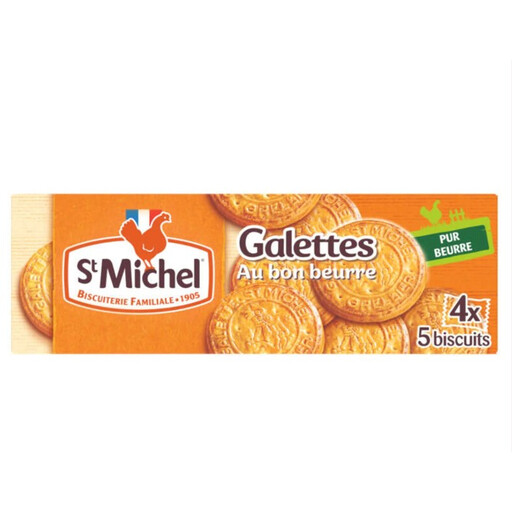 Image unavailable
A sweet shortbread to consider for your coffee-and-dessert table. The pack size shown is 120 g; the ingredients include wheat, coconut, milk and soya. Keep the packaging to hand so you can check the full label and any ‘may contain’ statements before serving.
No. The DGCCRF states that displaying it is voluntary, whereas nutritional declarations are generally mandatory for prepacked foods. When comparing biscuits, also check the values per 100 g, ingredients and allergens.
Keep the packaging for the products you serve so you can check their names, ingredients, allergens, dates and storage instructions. A simple label with the biscuit’s name isn’t a substitute for this information if a guest has a dietary restriction.
No. This claim alone doesn’t tell you how much energy the product contains. The Gerblé no added sugar shortbread sold by Auchan contains maltitols and provides 426 kcal per 100 g. Compare all the nutritional information and ingredients.
Look for a product explicitly labelled gluten-free, then check its other ingredients, allergens and ‘may contain’ statements in light of the restriction the guest has mentioned. The ‘Chaque Jour sans Gluten’ shortbread sold by E.Leclerc contains butter, among other ingredients: gluten-free doesn’t mean dairy-free.
Yes, as long as you check the date on each packet and follow its storage instructions until serving. Anses distinguishes between the best-before date, marked ‘best before’, and the use-by date. After its best-before date, a product may, for example, lose some of its flavour qualities.