People who bake several batches
If you make biscuits regularly, think about how much spread you use across your recipes and how much room you have to store the jars.


If you’re making a one-off batch of biscuits, start by comparing the amount you need with the contents of a single jar. A multi-jar pack makes more sense if you bake regularly or want to split the contents between containers. Whichever you choose, check the weight of each jar, as well as the ingredients and allergens in the product.
If you make biscuits regularly, think about how much spread you use across your recipes and how much room you have to store the jars.
Several containers can make it easier to share, or let you open one jar at a time. Check the number of jars and their weight: a pack of two very large jars is not the same as lunch box-sized portions.
If you’re serving biscuits made with the spread to other people, check the ingredients, allergens and nutritional information for the product you’re buying, whatever the format.
When making biscuits, first work out how much you’ll use, then compare the recipes and the actual number of containers.
| Criterion | What to check | Who this matters to |
|---|---|---|
| Amount you’ll use | Compare the total weight and the weight of each jar with the amount you expect to use for your batches. | If I make biscuits often, I want a supply that suits my routine without buying more than I’ll use. Around 31% of consumers put the amount needed first. |
| Ingredients and allergens | Check the ingredients list, allergens and sugars per 100 g for the product you’re considering. | When I’m baking for several people, I need to choose a recipe that suits their dietary requirements and my preferences. This is reportedly a priority for around 38% of consumers. |
| Use in biscuits | Check how much your recipe calls for. If the result is particularly important, try it with a small batch before buying a larger format. | When making a biscuit recipe again, I’d rather know how it turns out with the spread I’ve chosen than rely on the product name alone. Around 23% of consumers reportedly prioritise how it performs in baking. |
| Separate jars | Check the number of containers and the weight of each one, especially if you plan to share them. | If I want to split my supply, several separate jars are more useful than one large container. This is reportedly the top priority for around 8% of consumers. |
In France, the Nutri-Score logo is optional, according to the Ministry of the Economy. Nutrition declarations, on the other hand, are required for most prepacked foods, as the DGCCRF points out.
Compare the nutritional values per 100 g and the ingredients. Use the Nutri-Score as an additional point of reference when it appears on the packaging.
The Nutella pack listed by Cdiscount contains two 3 kg jars, making 6 kg in total. It is not made up of individual lunch box portions, nor is it necessarily the right amount for a single batch.
Check the weight of each jar and compare it with the quantities in your recipes.
Two jars of this size also need plenty of storage space.
Auchan’s listing for organic, palm-oil-free and gluten-free Nocciolata nevertheless states that it contains hazelnuts, milk and soya lecithin.
Check the allergens and any ‘may contain’ warnings on the specific jar you’ll use for your biscuits.
In France, the levy described by the Official Bulletin of Public Finances in its publication of 26 March 2025 applies to non-alcoholic drinks containing added sugars, not to spreads.
To compare products, look instead at the ingredients list and nutritional values per 100 g.
A familiar cocoa and hazelnut spread available in single jars; Cdiscount also lists a pack of two 3 kg jars.
A supermarket own-brand option to consider when comparing the sizes of individual jars.
A cocoa and hazelnut spread to consider if organic, palm-oil-free or gluten-free claims are among your priorities.
A 1 kg jar to compare with other large single-jar formats.
An option to consider when comparing the ingredients in 400 g jars.
These spreads in single jars let you compare sizes for making biscuits. The weight alone won’t tell you how each recipe will turn out when baked.
 Image unavailable
Worth considering for several batches if this amount suits your needs. This is one 1 kg jar, not several separate containers.
 Image unavailable
Compare this with other sizes if you’re making lots of batches and have room to store it. This 3 kg format is not a pack of separate jars.
 Image unavailable
A single-jar format to consider if 1 kg and 3 kg jars are more than you need for your biscuits. The jar contains 750 g; check the ingredients of this product before baking for other people.
 Image unavailable
Worth considering if you’d like an organic recipe in a 400 g format rather than a large jar. The organic claim doesn’t replace the need to check the ingredients and allergens.
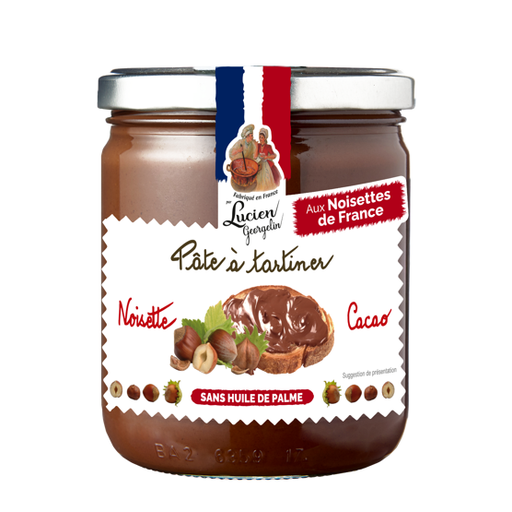 Image unavailable
A 400 g single jar to compare if you’re planning to use a moderate amount in your biscuits. Check the ingredients list and any ‘may contain’ warnings on the product you buy.
No, the Nutri-Score is optional in France, according to the Ministry of the Economy. The DGCCRF points out that nutrition declarations are required for most prepacked foods and show values per 100 g or 100 ml. Remember to compare the ingredients too.
No. The levy described by the Official Bulletin of Public Finances in its publication of 26 March 2025 applies to non-alcoholic drinks containing added sugars. Spread is not a drink.
Check the details on the jar you’ll be using. Auchan’s listings for Nutella 200 g and Nocciolata 650 g mention hazelnuts, milk and soya, among other ingredients. E.Leclerc’s Nustikao listing also warns of possible traces of other tree nuts and soya.
Not necessarily: the Nutella pack listed by Cdiscount contains two 3 kg jars, not individual portions. If you need small containers to take with you or share, check the number of jars and the weight of each one before choosing a pack.