Joybuy Insights

Bike Helmet Buyer’s Guide: Find the Right Model for Your Riding Style

Faced with a maze of models, technologies, and standards, choosing a bike helmet can quickly become a daunting task. Yet, whether you're a dedicated commuter, an avid mountain biker, or a casual cyclist, your safety is paramount. This guide is here to help you see things more clearly, decode the criteria that truly matter, and present our selection of the best helmets available today—all without the unnecessary marketing jargon.

How to Choose the Right Bike Helmet?

Before diving into our selection, let's review the key points that will guide your choice. The golden rule is simple: the best helmet is useless if it just sits in the closet. Therefore, it must be comfortable and perfectly adjusted, to the point where you forget you're even wearing it.

1. Define Your Main Discipline: Urban, Road, or MTB?

Different disciplines require different helmets. The design and features vary enormously depending on your terrain.

  • For the city: In an urban environment, the focus is on visibility and comfort. An urban bike helmet often includes practical features like a rear LED light, which is essential for weaving through traffic. Ventilation is a plus, but less critical than for a sports-focused ride.
  • For road and leisure: On the tarmac, every gram counts. Road helmets are therefore optimised for low weight, aerodynamics, and maximum ventilation. The models are generally unisex, with differences between a men's cycling helmet and a women's cycling helmet mainly coming down to sizes and colour schemes.
  • For MTB: In mountain biking, protection is paramount. A classic MTB helmet extends lower over the nape of the neck for better coverage. For more aggressive disciplines (enduro, DH, BMX), a full-face MTB helmet becomes essential. With its chin bar, this type of downhill MTB helmet protects the entire face in the event of a crash.

2. Understanding Protection Technologies: The MIPS Case

Beyond the shell, numerous technologies enhance your safety. The most famous is undoubtedly the MIPS (Multi-directional Impact Protection System).

In practical terms, this is a thin inner layer that allows your head to move slightly inside the helmet during an angled impact. This movement of a few millimetres helps to dissipate rotational forces, which are particularly dangerous for the brain. While it's not a mandatory standard, a MIPS bike helmet represents a significant safety advantage and is worth serious consideration when making your purchase.

3. Fit and Comfort: Non-Negotiable Criteria

A helmet is only effective if it is perfectly fitted. To find your size, measure your head circumference with a tape measure, placing it just above your eyebrows and ears. Once the helmet is on, use the adjustment dial at the back for a precise fit without any pressure points. The straps should form a clean "Y" shape under each ear, and the buckle, once closed, should allow one or two fingers to pass through, no more.

Our Recommended Bike Helmets

We have selected three standout models for you, each in its own category.

1. OutdoorMaster Full Face: For Aggressive Riding

OutdoorMaster Full Face Mountain Bike Helmet

  • The Concept: Maximum protection for the most demanding rides. Its Acrylonitrile Butadiene Styrene (ABS) outer shell and Expanded Polypropylene (EPP) liner are designed to withstand the harshest impacts. We appreciate the specific reinforcements at the chin bar and clavicle areas.
  • Advantages:
    • Full-face protection, ideal for DH and BMX.
    • Surprisingly good ventilation for a full-face helmet, with 27 ventilation channels.
    • A managed weight (under 750g) that you'll barely notice on long ride days.
    • Removable and washable inner pads for impeccable hygiene.
    • Adjustable visor and a guide for a perfect goggle fit.
  • Who is it for?: DH, freeride, enduro, and BMX riders who want a fortress for their head without suffocating on the first climb.

2. OutdoorMaster MIPS Gem: Versatility and Technology

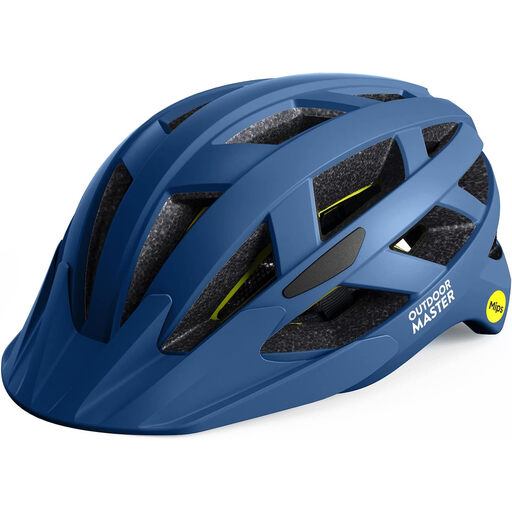
OutdoorMaster MIPS Gem I Adults Recreational Cycling Helmet

  • The Concept: Making MIPS technology accessible in an ultra-versatile helmet. Its In-Mold construction combines a Polycarbonate (PC) shell with EPS foam, a classic and proven duo for shock absorption.
  • Advantages:
    • The enhanced safety of MIPS technology against rotational impacts.
    • Unbeatable versatility: recreational MTB, road, BMX, and even skateboarding.
    • Highly effective ventilation provided by 25 large vents.
    • Custom fit thanks to the occipital dial and two sets of included pads.
    • Removable visor to switch from road to trail in a flash.
  • Who is it for?: The all-rounders, men or women, who switch between several disciplines and want MIPS protection without breaking the bank.

3. OutdoorMaster RhinoUrban: The Commuter's Companion

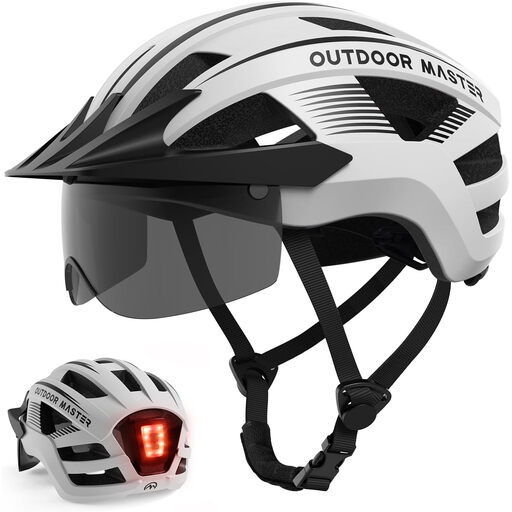
OutdoorMaster Cycling Helmet RhinoUrban With Goggles&Light

  • The Concept: The Swiss Army knife for the urban cyclist. This helmet is packed with practical features, led by a USB-C rechargeable rear light and a removable magnetic visor.
  • Advantages:
    • Maximum visibility with the integrated rear light (multiple modes available).
    • All-in-one protection from wind, insects, and sun thanks to the magnetic visor.
    • Comfortable for daily use with its 17 vents and dial-fit adjustment.
    • In-Mold construction (PC shell and EPS foam) for an excellent weight-to-protection ratio.
  • Who is it for?: The perfect helmet for commuters and urban cyclists, including e-bike riders, who are looking for a practical and safe all-in-one solution for their daily journeys.

Looking for Other Options?

This selection is just a preview. Is your riding style different? Are you looking for a specific colour or another technology? Many other models are waiting for you.

? Discover our entire range of bike helmets

Frequently Asked Questions (FAQ)

When should you replace a bike helmet?

Rule number one: a helmet must be replaced after any impact, even if it looks undamaged. The internal structure can be compromised and may no longer protect you effectively. Without any accidents, the lifespan of a helmet is 3 to 5 years. Beyond that, the materials (plastics, foams, glues) lose their effectiveness due to UV exposure, sweat, and natural ageing.

Is MIPS technology essential?

No, it is not essential, but it is highly recommended. MIPS is an additional safety feature designed to better protect the brain from rotational forces during an angled impact, a common scenario in a crash. All helmets sold in Europe comply with the EN 1078 standard, which ensures a fundamental level of protection. MIPS is a bonus, and the choice to get it will depend on your budget and your desire for the highest level of safety.

How do I choose the right helmet size?

Measure your head circumference with a flexible tape measure, passing it about 2 cm above your eyebrows and ears. Then, refer to the manufacturer's size guide (e.g., Size M for 55-58 cm). A well-fitted helmet should not move when you shake your head, nor should it create uncomfortable pressure points. Tighten the rear dial until you achieve a firm but comfortable hold.