Start by choosing a capacity that suits the amount of laundry you actually save up between washes. According to ADEME, 7 kg is usually enough, while Gifam recommends 9 kg or more as a guide for families. If space is limited, consider a top-loading model. If you need to dry clothes in the same appliance, compare its washing and wash-and-dry capacities separately. To help you choose between models, also check the energy label, spin-cycle noise and, in France, the durability index applicable to certain washing machines.
Who is this guide for?
Households that save up their laundry
If clothes, towels and bedding pile up between washes, base your choice on the size of your usual loads rather than simply the number of people in your household. ADEME says that 7 kg is usually enough, while Gifam recommends 9 kg or more as a guide for families.
Flat-dwellers who are mindful of noise
If your machine is near your living space or you use it in the evening, compare the noise level and noise class during the spin cycle. Que Choisir found that users it surveyed were more divided in their views on spin-cycle noise. Insee also highlights how important noise can be in shared housing.
Shoppers who value repairability
If you want to check reliability and repairability before choosing an appliance you’ll use regularly, look up the durability index for the model and check the exact terms of its warranty. According to France’s Ministry for the Environment, the index has applied to the relevant washing machines in France since April 2025.
Which criteria should you compare?
Front-loading washing machine
Worth considering: if you have enough space and want to combine regular loads.
Keep in mind: measure the depth and the clearance needed for the door, not just the width.
Top-loading washing machine
Worth considering: if limited width narrows your options; Gifam describes this format as typically 40 or 45 cm wide.
Keep in mind: check that the capacity of your chosen model is sufficient for the loads you save up.
Washer-dryer
Worth considering: if drying clothes in the same appliance would help with space or organisation.
Keep in mind: the capacity for a complete wash-and-dry cycle may be lower than the washing capacity alone.
| Criteria |
What to check |
Who it matters to |
| Usable capacity |
Compare the stated capacity in kilograms with your usual loads, including bedding and towels. ADEME gives 7 kg as a guide that is usually sufficient, while Gifam suggests 9 kg or more for a family. |
When laundry piles up, I want to combine loads without choosing a drum that’s too large for my everyday washing. Around 31% of consumers would prioritise getting the right capacity. |
| Energy, water and spin performance |
On the label, compare kWh per 100 cycles, water per cycle and the spin-drying efficiency class for the Eco 40-60 programme. |
With several washes a week, I want to consider water and energy use, as well as how damp the laundry is after spinning, rather than looking only at the maximum spin speed. Around 25% of consumers would make this a priority. |
| Noise and dimensions |
Check the dB(A) rating and noise class during the spin cycle, then measure the available space and required clearances. |
In a flat or a narrow room, I need to be able to fit the machine without overlooking how noisy it is during the spin cycle. Around 19% of consumers would put these constraints first. |
| Durability and repair |
For the relevant washing machines in France, check the durability index out of 10, information about spare parts and the model’s warranty terms. |
For an appliance I use regularly, I want to check the repair options and what the warranty actually covers before deciding. Around 25% of consumers would put this concern first. |
Mistakes to avoid
-
Choosing a large drum just because you do laundry frequently
A larger capacity won’t help you combine loads if you often run the machine before laundry has had a chance to build up. ADEME recommends matching capacity to your actual needs and says that 7 kg is usually enough.
Think about the size of your usual loads, including bedding and towels, before choosing a larger capacity. Gifam’s guide of 9 kg or more for a family is only useful if it suits the loads you actually do.
-
Looking only at revolutions per minute
The advertised maximum spin speed doesn’t tell you everything about spin performance or the energy and water figures for the reference programme.
Compare the spin-drying efficiency class and, for the Eco 40-60 programme, the kWh per 100 cycles, litres per cycle and duration shown on the label.
-
Underestimating spin-cycle noise
If your machine is near your living space, the noise of the spin cycle may matter more than how quiet the wash cycle seems. Que Choisir identified it as one of the aspects that prompted more mixed views among the users it surveyed.
Compare the dB(A) rating and noise class during the spin cycle, while making sure the format you choose still has enough capacity for your laundry.
-
Confusing the durability index with a guarantee of how long the machine will last
The durability index for the relevant washing machines in France provides information about reliability and repairability; it doesn’t promise that a particular appliance won’t break down. A warranty covering the motor won’t necessarily cover the whole machine.
Check the score and any available breakdown of what it covers, then read the warranty terms and information about spare parts for your chosen model separately.
Brands to consider
These examples relate to specific models; their features don’t apply to every appliance from the same brand.
Bosch
The front-loading WGG244FRFR is an example of a 9 kg option, with a maximum spin speed of 1,400 rpm listed on Bosch France’s product page.
- Bosch lists an energy class of A and a depth of 590 mm for this model.
- The advertised 10-year warranty covers the motor. Check the terms and don’t assume it applies to the whole appliance.
Whirlpool
The top-loading ZEN TDLRBX 6252BS FR/N is an example of a narrow appliance for when width is a deciding factor.
- Whirlpool France lists this model as 40 cm wide, with a capacity of 6 kg.
- Make sure its 6 kg capacity suits the laundry you want to combine. The product page lists a spin-cycle noise level of 72 dB(A), which is worth considering depending on where you’ll put it.
LG
The front-loading F94R31WHSA is a 9 kg option to consider if automatic dosing suits the way you do laundry.
- LG France lists ezDispense automatic dosing among this model’s features.
- The advertised 10-year warranty covers the AI Direct Drive motor. Also compare the energy label, noise level and the model’s durability index.
Washing machines to consider on Joybuy
These front-loading and top-loading models offer a range of capacities to consider for regular laundry. Start by choosing a format that fits your space, then check how each capacity compares with your usual loads.
 Image unavailable
Haier X Series 11 HW100-BD14397PGU1, 10 kg
Worth considering if your combined loads genuinely call for a 10 kg capacity. This front-loading model lists a 1,400 rpm spin speed, an energy class of A and AutoDose. Check the space you’ll need and the model’s durability index before choosing.
View on Joybuy
 Image unavailable
Electrolux EW7FI259160V, 9 kg
Worth considering if a 9 kg capacity suits your regular loads. This front-loading model lists a 1,600 rpm spin speed and SteamCare and SmartSelect functions. Compare its spin-drying efficiency class on the energy label and allow enough clearance for the door.
View on Joybuy
 Image unavailable
Haier T Series 7 THASN276TM6-S, 7 kg
A top-loading model is worth considering if width is limited and 7 kg is enough for your loads. This model lists a 1,200 rpm spin speed and an energy class of A. Pay particular attention to its spin-cycle noise if the machine will be near your living space.
View on Joybuy
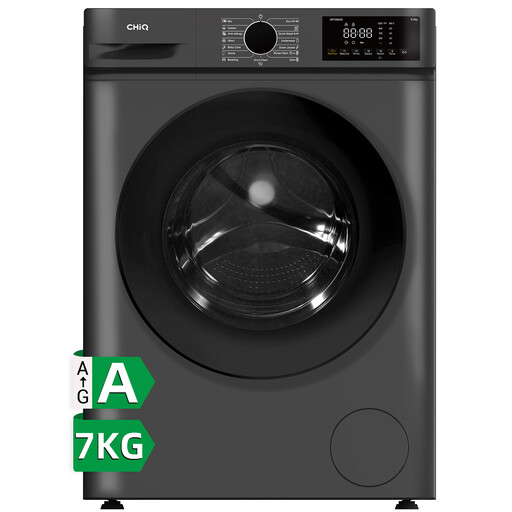 Image unavailable
CHiQ JW75883G, 7 kg, dark grey
A 7 kg capacity to compare with your usual loads before opting for a larger drum. This front-loading model lists an energy class of A, a 1,200 rpm spin speed and 16 programmes. Check the model’s energy label to compare water and energy use, spin performance and noise.
View on Joybuy
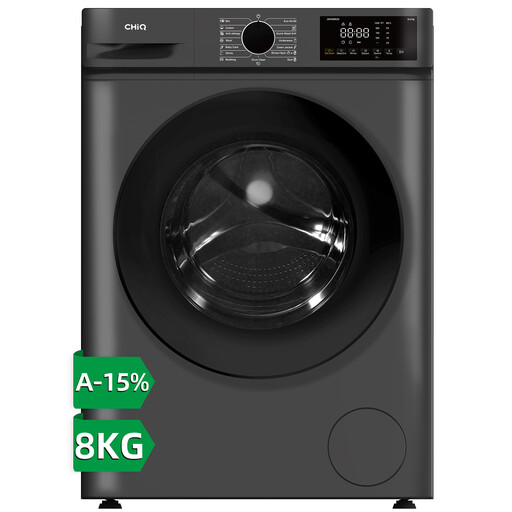 Image unavailable
CHiQ JW85883G, 8 kg, dark grey
Worth considering if 8 kg is a better fit for the laundry that builds up between washes. This front-loading model lists a 1,400 rpm spin speed and 16 programmes. To assess spin performance, noise and consumption, compare the figures on its energy label rather than looking only at the advertised speed.
View on Joybuy
Frequently asked questions
What capacity should I choose for several loads a week?
Choose a capacity based on how much laundry actually builds up between washes, not simply how often you do laundry. ADEME says that 7 kg is usually enough, while Gifam recommends 9 kg or more as a guide for families. Remember to include bedding and towels in your usual loads.
Which figures should I compare on the energy label?
Compare models using the figures for the Eco 40-60 programme: energy class, kWh per 100 cycles, water per cycle, duration, spin-drying efficiency class and spin-cycle noise. The maximum number of revolutions per minute is no substitute for the spin-drying efficiency class.
What is a washing machine’s durability index for?
It helps you assess the reliability and repairability of the relevant washing machines, with a score out of 10. According to France’s Ministry for the Environment, the index has applied to these appliances in France since April 2025. The score doesn’t replace the energy label or checking the model’s warranty terms.
Can a washer-dryer dry a full washing load?
Not necessarily: the stated capacity for a complete wash-and-dry cycle may be lower than the washing capacity alone. Check both capacities on the energy label and product page before planning to combine larger loads.


