People with a narrow alcove
In a compact kitchen or bathroom, measure the available width, depth and height, and remember to allow for the drum door and connections. A top-loader won’t necessarily solve a lack-of-depth problem.


In a flat, start by choosing based on the dimension that limits where you can install the machine: go for a front-loader if there’s enough width and room for the door to open, a top-loader if width is limited, or a slimline front-loader if the machine would otherwise stick out too far into the room. Then compare the spin noise on the energy label, and check the capacity, connections and clearances for the specific model. A stabilising accessory is no substitute for installing the machine in line with its instructions.
In a compact kitchen or bathroom, measure the available width, depth and height, and remember to allow for the drum door and connections. A top-loader won’t necessarily solve a lack-of-depth problem.
If the machine is near your lounge or a bedroom, compare its stated spin noise. Vibrations also depend on how the laundry is distributed in the drum and on the installation conditions, as Electrolux points out in its support advice.
ADEME says that a 7 kg washing machine is usually enough to avoid running extra cycles with a partly filled drum. However, compare this guidance with the amount of laundry you typically wash.
Identify which dimension is limiting the space, then compare suitable models against your laundry needs and the stated spin noise.
Consider one: if there’s enough width and space in front for the door to open and for you to load the machine.
Allow for: the door swing, as well as the space taken up by the machine.
Consider one: if width is your main constraint; a Whirlpool model listed in France is 40 cm wide.
Allow for: this same model is 60 cm deep, and you’ll need enough room above it to open the lid.
Consider one: if the machine sticking out into the room would obstruct the way; for example, French retailer BUT lists the Candy CS41272DE/1-S at 45 cm deep.
Allow for: a reduced depth doesn’t mean you can skip checking the other dimensions and the space needed for connections.
| Priority | What to check | What I need |
|---|---|---|
| Space and access | Measure the width, depth and height; check that the door or lid can open and allow space for the connections. | I need to be able to install the machine and access the drum without blocking a walkway or a piece of furniture. |
| Noise and vibrations | Compare the spin noise shown on the energy label. Also check the instructions for levelling and hose positioning; Electrolux notes that unevenly distributed laundry can cause the machine to shake. | The machine will be near a living area, so I want to compare its stated noise level without assuming that figure predicts all the vibrations in my home. |
| Capacity | Compare the stated capacity with the size of your usual laundry loads. ADEME says that 7 kg is usually enough, but this isn’t a rule for every household. | My usual loads need to fit in the drum. I don’t want to choose a large capacity just for occasional needs. |
| Water, energy and spin performance | Check the energy label for water and energy consumption, spin-drying efficiency and noise, as recommended by ADEME. | I want to consider everyday use and how damp my laundry will be after spinning, not just the size of the machine. |
| Durability and support | For a machine sold in France, check the model’s durability index and the documentation you’ll need for installation and maintenance. Check the parts commitments for the specific model. | I’d like to compare information for the specific model before deciding, beyond the comfort claims. |
The space saving may mainly be in the width: according to Whirlpool France, the Whirlpool TDLRSX7232BSFR is 40 cm wide but 60 cm deep. You’ll also need room to open the lid.
Measure each dimension that could be a limiting factor, as well as the clearance above the machine, before choosing this type of loading.
A spin speed in tr/min doesn’t tell you how noisy the machine is during the spin cycle. Electrolux also notes that poorly secured hoses or an unbalanced load can cause noise and shaking.
Compare the noise level on the energy label, then make sure the machine is installed in line with its instructions.
In its FAQ, Bosch says that the transit bolts must be removed and the feet adjusted to level the machine.
Check the model’s instructions or ask the installer to confirm which steps apply, rather than following a generic method.
It won’t answer questions about space, spin noise or capacity on its own. ADEME also recommends checking water consumption and spin-drying efficiency on the label.
Compare these details with the dimensions, clearances and capacity of the specific model.
These range and model examples help you focus on what to compare; their features don’t apply to every model from each brand.
The front-loading WGE03207FR is one model to consider; Bosch France lists its maximum spin speed as 1,200 tr/min.
The EWQ6412B is a 6 kg top-loader listed by Electrolux France. Consider it if a top-loading machine suits your space.
Samsung France lists the front-loading WW80T554DTW/S3 with an 8 kg capacity and dimensions of 600 × 850 × 550 mm.
Whirlpool France lists the top-loading TDLRSX7232BSFR at 40 cm wide, 60 cm deep and 90 cm high.
French retailer BUT lists the front-loading Candy CS41272DE/1-S as a 7 kg model with a depth of 45 cm.
These three front-loading washing machines offer different capacities and space requirements to compare. Before choosing one for your flat, check its product details and instructions against your available space and the spin noise that matters to you.
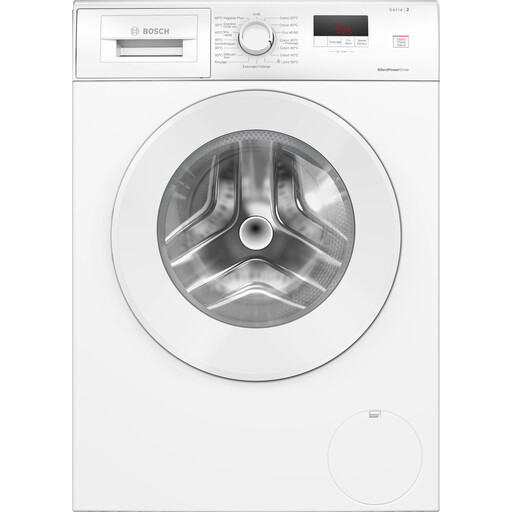 Image unavailable
Its stated 7 kg capacity could suit you if it matches your usual laundry loads and there’s enough space to open the front door. The product name indicates an A energy rating. Before deciding, check the model’s full dimensions, spin noise and connection requirements.
 Image unavailable
Compare this stated 9 kg capacity with the amount of laundry you actually wash: ADEME says that 7 kg is usually enough, although this isn’t true for every household. The product name mentions SteamCare, SmartSelect and connectivity. Check that the machine fits your space, allow room in front for the door to open, and check the model’s spin noise.
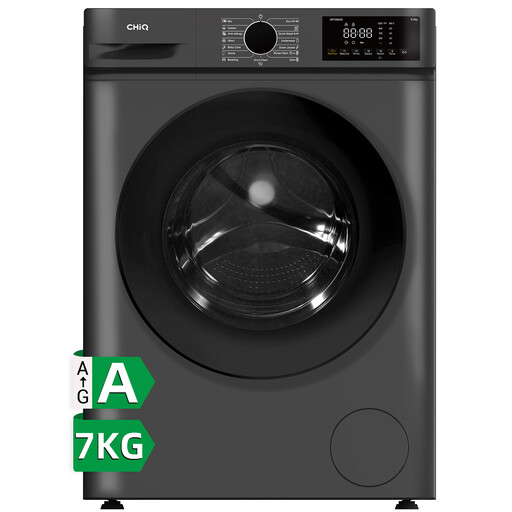 Image unavailable
This front-loader is worth considering if the machine sticking out into the room is your main concern. Its name lists a 7 kg capacity, 16 programmes and an A energy rating. Confirm the depth and other dimensions in the product details, and check the spin noise on its energy label. See the instructions for installation guidance.
Compare the spin noise, water and energy consumption, and spin-drying efficiency, as ADEME recommends. If the machine is near a living area, don’t focus on the energy rating alone.
No. It mainly helps when width is the issue. According to Whirlpool France, the TDLRSX7232BSFR is 40 cm wide but 60 cm deep; also check that there’s enough clearance above it to open the lid.
Electrolux lists poorly secured hoses, overloading and unevenly distributed laundry among the possible causes of noise and shaking. Check the instructions for your machine; Bosch also stresses the importance of removing the transit bolts and levelling the machine during installation.
Wait until you can confirm that it’s compatible with the machine and your installation. A mat doesn’t replace levelling the machine or carrying out the other preparations set out in its instructions.
It gives you extra information to compare for the specific washing machine. In France, ADEME Infos says that the index has been displayed in shops for washing machines since early 2025. However, it doesn’t replace checking the dimensions, capacity and spin noise.