What should you check before choosing?
First, identify the dimension or installation requirement that limits your options, then check that your chosen model’s capacity and access requirements suit your usual laundry loads.
| Criteria | What to check | Who should consider this? |
|---|
| Width and top access |
Measure the available width and check that a top-loader’s lid can open fully. |
If the recess is too narrow for a front-loader, I’m mainly looking for an appliance that will fit without making it difficult to load. Around 36% of consumers prioritise this width constraint. |
| Depth and front access |
Compare the overall depth given in the instructions with the clearance needed in front of the door. |
If the washing machine might stick out into the walkway, I’d opt for a shallower model while still leaving room to load the laundry. Around 29% of consumers share this priority. |
| Washing capacity |
Match the capacity in kg to your usual loads and check the energy label for water and energy use, spin performance and noise. |
If my usual washing includes larger loads, I don’t want to choose a drum that’s too small just to save space. Capacity comes first for around 21% of consumers. |
| Under a worktop or in a stack |
Check the front-loader’s installation dimensions. For a stacked setup, confirm that both appliances and the kit are compatible. |
If I need to save floor space or fit the appliance beneath a worktop, the installation requirements determine which format will work. Around 14% of consumers make this their priority. |
A washing machine to consider on Joybuy
This model may be worth considering if depth is a factor in your installation, provided you check its full dimensions and loading access against the space available.
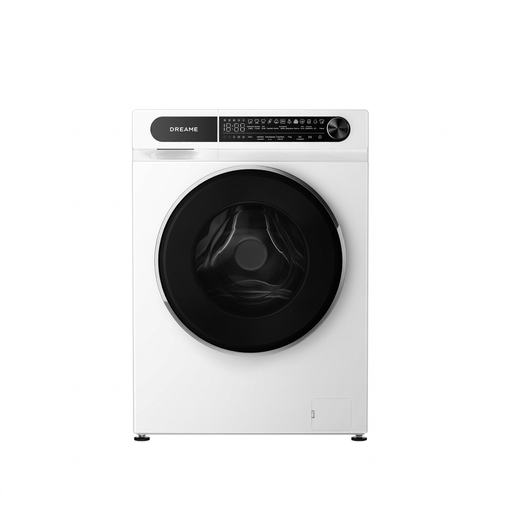 Image unavailable
Dreame DRWASHS8KG Washing Machine S, 8 kg, white
Worth considering if depth is a constraint and a capacity of 8 kg suits your laundry needs. Check the full dimensions, loading type, clearances and connections in the instructions. For a stacked setup, also confirm that the appliances and kit are compatible.
View on Joybuy
Frequently asked questions
What should I measure before choosing a washing machine for a small room?
Measure the recess, the delivery route and the space needed to open and load the appliance. Also check access to the connections and the clearances specified in the instructions. Que Choisir recommends leaving at least 0,5 cm between the machine and surrounding units, but this doesn’t replace the manufacturer’s guidance.
Is a top-loading washing machine suitable for every small bathroom?
No. A top-loader is mainly suited to spaces where width is limited, provided there’s room to open the lid. If depth is the issue, or the appliance needs to fit beneath a fixed worktop, consider a front-loader whose dimensions and door clearance suit the room.
Can you stack two front-loaders without a kit?
No. A stacked installation requires a stacking kit that’s suitable for the appliances. Bosch recommends confirming that both models can be stacked, aligning them and securing the kit in accordance with the instructions.
Can you put a washing machine in a bathroom cupboard?
Check the cupboard layout and the electrical safety zones around the bath or shower before deciding where to install it. Before choosing an appliance or changing the electrical installation, ask a qualified professional to assess the plans on site.
What capacity should I choose if only a shallow washing machine will fit?
Choose a capacity that suits your usual loads rather than simply opting for the smallest drum available. Que Choisir generally puts slimline front-loaders at between 4 and 6 kg. Compare this range with your everyday laundry, and check the energy label for water and energy use, spin performance and noise, as recommended by ADEME.


