Buying priorities
Start with the three dimensions and the required clearances, then match the capacity to your everyday laundry. The formats and conditions below are based in particular on guidance published by Que Choisir, Beko France and Promotelec.
| Priority |
What to check |
Your needs |
| Dimensions and access |
Measure the available width, depth and height. Leave room for hoses, skirting boards and the route into the room. Also compare the type of door or lid. |
I want the machine to be deliverable, connectable and usable once installed, not merely able to fit into the recess. |
| Usable capacity |
Compare the capacity in kg and the depth at the same time. Beko France states, depending on the range format, 44 cm for 6 kg and 49 cm for 7 kg. |
My drum needs to remain suitable for everyday laundry, so I can avoid running extra cycles or leaving out bulky items. |
| Door opening and under-worktop installation |
For a front-loader, allow for the door swing and space in front of the fascia. For a top-loader, check the clearance above the lid and whether it is compatible with a worktop. |
I am looking for a machine that is easy to load every day, even in a busy kitchen or bathroom. |
| Bathroom safety |
Check the distance from the shower or bath, the earthing and the circuit protected by a 30 mA residual-current device. According to Promotelec, zone 2 extends up to 60 cm from the outer edge of the bath or shower tray. |
I want to confirm that the location and existing power supply are suitable before choosing the model. |
Joybuy products
Joybuy options matching the two main configurations considered here: a top-loading washing machine to reduce the width required, or a standard front-loader when capacity comes first and the space is deep enough.
 Image unavailable
Candy TCA464TM4-S ProWash 500 top-loader, 6 kg
Worth considering when width is the main obstacle and loading from the top is still possible.
Stated capacity of 6 kg, 1400 rpm spin speed, 17 programmes, inverter motor and Wi-Fi.
Its stated depth of 60 cm does not automatically make it suitable for a shallow recess; also check the clearance required above the lid.
Joybuy
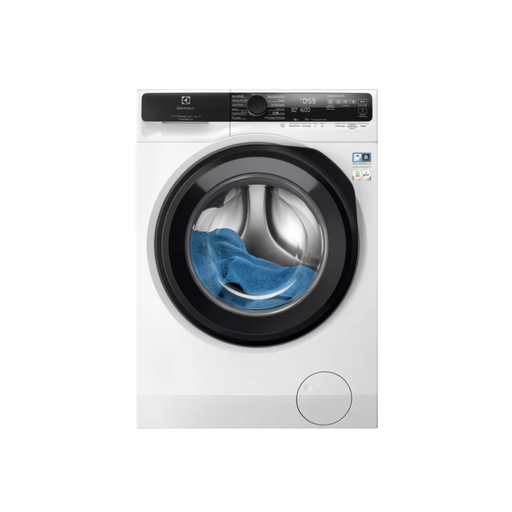 Image unavailable
Electrolux EW7FI259160V front-loader, 9 kg
This option is better suited to households prioritising a large load and with space suitable for a standard front-loader.
Stated capacity of 9 kg, 1600 rpm spin speed, SteamCare, SmartSelect and connected functions.
Its stated depth of 66 cm makes it unsuitable if limited depth is the main constraint; check the clearance in front of the door and behind the appliance.
Joybuy
Frequently asked questions
What measurements should I take before ordering a washing machine for a narrow room?
Measure the available width, depth and height, as well as the delivery route: front door, hallway, stairs, lift and route into the room. Also note the space needed for the door or lid, the position of the hoses and access to the water inlet, waste outlet and socket.
Is a slim washing machine always narrower than a standard front-loader?
No. In France, the term slim mainly refers to reduced depth: these appliances generally retain a width of around 60 cm, but may be approximately 33 to 45 cm deep. If width is limited, look instead at a top-loader measuring around 40 to 46 cm wide.
Can I install a washing machine in a bathroom in France?
Yes, subject to certain conditions. Promotelec states that the appliance must be earthed, supplied by a circuit protected by a 30 mA residual-current device and positioned beyond zone 2. If you are unsure about the existing installation, have it checked by a qualified professional.
Does a bathroom cupboard automatically make the installation compliant?
No. According to Promotelec, cupboard doors are considered open when assessing the safety zones. If the space is even partly within zone 2, the washing machine cannot be installed there.
When does a mini washing machine make sense?
It makes sense when a conventional washing machine cannot be installed and your needs are limited. Que Choisir presents 2 to 3 kg mini washing machines as supplementary solutions that are poorly suited to bulky textiles and may require more cycles.


