Households that dry laundry indoors
If your laundry is mainly air-dried in a room at home, compare spin efficiency, energy consumption and noise during the spin cycle. ADEME recommends checking the label for these criteria.


For laundry dried indoors, start by comparing a front-loading or top-loading washing machine based on the space available, then check spin efficiency, capacity and noise levels on the label. A washer-dryer is best suited to situations where saving space and running washing and drying consecutively are the priorities. However, its drying capacity is lower than its washing capacity, and the complete cycle should be assessed separately.
If your laundry is mainly air-dried in a room at home, compare spin efficiency, energy consumption and noise during the spin cycle. ADEME recommends checking the label for these criteria.
A washer-dryer combines washing and drying in a single machine. However, check that its drying capacity suits your usual loads, as it is lower than its washing capacity.
A top-loading washing machine may be suitable if width is limited or loading from above is more convenient. Its label data should still be compared model by model with those of a front-loading machine.
Consider it if: you mainly dry laundry indoors and have a space with front access.
Bear in mind: you will need room for the door to open and will have to load it while bending down.
Consider it if: a narrow width or loading from above is the deciding factor.
Check that: the lid can open fully, and remember that performance varies between models.
Consider it if: you do not have room for two appliances and need to dry some loads without hanging them up.
Accept that: drying capacity is lower and complete cycles need to be compared separately.
| Priority | What to check | Your needs |
|---|---|---|
| Spin cycle | Compare the spin-efficiency class, spin speed and reference programme. Do not rely solely on the maximum advertised speed. | I want to take less damp laundry out of the drum so I can reduce the time it spends on the airer. |
| Noise | Check the noise emissions during the spin cycle, in dB, along with the noise class. Also make sure the appliance will be correctly levelled on a stable floor. | The machine will be close to an occupied room or may run at times when noise is more disruptive. |
| Capacity | Choose a washing capacity suited to the loads you actually wash. For a washer-dryer, check the washing and drying capacities separately, in kg. | I want to avoid running lots of small washes while making sure that a load to be dried fits within the machine’s permitted capacity. |
| Consumption and duration | Compare kWh per 100 cycles, litres per cycle and the duration of the reference programme. For a washer-dryer, distinguish between washing alone and the complete wash-and-dry cycle. | I want to assess water, electricity and running time using comparable data rather than relying on a single energy class. |
| Durability | Look for the durability index displayed for the model sold in France and consult the information about spare parts and repairs. | I want to include repairability and after-sales service in my decision, beyond the washing programme’s performance. |
Residual moisture and noise during the spin cycle are two different criteria. A maximum speed does not tell you everything about spin efficiency or the noise level of the reference programme.
On the exact model’s label, compare the spin-efficiency class, dB and noise class, kWh per 100 cycles, water per cycle, capacity and duration together.
With a washer-dryer, a full washing load may need to be split before drying. This affects how you organise your laundry and the total running time.
Compare both capacities in kg for the specific model and choose a drying capacity suited to the load you usually want to dry.
Splitting a full wash into several drying cycles increases running time and may increase water and energy consumption.
A top-loading washing machine may solve a width restriction, but its lid must remain accessible and its performance cannot be inferred from its format.
Measure the width, depth, height and clearance above the machine before ordering, then compare spin performance, noise and consumption with a front-loader that fits the space.
An effective spin cycle can leave less moisture in the laundry, but drying clothes indoors will still add moisture to the room.
Use the spin cycle to reduce drying time and, when laundry cannot be dried outside, choose a well-ventilated room, as recommended by Anses.
A useful benchmark when comparing large-capacity washer-dryers, particularly if you want to run a limited load through washing and drying in one machine.
A useful benchmark for buyers comparing different washer-dryer formats, including integrated and freestanding models.
A useful benchmark for a top-loading washing machine when space is narrow or loading from above is preferred.
Joybuy options for comparing front-loading and top-loading washing machines based on spin performance, noise, capacity and dimensions when laundry is usually dried indoors.
 Image unavailable
A front-loading option for households with limited depth, with an advertised capacity of 8 kg.
B spin-efficiency class, 72 dB(A) and A noise class; 33 kWh/100 cycles, 38 L/cycle and 3 h 38 for Eco 40-60. Advertised depth: 47 cm.
The B spin-efficiency class does not match the A class to prioritise when minimising time spent air-drying is the main concern. Also check the durability index displayed in France, door clearance and connections.
 Image unavailable
A front-loading option for larger washes, with an advertised capacity of 10 kg and 68 dB(A) during the spin cycle.
B spin-efficiency class and A noise class; 41 kWh/100 cycles, 48 L/cycle and 3 h 58 for Eco 40-60. Advertised depth: 611 mm.
Do not infer drying speed from the 1,400 rpm figure alone. The depth must be compatible with the available space, and the durability index displayed in France should also be checked.
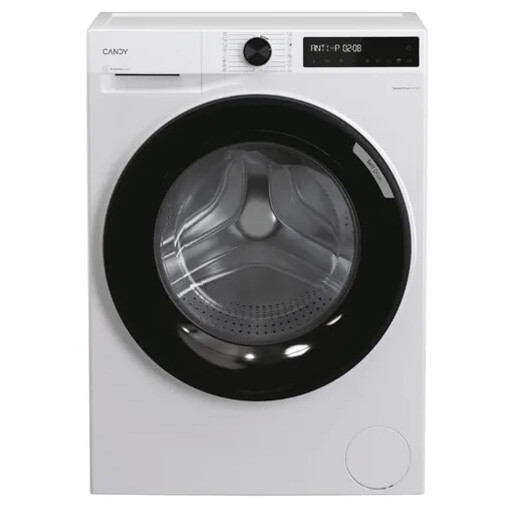 Image unavailable
A front-loading option for large loads, worth considering if your usual laundry volume justifies an 11 kg capacity.
B spin-efficiency class, 72 dB and A noise class; 37 kWh/100 cycles, 48 L/cycle and 3 h 58 for Eco 40-60. Advertised depth: 68.1 cm.
A large capacity may be excessive for frequent small loads. Check the space required in front of the door and the durability index displayed for this model in France.
 Image unavailable
A top-loading option for a narrow space and loading from above, with an advertised width of 405 mm.
7 kg capacity, B spin-efficiency class, 77 dB(A) and C noise class; 40 kWh/100 cycles, 42 L/cycle and 3 h 28 for Eco 40-60.
The advertised noise level and C noise class deserve careful consideration if the machine is near a living area. Leave sufficient clearance above the lid and check the displayed durability index.
 Image unavailable
A compact top-loading option for a narrow space and regular, moderately sized loads.
6 kg capacity, B spin-efficiency class, 1,400 rpm, 79 dB(A), C noise class, 49 kWh/100 cycles, 41 L/cycle and 17 programmes. Advertised width: 40.5 cm.
The advertised noise level may be disruptive near occupied rooms. Check the clearance above the lid, the full installation dimensions and the displayed durability index.
Compare the spin-efficiency class, noise during the spin cycle, kWh per 100 cycles, water per cycle, capacity and duration of the reference programme. ADEME recommends an A spin-efficiency class when laundry needs to dry quickly indoors.
No. The maximum speed should be considered alongside the spin-efficiency class and the conditions of the programme used. When comparing two models, prioritise the standardised values on the label rather than the advertised speed alone.
Not necessarily: drying capacity is lower than washing capacity. For example, Bosch states 10.5 kg for washing and 6 kg for washing and drying for the WNC254A0FR; always check both figures before buying.
Yes, if available width is limited and the top opening remains clear. However, compare the spin performance, noise, water and energy consumption of your chosen top-loader with a front-loader of equivalent capacity before deciding.
No. It can reduce residual moisture in the laundry, but it does not replace a well-ventilated room. Anses recommends drying laundry in a well-ventilated room when outdoor drying is not possible.