
Livraison le jour même ou le lendemain

Qualité garantie

Débloquez vos offres de bienvenue: Livraison GRATUITE | Jusqu'à -80 % | 30 jours d'essai gratuits à JoyPlus
Téléchargez l'application
Tired of the yellowish, worn-out glow from your old W5W bulbs?? Want to modernise your car with brighter, whiter, and longer-lasting light without getting into a complicated DIY project?? Switching to LEDs is the obvious solution, but navigating the jungle of part numbers, power ratings, and compatibility can quickly become a headache.
This guide is here to shed some light on the subject (no pun intended). We've broken down the essential technical specs to help you make the right choice, getting straight to the point.
Before you jump on the first model you see, let's review a few crucial points. This will guarantee a purchase that's perfectly suited to your vehicle and your needs.
The term W5W LED bulb is the most common, but you'll often come across the reference T10 LED bulb. Don't panic: in almost all cases, they refer to the same 10mm diameter glass wedge base. These bulbs are found all over the car?:
Pro tip?: always check your vehicle's owner's manual to confirm the bulb type before ordering.
Modern vehicles (generally post-2005) are equipped with an on-board diagnostic (OBD) system that monitors the proper functioning of the bulbs. An LED bulb consumes far less power than a halogen one. The on-board computer can interpret this low consumption as a faulty bulb and display an error message.
To avoid this false positive, opt for an error-free W5W, also known as a Canbus LED. These bulbs integrate a resistor that tricks the system by simulating the power draw of a standard bulb. This ensures a plug-and-play installation, with no annoying alerts on your dashboard.
After analysing the market, here are the models that caught our eye for their performance-to-price ratio and reliability.
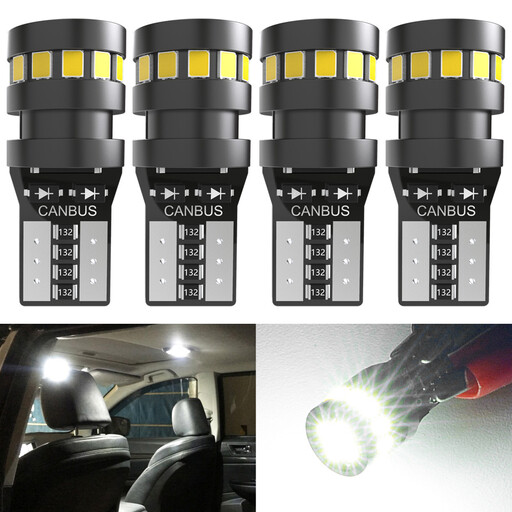
Why it stands out?? This OUSHI model is the perfectly balanced choice. It combines a bright 300 lumens per bulb with a 6500K xenon white colour, perfect for giving your vehicle a modern facelift. Its error-free Canbus system ensures compatibility with 99?% of modern cars, saving you from dashboard warnings. The aluminium body guarantees excellent heat dissipation, a key factor for longevity.
Advantages?:
Who is it for?? Anyone looking for a simple and effective solution for their interior lighting (dome, map lights) or exterior lighting (parking lights, license plate). It's the ideal way to get a noticeable boost in light and enjoy peace of mind thanks to the error-free system.
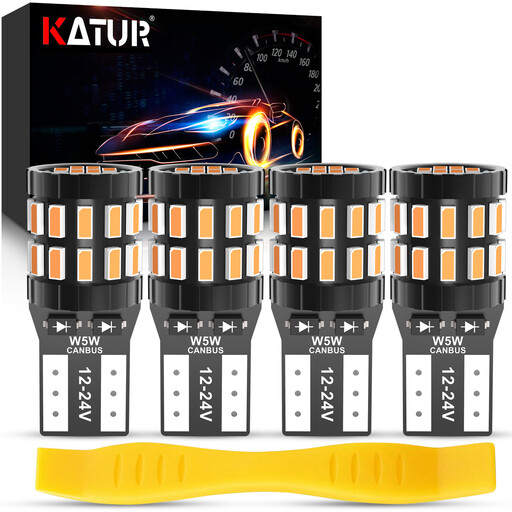
Why it stands out?? This KATUR model stands out from the crowd with its amber yellow hue and impressive 450-lumen output. It's ideal for turn signal repeaters or for those seeking a custom look for their parking lights. Its 12-24V compatibility makes it highly versatile, and its error-free Canbus system guarantees seamless integration.
Advantages?:
Who is it for?? For car customisation enthusiasts or those needing to replace side indicators with a powerful amber LED solution. Its 24V compatibility also makes it an excellent choice for vans and HGVs.
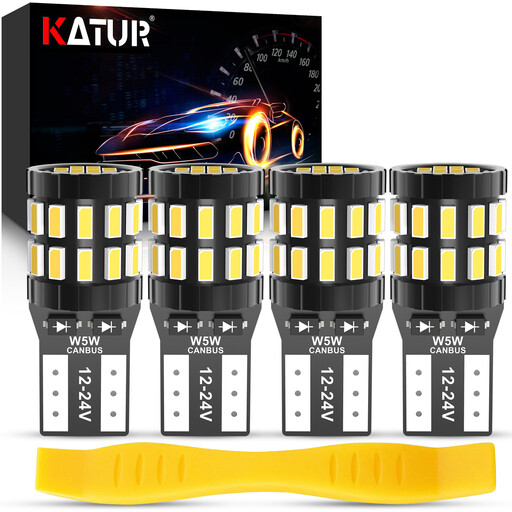
Why it stands out?? This version of the KATUR bulb offers the same excellent features as the amber model, but in a 6000K xenon white colour. At 450 lumens, it's simply one of the most powerful bulbs in its class. A raw performance choice for those who demand maximum illumination, whether for a car dome light, reversing lights (if the format fits), or parking lights.
Advantages?:
Who is it for?? For drivers who prioritise brightness above all else. Perfect if you find standard LEDs a bit too dim, or for flooding a large cabin or your vehicle's exterior with light.
If these models don't tick all the boxes or if you're looking for a different type of lighting for your vehicle, feel free to explore our full catalogue to find the perfect fit.
Explore Our Entire 12V Bulb Category
Physically, yes in most cases?: the T10/W5W base is a near-universal standard. The real question is electronic compatibility. For cars made after 2005, it's almost essential to choose an error-free W5W (Canbus) model to avoid a warning message on your dashboard.
It's a classic issue?! The problem stems from the very low power consumption of an LED compared to a halogen bulb. The on-board computer (OBC) thinks the bulb has blown and alerts you. A Canbus LED bulb solves this problem with an integrated resistor that mimics the original bulb's power draw.
This is one of the major advantages of LEDs. A standard halogen bulb lasts for an average of 1,000 to 2,000 hours. Quality LEDs, like those in our selection, have theoretical lifespans of over 50,000 hours. Simply put?: once they're installed, you should never have to touch them again.