
Livraison le jour même ou le lendemain

Qualité garantie

Débloquez vos offres de bienvenue: Livraison GRATUITE | Jusqu'à -80 % | 30 jours d'essai gratuits à JoyPlus
Téléchargez l'application
For specialty coffee enthusiasts, every detail matters. You carefully select your beans, you dial in your grind... but is the result in the cup sometimes lacking consistency? The secret to a perfect extraction, one that can unlock the full aromatic complexity of your coffee, often comes down to two key factors: water temperature and pouring control. Far from being a mere gadget, a variable temperature gooseneck kettle is the precision instrument that gives you control over both.
This guide is designed to help you navigate the options and find the model that will perfectly suit your ritual, whether you're a devotee of the V60, Chemex, or other pour-over brewing methods.
Before diving into our selection, let's review the essential criteria for making an informed choice that lives up to your ambitions as a home or expert barista.
Water temperature directly impacts the extraction of coffee compounds. Too hot (near 100?°C), and it risks scorching the grounds and releasing unpleasant bitterness. Not hot enough, and it won't manage to dissolve all the flavours, resulting in a flat, or even sour, cup. A kettle with precise temperature control allows you to target the ideal range, generally between 90 and 96?°C, and to adjust it with fine-tuned precision according to the origin and roast level of your beans. Some models offer degree-by-degree adjustment: a game-changer for purists.
The distinctive design of the "gooseneck" spout is far from being purely aesthetic. It is engineered to provide a slow, thin, and steady stream of water. This absolute control is essential for slow coffee methods like pour-over. It allows you to saturate the grounds perfectly evenly, avoid creating preferential "channels" in the coffee bed, and ultimately, ensure even saturation. This is the key to a balanced extraction, whether you're using a V60 dripper or another filter coffee method.
Capacity is a criterion that shouldn't be underestimated. A 0.9?L stainless steel electric kettle is generally sufficient for preparing one to three cups, which suits typical personal use. For family use or if you prepare larger volumes, a 1.7?L model will be more appropriate. Stainless steel remains the material of choice: it's durable, doesn't impart any taste to the water, and is easy to clean.
Here are a few models that stand out for their features and cater to different user profiles.
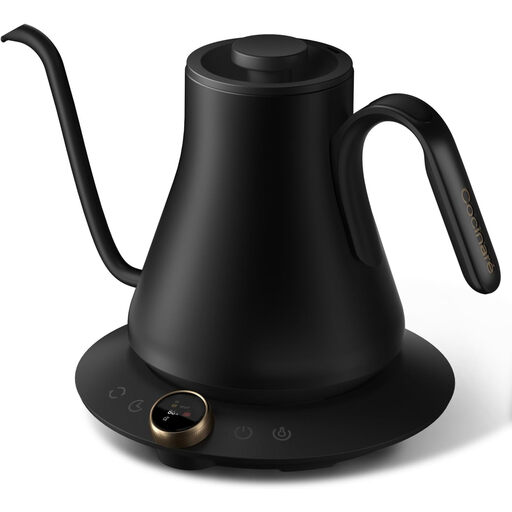
Why it stands out: The Cocinare FLOW M9 was specifically designed for discerning filter coffee enthusiasts. It combines a gooseneck spout optimised for high-precision pouring with temperature control stated to be accurate to ±1?°C. Its additional features, like the built-in brew timer, make it an all-in-one tool for standardising and perfecting your technique.
Pros:
Who is it for? The specialty coffee enthusiast who seeks total control over every parameter of their extraction and regularly uses pour-over methods.
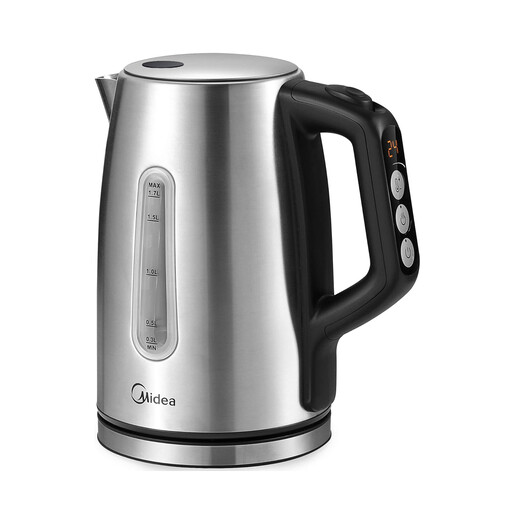
Why it stands out: Although it doesn't have a gooseneck spout, this Midea kettle focuses on versatility with its large capacity and preset temperature settings. It's an excellent option for more general-purpose use, from tea to culinary preparations, while still offering valuable temperature control for coffee.
Pros:
Who is it for? For families or those looking for a versatile kettle with temperature control, equally suitable for tea as for a French Press, where pouring precision is less critical.
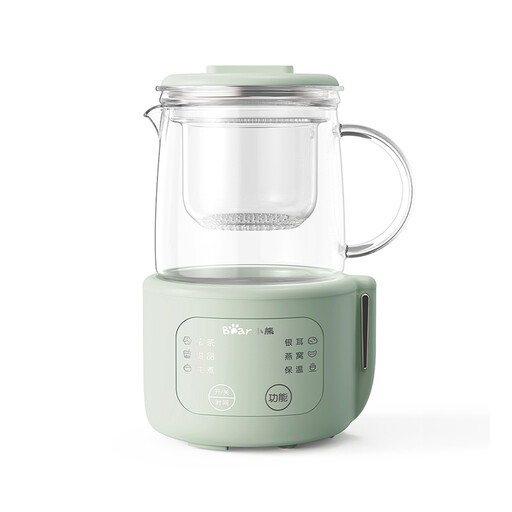
Why it stands out: This Bear model presents itself as a portable, personal, and compact solution. With its 400?ml capacity, it's designed for individual use, at the office or on the go. Its multiple programs make it highly versatile for a wide variety of hot beverages, far beyond just coffee.
Pros:
Who is it for? For the person looking for an individual, multi-function kettle for their desk or a small apartment, and whose hot beverage preferences extend beyond specialty coffee.
Our selection highlights models that meet specific needs, from the demanding barista to the versatile family-friendly option. If you're looking for a simpler model or one specifically designed for a work environment, other solutions exist.
For those who want to explore smart, compact models, our Office Kettle category brings together a varied range of products designed for small spaces.
Water temperature acts as a solvent that extracts oils, acids, and sugars from the coffee grounds. A controlled temperature allows for a balanced extraction: hot enough to dissolve the desired aromatic compounds, but not so hot that it over-extracts bitterness and astringency from the tannins.
There isn't one single perfect temperature, but rather a reference range. Most baristas and roasters agree on a range between 90 and 96?°C. Light roasts often express themselves better at the higher end of this range (94-96?°C), while darker roasts benefit from being brewed with slightly cooler water (90-92?°C) to limit bitterness.
For immersion methods, like the French Press, a standard kettle will do the job. However, for pour-over methods (V60, Chemex), where water is poured over the grounds in stages, flow control is fundamental. The gooseneck spout is uniquely able to provide this slow, precise pour, ensuring uniform saturation of the coffee and, ultimately, a much more balanced and complex cup. It's a tool that makes a real difference for anyone looking to take their filter coffee brewing to the next level.