If you’re short on time and storage space
You want to grab the vacuum quickly for frequent cleaning on hard floors, then put it away in a cupboard or on a wall-mounted dock.


For frequent cleaning in a small home, choose a cordless stick vacuum if you want something quick to grab and easy to store. A compact cylinder vacuum may be a better fit if your rugs, carpets or grooved wood floors need a more thorough clean. A robot vacuum can handle extra cleaning on clear floors, provided you check the thresholds and obstacles between rooms.
You want to grab the vacuum quickly for frequent cleaning on hard floors, then put it away in a cupboard or on a wall-mounted dock.
Before opting for a compact or cordless model, you’ll want to check how well its brush and suction perform on your floor coverings.
You’re considering a robot vacuum to maintain clear floors, while keeping a manual vacuum for edges, upholstery and targeted cleaning.
Best for: frequent, quick cleans, especially on hard floors, when you need a vacuum that’s easy to grab and put away.
Bear in mind: according to UFC-Que Choisir, the maximum run time advertised is generally measured at low power, so you may get less time on carpets.
Worth considering: if thick rugs, carpets or grooved wood floors make cleaning your floor coverings a priority. UFC-Que Choisir’s guides distinguish this type of use from quick cleans with a stick vacuum.
Bear in mind: even a compact cylinder vacuum needs space for the main unit, hose and cable.
Worth considering: for regular cleaning between manual cleans, if the floors are clear enough for the robot to move around.
Bear in mind: thresholds, rugs and objects on the floor can restrict where it can go, so you’ll still need to clean edges and tackle specific areas yourself.
| Factor | What to check | What matters to consumers |
|---|---|---|
| Getting it out and putting it away | Measure the available space and check where you could fit a wall-mounted dock or store the vacuum between uses. | When every clean needs to be quick, I want to be able to grab the vacuum without moving other things; around 36% of consumers would put this convenience first. |
| Cleaning your floor coverings | Look for tests on the types of flooring you have and check which brush is supplied for the rugs, carpets or wood floors you need to clean. | If I have rugs or grooved wood floors, I’d rather check how well a vacuum performs on those surfaces before choosing a type; this would be the top priority for around 36% of consumers. |
| Usable cleaning time | For a cordless stick vacuum, compare the run time in the mode you need for your floors, rather than looking only at the advertised maximum. | If I need to use a high-power setting for a long time, I don’t want to stop cleaning to recharge; around 21% of consumers would prioritise being able to clean without interruption. |
| Automated cleaning | Measure your thresholds and check how the robot you’re considering handles rugs and obstacles on the floor. | Between manual cleans, I’d like to leave the robot to clean clear floors; nearly 7% of consumers would make this their top priority. |
UFC-Que Choisir points out that this figure is generally measured at low power, while rugs and carpets may need a more power-hungry setting.
Compare the run times for the settings and brushes you’ll use, particularly on carpeted areas.
Watts, volts and air watts alone don’t tell you how much the brush will lift from each type of flooring.
For your rugs, carpets or grooved wood floors, look for tests on similar surfaces and check which brush is included.
A threshold it can’t cross or a rug that stops it in its tracks could leave a room outside its cleaning area.
Measure the thresholds between rooms, check for obstacles on the floor and compare them with the limits of the exact model you’re considering.
The condition of the filters, brushes, bag or dust container all matter when you use the vacuum day to day.
Check which consumables and parts are compatible with the model you choose, then follow its care instructions.
The range may appeal if you’re looking for a stick vacuum for frequent cleans on hard floors.
The Unlimited range is worth considering if a wall-mounted dock suits your storage space.
The Compact Power RO3945EA cylinder vacuum is worth considering if you’re happy to use a cord and want a model that fits into a small storage space.
The Roomba Combo j5 is worth considering as an extra cleaning aid if the robot can access your rooms.
These two cordless vacuums suit the need for quick cleans in a small home. Before choosing, compare their set-up, storage requirements and run time with your own cleaning needs and the floors you have.
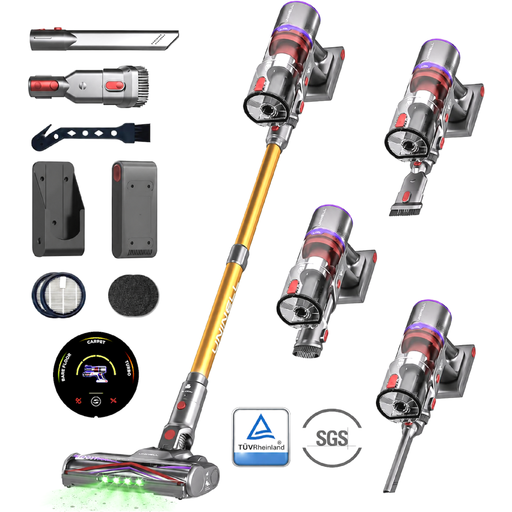 Image unavailable
Its cordless, freestanding design may suit frequent cleaning if you have somewhere to stand it between uses.
It offers up to 65 minutes of run time in standard mode; check how long it lasts in the setting you need for your rugs and other floor coverings.
 Image unavailable
Worth considering for quick cleans if the configuration supplied is suitable for the floors you need to clean.
The title lists 18 kPa and 40 minutes of run time, but doesn’t specify how long it lasts in each mode or on each type of floor. Check which accessories are included and how much storage space it needs.
Compare how long they last in the settings you’ll use on your floors, rather than looking only at their maximum run time. UFC-Que Choisir says this is generally measured at low power and reports an average of around ten minutes at full power in its tests of dozens of stick vacuums; this is a useful guide, but it won’t predict the run time of a specific model.
Measure your thresholds and check the documentation for the robot you’re considering before relying on it to move between rooms. iRobot Assistance France says Roomba vacuums can cross thresholds up to 1,6 cm high, but this doesn’t confirm that they can handle every rug, or that other robot vacuums can do the same.