
Livraison le jour même ou le lendemain

Qualité garantie

Débloquez vos offres de bienvenue: Livraison GRATUITE | Jusqu'à -80 % | 30 jours d'essai gratuits à JoyPlus
Téléchargez l'application
The proliferation of electronic devices has turned our bags and desks into a jungle of cables and adapters. One for the laptop, another for the smartphone, a third for the tablet… It's a daily headache that's as frustrating as it is inefficient. Fortunately, the fast USB-C GaN charger is emerging as the ideal solution to unify and accelerate charging for all your gear.
This guide will help you cut through the noise and choose the model that truly fits your devices and lifestyle, based on essential criteria like power, number of ports, and compactness.
Before diving into our selection, let's review the essential criteria to ensure you make the right choice.
Expressed in watts (W), power is the number one criterion. While 20-25W is enough for a smartphone, you'll need to aim for 65W or more to comfortably power a laptop.
Also, ensure compatibility with the Power Delivery (PD) standard. This smart charging protocol allows the charger to communicate with your device to deliver just the right amount of power, ensuring a charge that is both fast and perfectly safe.
A multi-port charger is ideal for powering several devices at once, like a MacBook and a smartphone. Ask yourself the right questions: How many devices do you charge simultaneously? Are USB-C ports enough for you, or do you still need a USB-A port for your older peripherals? A model with multiple USB-C ports will be a better long-term investment.
Gallium nitride (GaN) is the semiconductor material that has completely revolutionized the world of chargers. Thanks to GaN, adapters are much smaller, lighter, and more energy-efficient than older silicon-based models. The icing on the cake? They generate less heat, making them safer and the ultimate travel charger.
Whether you're a digital nomad, a student, or simply looking for a single do-it-all charger for your home, here are the models that caught our eye.

Why it stands out: With its four ports (two USB-C, two USB-A) and high total power output, this model is for those who need to juggle a multitude of devices. Its configuration allows for smart power distribution, with one USB-C port capable of delivering up to 65W for a laptop, while the other ports handle secondary devices.
Key Features:
Who is it for? For the hyper-connected user juggling a laptop, smartphone, tablet, and accessories (earbuds, watch...). A true all-in-one charging station.
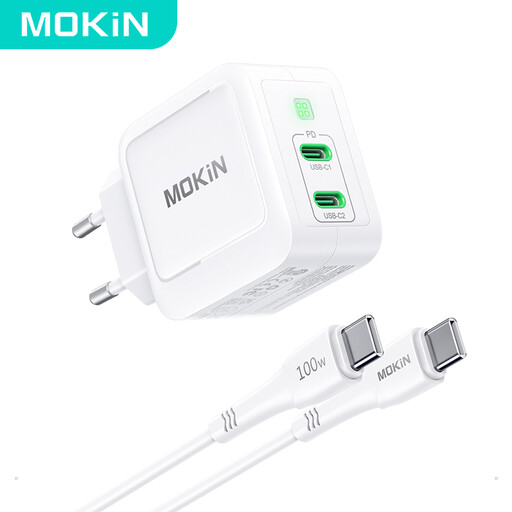
Why it stands out: This charger focuses on simplicity and efficiency with its two USB-C ports. It can deliver up to 67W from a single port, which is perfect for most ultrabooks like the MacBook Air. Its compact design, made possible by GaN technology, makes it an ideal travel companion.
Key Features:
Who is it for? For the professional or student who primarily charges their laptop and smartphone. Its minimalist design and power make it the perfect ally for clean desks and travel bags.
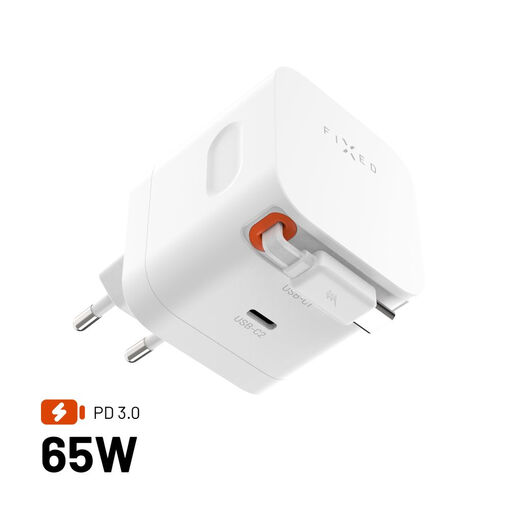
Why it stands out: Its secret weapon? A built-in, retractable 64 cm USB-C cable. No more tangled or forgotten cables! This brilliant idea is paired with a second USB-C port, for a total power output of 65W.
Key Features:
Who is it for? For the frequent traveller and anyone who hates clutter. The convenience of the built-in cable makes it an obvious choice for fans of organization and lightweight packing.
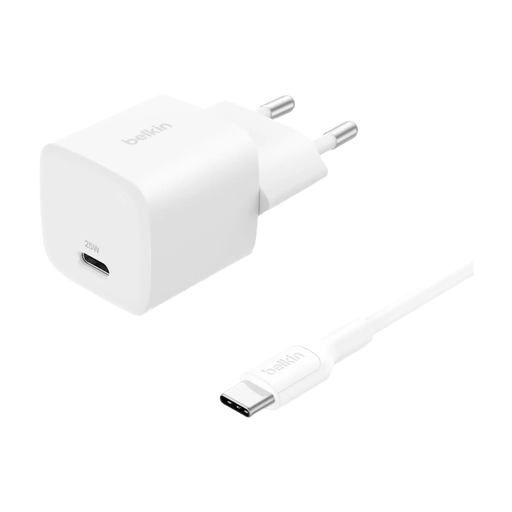
Why it stands out: This Belkin model is a powerhouse of reliability and performance for fast-charging smartphones and tablets. With 25W of power and compatibility with Power Delivery 3.0 and PPS, it optimizes charging for compatible devices, especially the latest iPhone and Samsung Galaxy series.
Key Features:
Who is it for? For those primarily looking for a high-performance and discreet Power Delivery adapter for their smartphone or tablet. An excellent choice to replace or supplement the original charger.
A great charger is only half the battle! The quality of your cable is just as crucial for enjoying fast, safe charging. Need a cable that can keep up with your new charger? Take a look at our selection.
? Discover our full range of USB-C PD cables
GaN (gallium nitride) is a next-generation semiconductor that is replacing traditional silicon. It allows for the design of chargers that are much more compact, lighter, and more efficient, generating less heat while delivering high power.
Yes, absolutely. Thanks to the Power Delivery (PD) standard, the charger and your device "talk" to each other to agree on the ideal power level. The charger will only supply what your smartphone can accept (25W in this case), ensuring a fast and completely risk-free charge.
For most ultrabooks (like the MacBook Air, Dell XPS 13), a 45W to 65W charger is perfect. However, more power-hungry machines (workstations, gaming PCs) will require 90W or even more. When in doubt, always check the specifications provided by your computer's manufacturer.