
Livraison le jour même ou le lendemain

Qualité garantie

Débloquez vos offres de bienvenue: Livraison GRATUITE | Jusqu'à -80 % | 30 jours d'essai gratuits à JoyPlus
Téléchargez l'application
That infamous junk drawer, overflowing with incompatible chargers for every device… sound familiar? Add painfully slow charging times to the mix, and frustration is never far behind. The arrival of USB-C promised to bring order to this chaos, but it also created new confusion: Which wattage should you choose? Is GaN technology more than just a marketing buzzword? How do you find the perfect USB-C fast charger capable of powering an iPhone, a Samsung device, and a MacBook all at once?
We're here to cut through the noise. As the Head of Product Recommendations at Joybuy, my mission is simple: to give you the tools to choose the right USB-C wall charger for your needs, without drowning you in impenetrable technical jargon.
Before diving into our top picks, here are the key factors to consider to ensure you make the right choice.
This is the most critical factor. Expressed in watts (W), power output is the number one criterion. A 20W charger is perfect for a smartphone but will struggle to power a laptop.
Rest assured, using a charger that's more powerful than necessary poses no risk. Power Delivery technology automatically adjusts the power output to match what your device can safely receive.
These two acronyms are everywhere, and for good reason.
If you're juggling multiple devices, a multi-port charger is the ideal solution to free up your power strip and declutter your desk or nightstand. You can find models with multiple USB-C ports, or a mix of USB-C and USB-A ports for maximum compatibility.
Here are our top picks, selected to meet different needs, from the busy nomad to the fully-equipped professional.
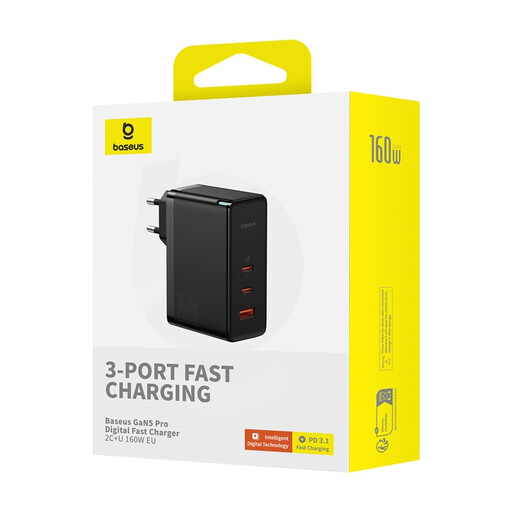
Why it stands out: With its total output of 160W and three ports (two USB-C, one USB-A), this powerhouse is for users who want it all, right now. Its GaN technology allows it to maintain a surprisingly compact form factor. The bonus for tech enthusiasts? The digital display that shows the real-time power delivery.
Key features:
Who is it for? For mobile professionals, content creators, and anyone juggling power-hungry devices who needs a single, ultra-powerful charging solution.
See the Baseus GaN5 Pro 160W Charger
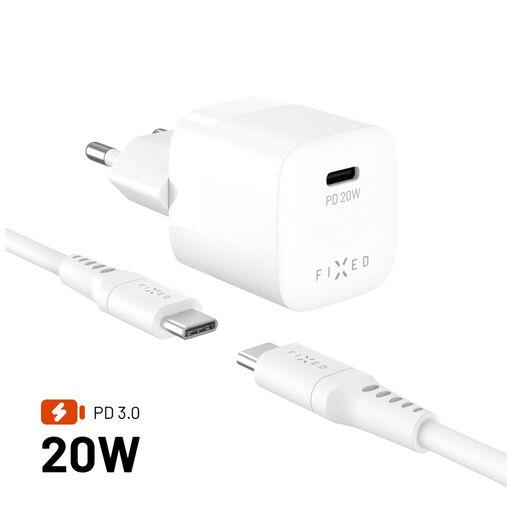
Why it stands out: This compact charger is a true champion of portability. Its mini form factor allows it to slip into any pocket. Despite its tiny size, it features Power Delivery 3.0 technology and 20W of power, ideal for quickly reviving modern smartphones.
Key features:
Who is it for? For smartphone users (iPhone charger, Samsung charger) who want a simple, fast, and ultra-portable charging solution for everyday use and travel.
See the FIXED 20W Mini Charger
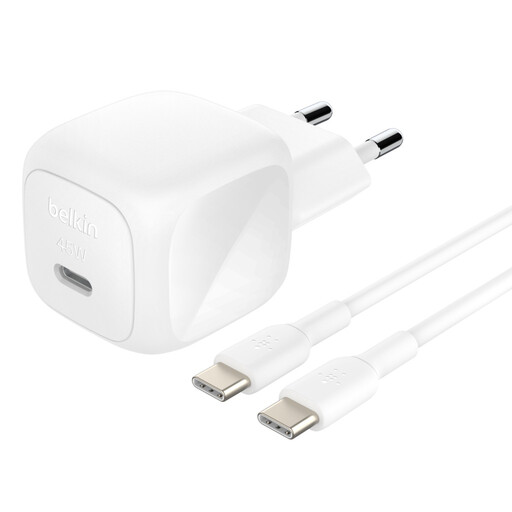
Why it stands out: Belkin delivers the ideal compromise between power and portability. With its 45W output, it can charge a smartphone or tablet just as effectively as an ultraportable laptop like the MacBook Air. Certified for USB-C PD 3.1, it also includes the PPS protocol for optimised adaptive charging—a real plus for Samsung devices.
Key features:
Who is it for? For the versatile user who switches between a smartphone, tablet, and lightweight laptop. It's the single, reliable solution for home, the office, and on the go.
See the Belkin BoostCharge 45W Charger
Our selection covers the most common use cases, but the world of charging accessories is vast. If you have more specific needs, feel free to explore our full range.
? Discover Our Collection of USB to USB-C Adapters and Charging Solutions
1. What wattage should I choose for a USB-C fast charger? It all depends on your devices. For a smartphone, 20-30W is sufficient. For a tablet or an ultraportable (like a MacBook Air), aim for 45-65W. For a powerful laptop, you'll need 100W or more. The best practice: check the maximum charging power supported by your device in its technical specifications.
2. Is a GaN charger really better? Not in terms of raw speed: at the same wattage, a 65W GaN charger and a traditional 65W charger will deliver the same amount of energy. The real performance of a GaN charger lies in its far superior energy efficiency. The result? It's much more compact, lighter, and runs cooler. For portability, this is a decisive advantage.
3. Can I use a USB-C charger that is more powerful than my device requires? Yes, absolutely, and without any risk. Thanks to the Power Delivery (PD) protocol, the charger and the device "talk" to each other to agree on the right amount of power to send. The charger will never deliver more power than your device can safely accept. For example, you can plug an iPhone (which accepts around 27W) into a 160W charger without any issues.