So, you've made the switch to an electric car! But now, choosing a charging station can be a daunting task. Power, connectors, features… it's easy to get lost. But don't worry! This guide is here to help you make sense of it all and choose the perfect Type 2 charging solution for your car and your lifestyle.
As the Head of Product Recommendations at Joybuy, I've selected reliable and relevant solutions for you, without the unnecessary marketing jargon.
How to Choose the Right Charger for Your Electric Vehicle
Before diving into our top picks, let's review three key points to help you make the right choice.
1. What Charging Power Do You Need?
The charging speed at home depends on two key factors: the power your car's on-board charger (OBC) can accept and the power output of your charging station.
- 7 kW Charger (Single-Phase): This is the most common solution for a residential installation. A 7kW wallbox can charge most electric and plug-in hybrid vehicles overnight. It requires a standard 32A single-phase installation.
- 11 kW Charger (Three-Phase): If your home has a three-phase connection and your car is compatible, an 11kW three-phase charger will significantly speed up charging. This is the preferred option for all-electric vehicles with large batteries.
- 22 kW Charger (Three-Phase): While even faster, this power level is rare for residential use. It requires a substantial electrical service plan and a compatible vehicle, which limits its practical appeal.
The golden rule: choose a power level that matches your vehicle. There's no point in investing in a 22?kW charger if your car can only accept 7.4?kW.
2. Wallbox, Portable Charger, or Just a Cable?
The format you choose will largely depend on your habits.
- Type 2 Charging Cable Only: Essential if your home charging station doesn't have a tethered cable, or if you frequently use public charging points. This electric car charging cable simply connects the station to your car.
- Wall-mounted Charger (Wallbox): This is the well-known fixed wall-mounted charging station, installed in your garage or parking space. It's the safest and most convenient solution for daily use.
- Portable EV Charger: This portable charger plugs into any electrical socket (domestic or industrial CEE type). It offers maximum flexibility, allowing you to charge your vehicle anywhere a compatible outlet is available.
3. Safety and Compatibility: Don't Overlook These Points
When it comes to charging, safety is non-negotiable.
- Compatibility: The Type 2 connector is the European standard for alternating current (AC) charging. It has been adopted by almost all manufacturers, including for Tesla compatibility on its models sold in Europe.
- Certifications: Opt for products certified by independent bodies like T?V. The CE and UKCA marks also guarantee compliance with current regulations in Europe and the United Kingdom.
- IP Rating (Ingress Protection): This rating assesses protection against dust and water. An IP54 rating is sufficient for a garage or a sheltered location. For an outdoor installation, aim for an IP65 rating or higher.
Recommended Type 2 Chargers and Cables
We've selected products for you that check all the boxes for reliability, safety, and ease of use.
GONEO Type 2 7kW 32A Charging Cable
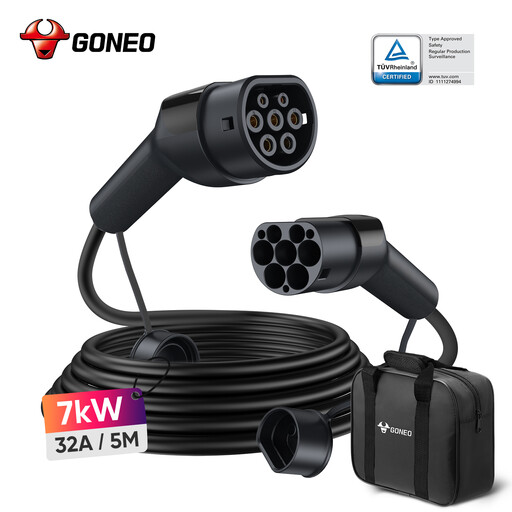
Why it stands out: A simple, robust, and certified charging cable designed to connect your vehicle to any public or home charging station.
Pros:
- Certified Safety: T?V Rheinland certified and compliant with CE, UKCA, and IEC standards.
- Durable Design: A tough TPU sheath and silver-plated contacts ensure excellent conductivity and a long lifespan.
- Weather-Resistant: IP54 certified, it's resistant to dust and water splashes, and can withstand extreme temperatures (-40?°C to +50?°C).
- Universal Compatibility: Compatible with all electric and plug-in hybrid vehicles equipped with a Type 2 or CCS2 port.
Who is it for? For EV drivers looking for a reliable 32A T2 cable to connect to public chargers or a wallbox without a tethered cable.
feyree 7kW 32A Wall-mounted Charger

Why it stands out: A fixed home charging station that is user-friendly and packed with safety features for complete peace of mind.
Pros:
- Stable Charging: 7?kW power output, ideal for getting a full charge overnight.
- Robust Construction: Its aluminium alloy chassis and IP65 certification allow for both indoor and outdoor installation.
- Integrated Safety: Features 10 built-in safety protections (current leakage, overvoltage, overload, overheating, etc.).
- Practicality: The 5-metre cable and included wall mount help keep your garage or parking space neat and tidy.
Who is it for? For homeowners who want a primary home charging solution that is permanent, safe, and simple to use.
feyree Type 2 11kW 16A Portable Charger with Wi-Fi
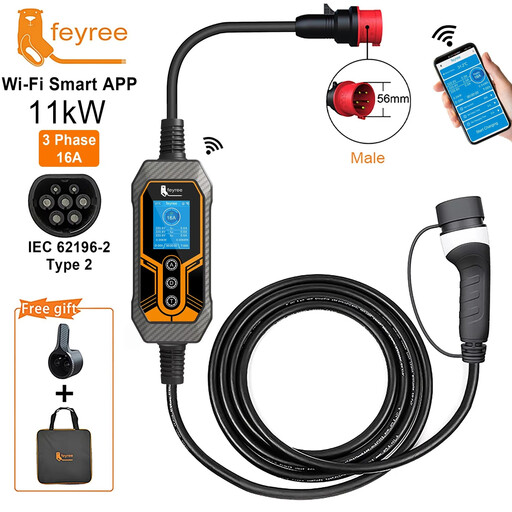
Why it stands out: This portable charger combines the flexibility of a mobile unit with smart features to help you optimise your electricity bill.
Pros:
- Smart Wi-Fi Charger: The companion app (Wi-Fi and Bluetooth) allows you to schedule charging during off-peak hours, monitor its status in real-time, and adjust the current.
- Power and Flexibility: Capable of delivering up to 11?kW on a three-phase connection via a CEE socket, with adjustable current (8, 10, 13, or 16A) to suit any situation.
- Real-time Information: Its 2.8-inch LCD screen displays power, current, and charging status at a glance.
- High Protection: Maximum safety with Type B RCD protection (AC 30mA + DC 6mA) and an IP66 waterproof rating.
Who is it for? For those who have access to a three-phase industrial socket (at home, the office, etc.) and want to manage their charging via an app.
Didn't find what you were looking for?
The ideal charging solution ultimately depends on your needs. If our selection didn't quite convince you, don't worry, many other options are available.
Explore our full range of Electrical Cable Connectors to find the perfect match for your vehicle.
Frequently Asked Questions about Type 2 Chargers
What's the difference between a single-phase and a three-phase charger?
A single-phase installation, the most common in households, uses only one electrical phase. A three-phase installation uses three, allowing it to deliver more power for faster charging. However, this setup requires a suitable electrical service plan and installation, which is more common in new homes or commercial properties.
Can I use an 11 kW charger on a car that only accepts 7 kW?
Yes, absolutely. The vehicle and the charging station constantly communicate to determine the optimal charging power. The charge will therefore automatically be limited to the maximum power the car can accept, in this case, 7?kW. There is no risk of damaging the battery.
How do I know if a Type 2 charger is compatible with my Tesla?
Yes. In Europe, the Tesla Model 3, Model Y, and recent Model S and Model X vehicles are all equipped with a Type 2 port for alternating current (AC) charging. Therefore, any Type 2 charger or cable is compatible for charging at home or at public AC stations.
Published by the Joybuy Head of Product Recommendations


