
Livraison le jour même ou le lendemain

Qualité garantie

Débloquez vos offres de bienvenue: Livraison GRATUITE | Jusqu'à -80 % | 30 jours d'essai gratuits à JoyPlus
Téléchargez l'application
A truly restorative night's sleep or a daytime nap shouldn't be a luxury. Yet, between streetlights, a lack of privacy, and the whims of the weather, maintaining your cosy sanctuary can quickly become a challenge. The thermal blackout curtain is the ultimate two-in-one solution: it plunges your room into darkness while boosting its insulation.
As a Product Expert at Joybuy, I'm here to break down the market for you. This guide offers practical advice and a curated selection to help you make the right choice—one that's perfectly suited to your needs and your home's interior.
Before you begin, there are a few criteria to consider. They will ensure you find the best solution for your window and your daily life.
The choice depends on your windows, your living situation (tenant or homeowner), and the aesthetic you're aiming for.
The terminology can be confusing. A 100% blackout curtain is designed with a specific fabric or lining that completely blocks light, plunging the room into near-total darkness, which is ideal for a bedroom curtain. A simple light-filtering curtain, on the other hand, will only diffuse the light.
For insulation, a thermal and acoustic insulating curtain is made from multiple layers of fabric or a thick lining. In winter, it limits heat loss to the outside. In summer, it blocks the sun's rays, helping to keep the interior cool. This textile barrier also helps to dampen outside noise.
The material influences both efficiency and style. Polyester is very common for its blackout properties and ease of care. Finishes with a linen or cotton look allow you to combine technical performance with a natural aesthetic.
Measure your window precisely before any purchase. For a curtain, the width should be at least 1.5 times that of the window for a beautiful drape. The height depends on the desired effect (draping to the floor or stopping above a radiator). For a blind, measure the width of the glass and add a few centimetres to cover the edges properly.
We have selected three models that stand out from the crowd, each meeting very specific needs.
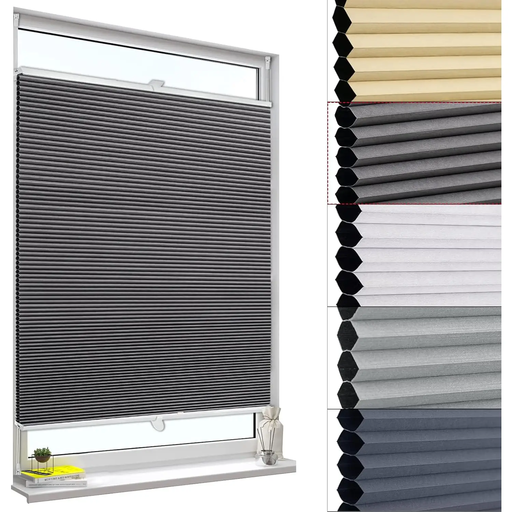
Why it stands out: This blind combines three key advantages: total blackout, a completely drill-free installation, and enhanced insulation. Its honeycomb structure with an internal aluminium coating is designed to block 100% of light and create an effective thermal and acoustic barrier.
Key features:
Who is it for?: For tenants, those who cannot or do not want to drill into their PVC windows, and for any room (bedroom, office, kitchen) where darkness and insulation are priorities.
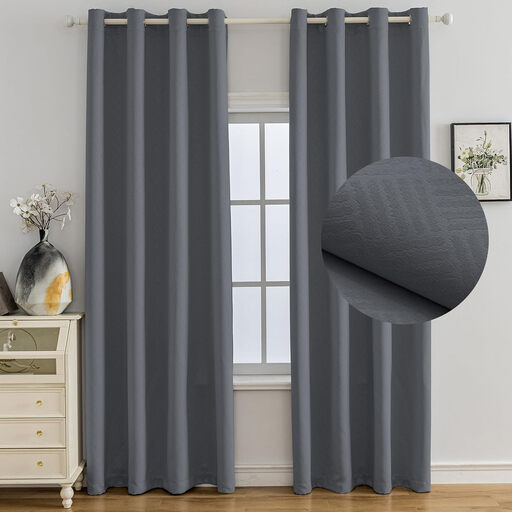
Why it stands out: With its generous dimensions (140 x 300 cm per panel), this set of curtains is the perfect solution for very tall windows or wide bay windows. Its triple-weave technology guarantees top-tier performance.
Key features:
Who is it for?: For homeowners or tenants with large openings (French doors, bay windows) who want to effectively insulate a large room from cold, heat, and light.
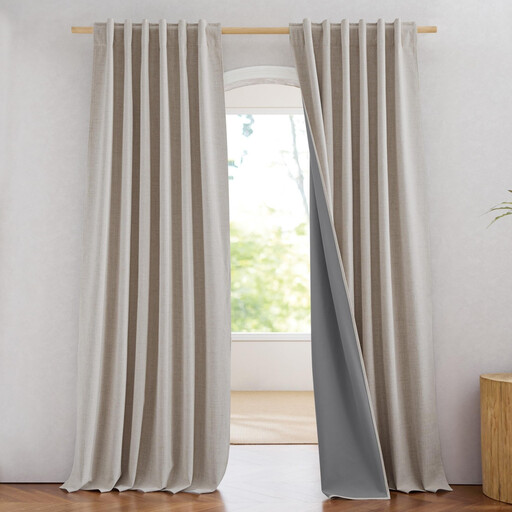
Why it stands out: This model rises to the challenge of blending the elegance of a natural linen-look fabric with the performance of a 100% blackout curtain. It allows you to create a warm and decorative atmosphere without compromising on darkness.
Key features:
Who is it for?: For those who refuse to choose between style and efficiency. It's the perfect solution for a bedroom or living room where aesthetics matter as much as blackout performance.
Our selection is just a glimpse of the possibilities. To explore other sizes, colours, or mounting systems, feel free to browse our full catalogue.
? Explore our full range of thermal blackout blinds
A blackout curtain's primary function is to block light. A thermal curtain, on the other hand, aims to insulate from cold and heat. The thermal blackout curtain combines both functions: it is made with dense materials or special linings that block light while creating an insulating barrier.
The fabric of a 100% blackout curtain is indeed woven to let no light through. However, total darkness in the room will also depend on the quality of the installation. Some light may filter in at the sides, top, or bottom of the curtain. To minimise this effect, choose a curtain that is much wider than your window and a rod that positions it close to the wall. A roller or pleated blind, installed as close to the glass as possible, is often very effective at limiting these light leaks.
Most of these curtains, often made of polyester, are machine washable. The first rule of thumb: always read the manufacturer's label. As a general rule, a gentle cycle at a low temperature (30°C) without a powerful spin is recommended. Never iron the blackout or thermal lining directly. Finally, opt for air-drying to preserve the fabric's properties.