
Livraison le jour même ou le lendemain

Qualité garantie

Débloquez vos offres de bienvenue: Livraison GRATUITE | Jusqu'à -80 % | 30 jours d'essai gratuits à JoyPlus
Téléchargez l'application
Between the computer, TV, game console, and the whole family's smartphones, our wall outlets are quickly overwhelmed. The result: a tangled mess of wires behind the TV stand and overloaded basic power strips. However, a simple extension cord is far from enough to shield your valuable equipment from the whims of the power grid.
A surge protector power strip is a small investment that can save you from major disasters. Much more than a simple power strip, it acts as a shield, offering protection against power surges—sudden voltage spikes that can permanently fry your devices. This guide is here to help you choose the perfect model for your needs by breaking down the essential criteria: safety, convenience, and energy savings.
Before you check out, let's review the few points that distinguish a simple power block from a true fortress for your devices.
The number one criterion is, of course, its ability to act as a bodyguard for your devices. A power surge is a sudden, very brief spike in voltage, often caused by a thunderstorm or simple instability in the electrical grid. A good model must therefore include a device capable of absorbing this current spike to protect the fragile electronic circuits of your equipment.
For families, child safety is not an option. The power strip should be equipped with shutters that block the socket openings, preventing an object or curious little fingers from getting in. This is essential for preventing household accidents.
Once safety is ensured, everyday convenience makes all the difference. Ask yourself how you will use it:
The number of outlets obviously depends on your current... and future needs! It's better to aim a little high. A 6-outlet power strip is a versatile classic for an entertainment centre or a desk. For more demanding setups, models with 8 outlets or more are available.
Finally, think about installation. Most can simply be placed on the floor, but a wall-mountable power strip, featuring mounting slots on the back, is a much cleaner and more secure solution to keep cables from trailing on the ground.
To help you sort through the options, here is our selection of models that check all the boxes, each meeting a specific need.
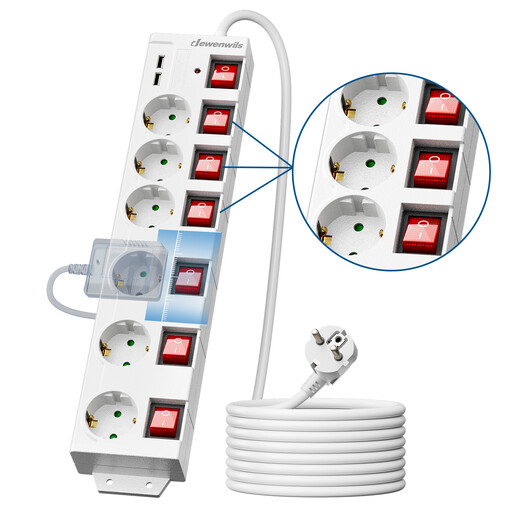
Why it stands out: This model is the champion of power management and convenience. Each outlet has its own switch, which is ideal for completely cutting off power to devices in standby mode. Add two USB ports and a 3-meter cable, and you have the perfect solution for a well-organized desk or TV stand.
Pros:
Who is it for? For those who want to control their electricity consumption down to the last outlet and are looking for an all-in-one solution for the office or living room.
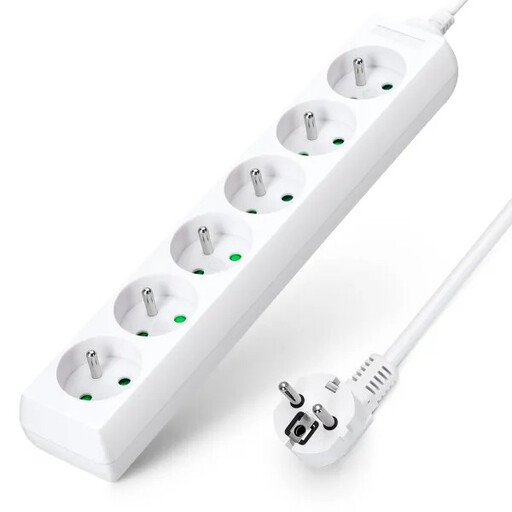
Why it stands out: This one is all about simplicity and durability. No switch, no frills: this block gets straight to the point, reliably providing six additional outlets. Its strong point is its robust design and child safety features, making it a trustworthy choice for everyday family use.
Pros:
Who is it for? For families and anyone looking for a basic, safe, and durable extension power strip without superfluous features.
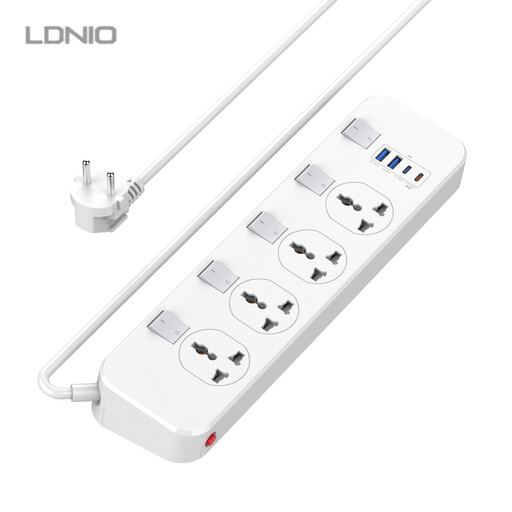
Why it stands out: The perfect model for geeks and gadget lovers. It not only offers 4 universal outlets with switches but also features state-of-the-art charging ports: 2 USB-A ports, 1 USB-C port, and most importantly, a 20W USB-C Power Delivery port for fast charging of modern smartphones and tablets.
Pros:
Who is it for? The obvious choice for tech enthusiasts who juggle multiple devices and need fast charging and versatile outlets.
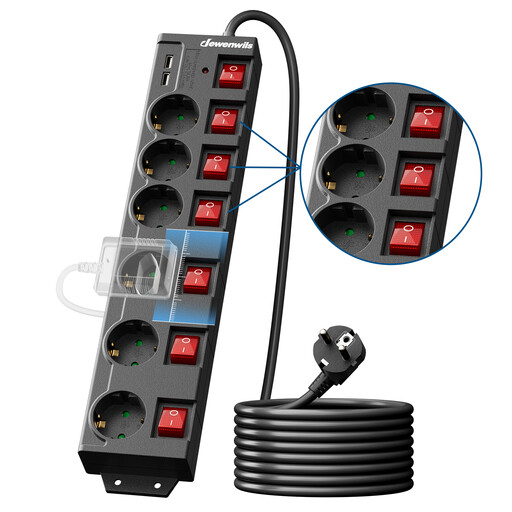
Why it stands out: Same great features, new look! This model shares the excellent characteristics of its white twin (individual switches, protection, 3m cable) but comes in a sleek and elegant black finish. Perfect for discreetly integrating into a setup where black dominates: TV stand, game console, hi-fi system...
Pros:
Who is it for? For those who want the best of both worlds: top-notch power management and complete protection, all in a design that matches their audio/video or computer equipment.
If none of these models check all your boxes, don't worry. Whether you're looking for more outlets, a longer cable, or specific features, our catalogue is full of other gems. Feel free to explore our complete category to find the power strip that will perfectly fit your setup.
Discover our full range of switches and outlets
What is the difference between a standard power strip and a surge protector power strip? A standard power strip only multiplies the number of outlets. A surge protector adds a crucial layer of security: it integrates an electronic component (a varistor, or MOV) that acts like a sponge, absorbing dangerous voltage spikes and thus shielding your devices.
How do I know if my power strip's surge protection is still working? Most models include an indicator light. As long as it's on, everything is fine: the protection is active. If it goes out (especially after a storm), it means the protective device has done its job by absorbing a surge. The power strip will continue to function as a simple extension cord, but it will no longer offer any protection. It is then imperative to replace it.
Can you plug a power strip into another power strip? Absolutely not! Plugging power strips in a series (one into another), a practice sometimes called "daisy-chaining," is a very bad idea. It creates a risk of overloading the first power strip or the wall outlet, with a real danger of overheating and fire. A golden rule: a power strip should always be plugged directly into a wall outlet.