
Livraison le jour même ou le lendemain

Qualité garantie

Débloquez vos offres de bienvenue: Livraison GRATUITE | Jusqu'à -80 % | 30 jours d'essai gratuits à JoyPlus
Téléchargez l'application
Whether you're working remotely, as a freelancer, or cramming for exams, spending your days glued to a chair has become the norm for many of us. The result: back tension, neck pain, and a general drop in energy. The standing desk has emerged as a simple and remarkably effective solution to reintroduce movement into your daily routine, improve your posture, and boost your productivity.
But with an overwhelming number of options, it's hard to know where to start. This guide is here to provide some clarity by breaking down the essential criteria and presenting a selection of models to help you make the right choice, without unnecessary marketing jargon.
Before you decide, it's helpful to understand the key features that separate a good ergonomic desk from a mere gadget. Here are three points to examine closely.
A desk that wobbles with the slightest movement is a constant distraction. Stability is therefore a non-negotiable criterion, especially in the standing position. It mainly depends on the quality of the frame, often made of steel, and the design of the legs. A good electric desk must also have a reliable and quiet motor. Smooth and discreet operation (typically under 50 dB) allows you to change positions without disturbing your concentration or those around you.
The size of the desktop is obviously a crucial factor. Measure the space you have available, but also anticipate your needs: how many monitors do you use? Do you need space for documents or a notebook? Standard dimensions vary, ranging from 120 cm in width for compact setups to 160 cm or more for complete workstations. Features like cable grommets, headphone hooks, or storage pouches help maintain a clean and organised workspace—a significant advantage for a desk for remote work.
The smartest models include options that make daily life easier. The memory function is particularly popular: it allows you to save several heights (for example, one for sitting and one for standing) and switch between them with a single press. Some motorised desks also offer integrated USB ports to charge your devices, or even a reminder to prompt you to change positions at regular intervals.
To help you visualise what the market has to offer, here are three options that cater to different needs and workspaces.
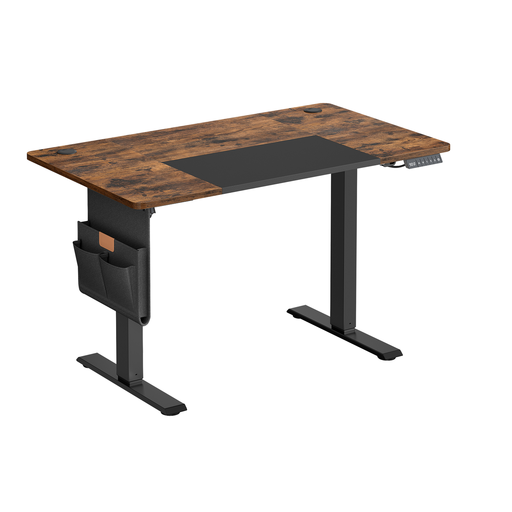
What sets it apart
This model is an excellent entry point into the world of standing desks. Its compact dimensions of 120 x 60 cm make it ideal for apartments, student rooms, or office nooks where space is at a premium. Yet, it makes no compromises on essential features.
Key features
Who is it for?
Ideal for students and remote professionals with limited space. It offers all the benefits of a modern ergonomic desk in a compact package.
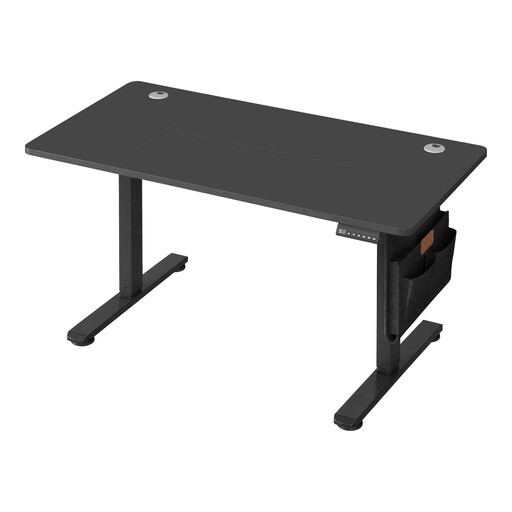
What sets it apart
Its main advantage? A 140 x 60 cm desktop that offers superior working comfort, making it easy to set up two monitors and their peripherals. Its reinforced steel structure ensures excellent stability, even at its maximum height.
Key features
Who is it for?
This motorised desk is aimed at professionals who spend long hours at their workstation and need a large, versatile workspace. It's a balanced choice for a dedicated home office.
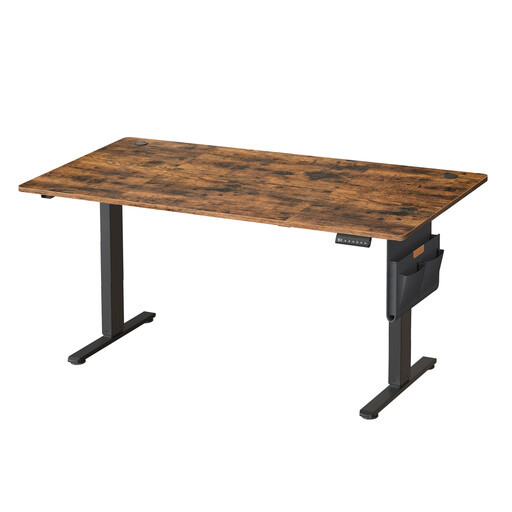
What sets it apart
What makes it stand out? It's the premium solution for those who don't want to compromise on space and sturdiness. Its very large 160 x 70 cm desktop can accommodate the most demanding setups, while its two-tone design (rustic brown and black) adds a touch of elegance to the room.
Key features
Who is it for?
Aimed at power users and those looking for a true command centre for their home office. Its large size and robustness make it a long-term investment for optimal working comfort.
Not completely sold on a standing desk? If you prefer a more traditional solution, other options are available. For example, some workstations are specifically designed with integrated storage or sliding keyboard trays.
? Discover our selection of desks with keyboard trays.
The ideal height, whether you are sitting or standing, is one that allows your elbows to form a 90-degree angle when your forearms are resting flat on the desk. Your shoulders should be relaxed and your back straight. Most adjustable desks offer an adjustment range from about 72 to 120 cm, which covers the needs of most body types.
Recent models are designed to be exceptionally quiet. The noise level of a well-made electric desk is typically below 50 dB during adjustment. This is equivalent to a quiet conversation or the background noise of a library, which is perfectly acceptable in an office or an open-plan office.
For standard office use, a load capacity of 70 to 80 kg is more than sufficient. This is enough to easily accommodate one or two monitors, a laptop, a lamp, and various accessories. Always check this specification, especially if you plan to place heavy equipment (like a PC tower) directly on the desktop.