
Livraison le jour même ou le lendemain

Qualité garantie

Débloquez vos offres de bienvenue: Livraison GRATUITE | Jusqu'à -80 % | 30 jours d'essai gratuits à JoyPlus
Téléchargez l'application
Whether you dream of kneading the perfect bread dough, whipping egg whites to absolute stiffness, or crafting a light and airy brioche, the stand mixer is the indispensable ally for your kitchen. But faced with a jungle of models, power ratings, and attachments, making the right choice can quickly become a daunting task.
This guide is here to help you navigate the options. Our mission: to give you the keys to choosing the stand mixer that truly fits your needs, far from the marketing hype.
Before diving into our top picks, let's review the key points that will guide your decision.
The wattage (W) is often the first number people look at. However, the motor type is an equally crucial criterion.
For regular use, and especially for kneading heavy doughs (bread, pizza, brioche), a high-performance motor is non-negotiable. A good dough mixer must be able to maintain a steady pace without ever overheating.
Expressed in litres (L), the bowl's capacity determines the volume of ingredients you can process in a single batch. For a family of four, a 4.5 to 5?L bowl is a good compromise. If you think big, aim for 6?L or more for maximum convenience.
Planetary mixing action is an essential standard today. The principle? The attachment spins on its own axis while also sweeping the sides of the bowl. The result is a perfectly homogeneous mixture that leaves no ingredients behind, either on the sides or at the bottom.
A stand mixer always comes with the essential trio of attachments:
Some models, often described as professional-grade stand mixers for their robustness, push the boundaries of versatility. They can accommodate dozens of optional attachments (meat grinder, pasta roller, ice cream maker...) and transform your appliance into a true kitchen sous-chef.
We have selected three models that stand out for their philosophy, performance, and design, catering to a variety of needs and budgets.
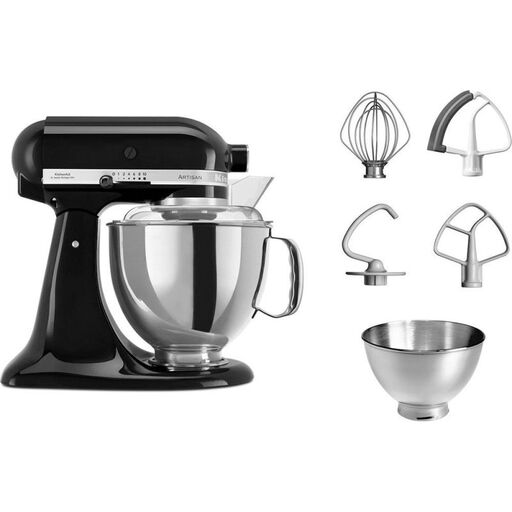
Why we love it
Instantly recognizable, the KitchenAid Artisan is more than a mixer: it's a design object. Its all-metal construction ensures unshakeable stability and legendary durability. Don't be fooled by its 300?W rating: its direct drive motor delivers constant, reliable power for most tasks, from the gentlest kneading to the most intense whipping. Its signature planetary action guarantees a flawless mix.
Key Features
Who is it for?
For baking and design enthusiasts looking for a high-performance, durable, and iconic appliance. It's a true investment, designed for those who value impeccable build quality and an expandable ecosystem.
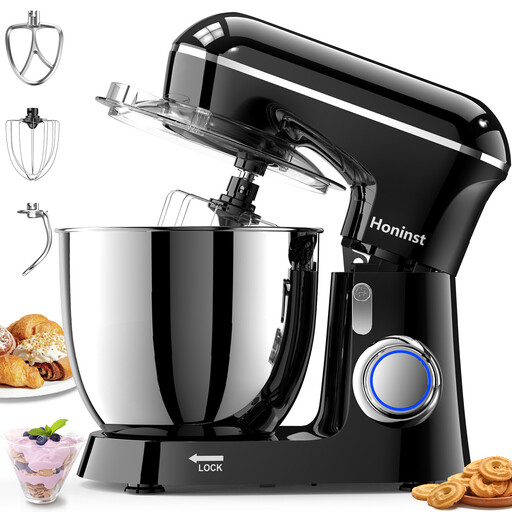
Why we love it
The Honinst mixer gets straight to the point: offering maximum capacity and functionality. With its extra-large 6.2-litre (6.5QT) stainless steel bowl, it's aimed at those who think big in the kitchen. Its powerful motor, paired with 10 speeds, allows it to tackle a wide range of recipes, from the simplest to the most ambitious.
Key Features
Who is it for?
For large families and home bakers who regularly prepare large quantities. It's a pragmatic and efficient solution for anyone who makes bowl capacity their number one criterion.
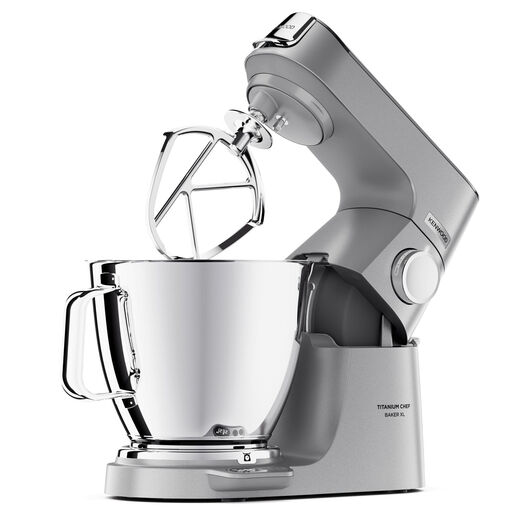
Why we love it
The Kenwood Titanium Chef Baker XL plays in the big leagues. Its ace in the hole? The integrated EasyWeigh scale to weigh ingredients directly in the bowl. Goodbye to a sink full of dishes! Its powerful 1200?W ChefMotor handles the densest doughs without breaking a sweat. The icing on the cake is that it comes with two bowls (7?L and 5?L), a real plus for tackling back-to-back recipes without intermediate cleaning.
Key Features
Who is it for?
For the demanding baker who makes no compromises on precision, power, and efficiency. The integrated scale and dual bowls are major selling points for those looking to optimise every step of their recipes and guarantee perfect results every time.
Our selection highlights three distinct philosophies. If your needs are more specific, or if you simply want to discover other models, brands, and price points, feel free to browse our complete catalogue.
? Discover our full range of stand mixers and find the model that meets your ambitions.
1. How many watts does a good stand mixer need?
Don't rely solely on the raw wattage. A 300-500?W direct drive mixer can be just as effective for kneading as a 1000-1200?W belt-drive model. For very heavy and dense doughs (whole wheat, rye...), opt for a direct drive motor known for its high torque or, failing that, a nominal power rating above 1000?W.
2. What's the difference between a stand mixer and a food processor?
The stand mixer is a specialist in mixing, whipping, and kneading, thanks in large part to its planetary action. A food processor, on the other hand, is a jack-of-all-trades: it chops, blends, grates, slices... but is often less adept at kneading heavy doughs. The line is blurring, however, as many stand mixers become multifunctional with their optional attachments.
3. How do I maintain my stand mixer?
Maintenance is very simple. The bowl and attachments (whisk, beater, hook) are often dishwasher-safe (check the manual), although hand washing will preserve their shine longer. For the mixer's body, a simple wipe with a damp cloth is sufficient. The golden rule: never immerse the motor block in water and always unplug the appliance before cleaning it.