
Livraison le jour même ou le lendemain

Qualité garantie

Débloquez vos offres de bienvenue: Livraison GRATUITE | Jusqu'à -80 % | 30 jours d'essai gratuits à JoyPlus
Téléchargez l'application
Baking your own bread, preparing golden brioches, or crafting cakes for dessert… More and more people are discovering the joy of home baking and pastry making. But let's be honest: kneading dough by hand can quickly become a chore. This is where a stand mixer enters the scene, proving to be a powerful ally in the kitchen. Faced with an overwhelming number of options, how do you find your way? Power, capacity, accessories… the criteria are numerous, and it's easy to get lost.
Our guide is here to help you see more clearly and choose the model that will truly meet your needs, cutting through the marketing noise.
Before you take the plunge, let's review the key technical points that will make all the difference in daily use.
Expressed in litres, the bowl's capacity simply defines the amount of dough you can prepare in a single batch. For a single person or a couple, a 4 to 5-litre bowl is often sufficient. For a family or if you enjoy cooking in large quantities, a 6-litre bowl or larger will be much more convenient.
The wattage is a figure that's often highlighted, but be careful not to rely on it blindly. It must be considered in relation to the motor type. A Direct Current (DC) motor is often quieter and offers high torque even at low speeds, which is a major advantage for a dough mixer. An Alternating Current (AC) motor remains a powerful and reliable option. For standard home use, a power rating of 400 to 500W is more than enough.
A good stand mixer must include the essential trio of baking attachments:
A splash guard is also a real bonus to avoid redecorating your kitchen walls. The appliance's versatility will depend on these attachments and its ability to drive them with vigour.
Nothing is more annoying than a mixer that starts dancing across the countertop. Stability is ensured by the appliance's weight and the presence of suction-cup feet. Silence is golden, especially in an open-plan kitchen. A quiet stand mixer transforms the experience. Keep an eye on the noise level, expressed in decibels (dB). Below 75 dB, a model can be considered relatively discreet for this type of machine.
We have selected a few models that stand out from the crowd, each meeting specific needs.

Why it stands out
This model is distinguished by its 450W DC motor, which is both powerful and quieter than many of its counterparts. Its large 6-litre stainless steel bowl is perfect for large batches, and its design (suction-cup feet, vibration absorption) guarantees rock-solid stability.
Pros
Who is it for? Ideal for large families, avid bakers who regularly make large quantities, or those who are particularly sensitive to noise in the kitchen.

Why it stands out
This stand mixer offers an excellent balance of performance and a compact design. With its 5-litre bowl, it meets the needs of most households. It stands out with its 10 adjustable speeds, which allow for very precise control over the mixing process, complemented by a Pulse function to reach maximum speed in an instant.
Pros
Who is it for? Perfect for couples, small families, or those new to baking who are looking for a versatile and user-friendly appliance that won't clutter the kitchen.
Why it stands out
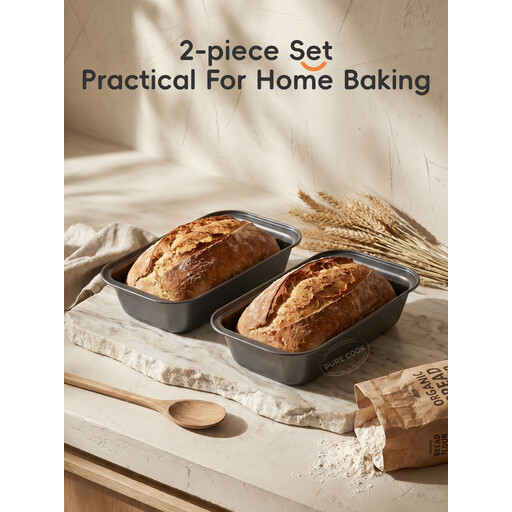
A good knead isn't everything: the baking is the final, crucial step. And for that, you need the right pan. This set of two loaf pans made of heavy-gauge carbon steel is designed for even heat conduction. The result: perfectly uniform baking, so you can say goodbye to burnt bottoms and undercooked centres.
Pros
Who is it for? The essential accessory for anyone investing in a stand mixer with the goal of making their own bread at home.
Our selection is just a taste of the possibilities available to equip your kitchen. To discover other models, find more specific accessories, or compare brands, feel free to explore our full catalogue.
Discover our complete collection in the Bread & Pastries category to find inspiration and the tools that will transform your kitchen.
Raw wattage isn't everything. A power rating of 400 to 500W is more than sufficient for home use, even for tackling the densest doughs. What's more important is to look at the motor technology (DC or AC) and the quality of the transmission (favour metal gears), which ensure efficient power transfer to the hook.
Wash most attachments (whisk, hook, beater) and the stainless steel bowl by hand with hot water and dish soap. Some may be dishwasher-safe, but checking the manufacturer's instructions is always a good idea to avoid premature damage. The body of the mixer can be cleaned simply with a damp cloth. Always remember to unplug the appliance before any handling.
Not entirely. A stand mixer is a specialist in mixing, whipping, and kneading. It excels at preparing doughs and creams. A multi-function food processor, on the other hand, is designed for chopping, slicing, grating, or blending soups. Although some stand mixers can be fitted with optional attachments to perform these functions, their core purpose remains baking and pastry making.