
Livraison le jour même ou le lendemain

Qualité garantie

Débloquez vos offres de bienvenue: Livraison GRATUITE | Jusqu'à -80 % | 30 jours d'essai gratuits à JoyPlus
Téléchargez l'application
Whether you're a weekend baker or a seasoned dough enthusiast, who hasn't felt that sinking feeling when faced with a brioche dough that needs endless kneading or egg whites that refuse to stiffen? A good stand mixer transforms these laborious steps into a breeze, freeing up your time for what truly matters: creativity. But with an overwhelming number of options on the market, how do you find your way? Our editorial mission is to cut through the noise for you. Forget the marketing jargon; we'll guide you step-by-step to find the model that truly fits your needs.
Before diving into our top picks, let's review the essential criteria for making the right choice.
Power, measured in watts (W), determines the motor's ability to knead the densest doughs (bread, pizza) without overheating. For regular use, aim for a minimum of 1000W—it's a solid baseline. The secret to a perfectly uniform mixture? Planetary mixing action, where the attachment spins on its own axis while sweeping the sides of the bowl. This is the hallmark of the most effective stand mixers.
The bowl's capacity, measured in litres, dictates the quantities you can prepare. A 5L bowl is an excellent all-rounder, ideal for a family. For large gatherings or generous batches, a 6L bowl or larger will offer more convenience.
Also, consider the included attachments. The essential trio includes:
Some models push versatility even further, transforming into a true multi-functional kitchen machine with additional accessories, such as a stand mixer with a blender or a meat grinder.
A good stand mixer must remain perfectly stable on your worktop, even at full speed. Suction-cup feet are a real bonus for preventing any mishaps. The quality of the materials is a guarantee of longevity: opt for a stainless steel bowl and robust attachments. Lastly, don't overlook the noise level (in decibels, dB), especially if you have an open-plan kitchen or bake frequently. It's an essential comfort factor.
After analysing dozens of models, we've selected three mixers that stand out for their performance and value, catering to a variety of needs and budgets.
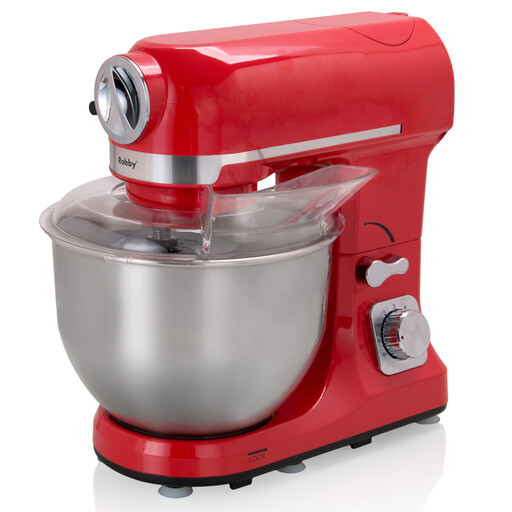
Why it stands out: The Robby ROBIMIX isn't just a stand mixer; it's a true Swiss Army knife. It combines baking functions with a blender and a meat grinder. It's the perfect solution for optimising space and budget with a single appliance.
Key features:
Who is it for? For beginners or those looking for their first ultra-versatile multi-functional kitchen machine that can juggle cake batter, morning smoothies, and minced meat for dinner.

Why it stands out: The Monsga SM100 strikes the perfect balance: it combines reliable power with remarkably quiet operation (under 75 dB). Its elegant design and thoughtful construction make it as pleasing to look at as it is to use.
Key features:
Who is it for? For enthusiasts who bake regularly and value a peaceful kitchen environment. Its refined design will appeal to those who believe aesthetics and performance go hand in hand.
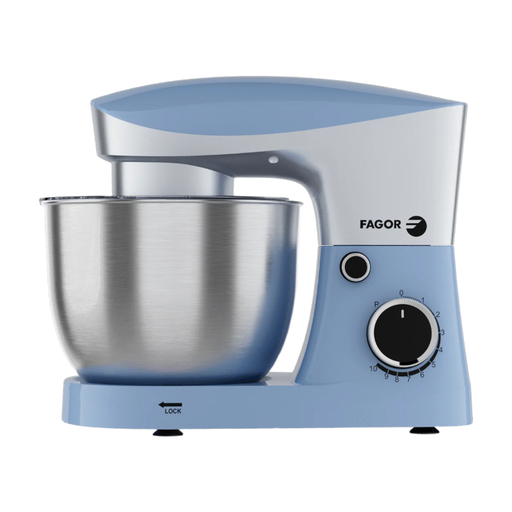
Why it stands out: With its 1500W DC motor and large 6L bowl, the FAGOR FG4519 delivers performance comparable to a professional stand mixer. It's designed to handle large quantities and very dense doughs with impressive ease and stability.
Key features:
Who is it for? For experts, large families, and anyone who thinks big. This is the choice for raw power and durability, ready to tackle the most ambitious culinary challenges without breaking a sweat.
These three models cover distinct use cases, but the world of kitchen machines is much broader. Your perfect match might be waiting! Feel free to explore our complete collection to find it.
? Explore our full range of kitchen machines
1. What motor power do I need for my stand mixer? For versatile use (cakes, light yeast doughs), an 800W to 1000W motor is sufficient. If you plan to frequently knead dense, heavy doughs (sourdough bread, large quantities of pizza dough), a 1200W model or higher, like the FAGOR FG4519, will offer greater endurance and durability.
2. Stand mixer vs. food processor: what's the difference? A stand mixer is a specialist in mixing, whipping, and kneading thanks to its planetary action. It's the king of doughs and batters. A food processor, on the other hand, is more of a generalist: it chops, grates, slices, and sometimes even cooks. Some hybrids, like the Robby ROBIMIX, merge these two worlds. It all depends on your priority: pure baking or help with daily meal prep.
3. How do I clean and maintain my stand mixer? The golden rule: always unplug the appliance before cleaning. Most stainless steel bowls and attachments (whisk, beater, dough hook) are dishwasher-safe (check the manual to be sure). For the body of the mixer, which houses the motor, a simple wipe with a damp cloth is enough. Never submerge it in water! Regular maintenance is the secret to its longevity and your safety.