
Livraison le jour même ou le lendemain

Qualité garantie

Débloquez vos offres de bienvenue: Livraison GRATUITE | Jusqu'à -80 % | 30 jours d'essai gratuits à JoyPlus
Téléchargez l'application
Choosing the right pan for your induction cooktop can often feel like a puzzle. Between marketing jargon and cryptic spec sheets, it's easy to end up with a disappointing piece of cookware. As the head of product selection at Joybuy, I analyze dozens of items every day. Let me guide you through the common pitfalls and help you identify the criteria that truly matter.
The cookware aisle is filled with flashy claims that often hide mediocre quality. Here are three critical points to watch for before making your decision.
To avoid these disappointments, let's focus on the technical specifications, which don't lie.
A stainless steel pan worthy of the name is rarely made from a single piece. High-performance models feature a multi-ply construction, often called "3-ply" or "5-ply."
Here, it all depends on your cooking style and priorities.
Versatility in the kitchen is also a matter of format. A 28 cm pan is the quintessential all-rounder, perfect for a household of 2 to 4 people. For saucy dishes or larger quantities, a stainless steel sauté pan, with its high sides, will prove much more practical.
Instead of an endless list, we've selected models that meet specific needs, rigorously applying the quality criteria we've just defined.
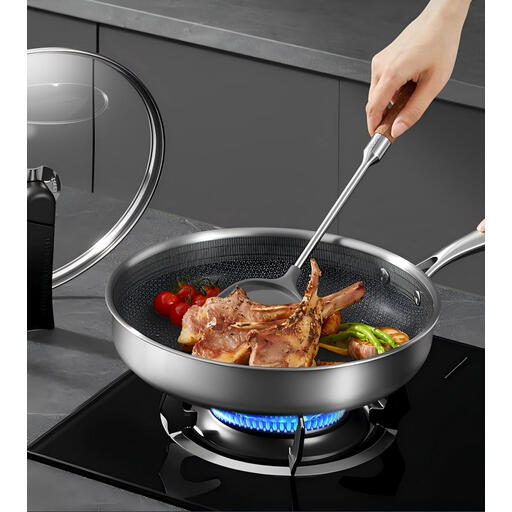
Why we recommend it: This is the smart compromise for everyday cooking. Its 28 cm diameter is ultra-versatile, and its hybrid structure offers the best of both worlds: the powerful searing of stainless steel and the ease of non-stick for delicate foods like fried eggs or a fish fillet.
Its honeycomb structure shields the non-stick coating from metal utensils, directly addressing the fragility of conventional non-stick surfaces. Its multi-ply base ensures excellent responsiveness on induction.
Its versatility: it can do it all, from searing meat to keeping a dish warm. The included glass lid is a real bonus for monitoring simmering dishes.
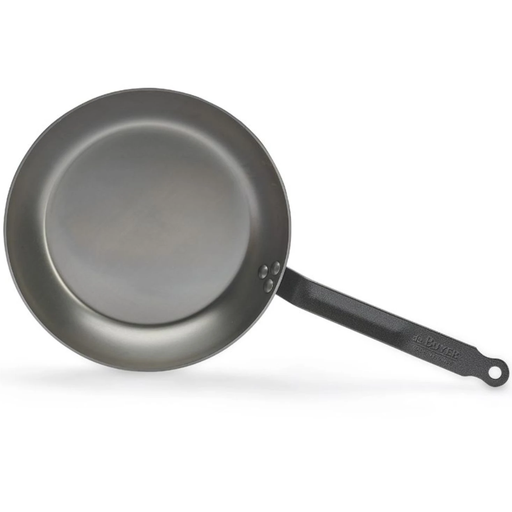
Why we recommend it: For those who see their cookware as an heirloom, a carbon steel pan is a clear choice. Naturally free of any chemical coatings, its lifespan is measured in decades. It requires a little attention at the beginning for seasoning, but it's an investment that pays off in the long run.
By definition, it bypasses the coating pitfall because it doesn't have one. Its 3 mm thick steel sheet provides exceptional thermal inertia and unbeatable durability, with zero risk of warping.
Outstanding durability and performance that improves with time. It's a true **professional-grade pan** for your home.
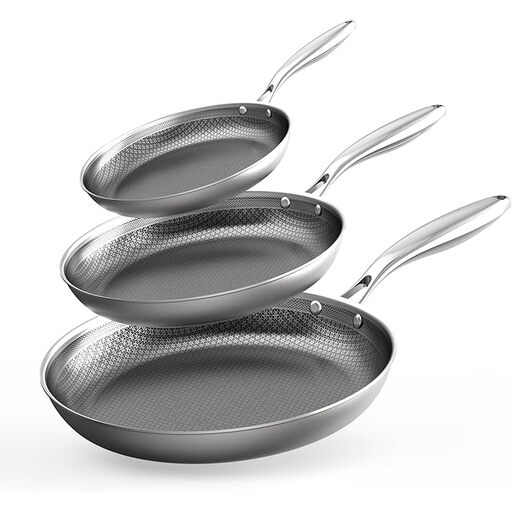
Why we recommend it: For starting from scratch or replacing everything at once, a set is often the smartest and most cost-effective solution. This **stainless steel pan set** covers all daily needs with its three diameters (20, 25, and 30 cm), from a single fried egg to a full meal for the whole family.
By choosing a set from the same range, you ensure consistent manufacturing quality and induction performance across all sizes. No more puzzling over why the 24 cm pan heats perfectly while the 28 cm one struggles.
A complete and coherent trio for maximum versatility, with a stainless steel construction that performs on all cooktops, including induction.
Discover our full selection of pans that meet our quality charter and the most demanding safety standards.
To wrap up, let's answer the most common questions.
The secret is preheating. Heat your empty pan over medium heat for one to two minutes. The famous water drop test is foolproof: if the drop glides across the bottom like a small bead, it's perfect. You can then lower the heat slightly, add your fat, and then your food. The golden rule: don't touch it right away! Let a crust form, and the food will release on its own.
A quality multi-ply stainless steel pan is an investment for decades, or even a lifetime if well-maintained. Unlike a coated pan, it is not afraid of metal utensils, and its cooking performance never degrades.
This is the classic symptom of a low-quality pan. The base is too thin and cannot withstand the intense thermal shock of induction. The rapid, intense heat causes it to expand unevenly, and it eventually deforms. In contrast, a pan with a thick, multi-ply base is designed to handle this power and will remain perfectly flat.