
Livraison le jour même ou le lendemain

Qualité garantie

Débloquez vos offres de bienvenue: Livraison GRATUITE | Jusqu'à -80 % | 30 jours d'essai gratuits à JoyPlus
Téléchargez l'application
Tired of plastic containers that stain, warp, and raise concerns about their safety? You're not alone. A healthy, sustainable alternative exists: the stainless steel food container. Robust, hygienic, and built to last, it has become the essential tool for preparing, transporting, and storing your food.
But with various types of steel, lids, and sizes available, making the right choice isn't always easy. This guide is here to help you understand the key criteria and find the perfect set of stainless steel food containers for your needs, featuring our selection of the best models currently on the market.
Before you dive in, let's review the essential points to check to find the model that will perfectly suit your lifestyle.
The number associated with stainless steel isn't just a marketing detail. It indicates its composition and, consequently, its durability.
We often focus on the container, but the lid is just as crucial. It's what guarantees a leak-proof seal and ease of use day-to-day.
Consider how you'll use them. For weekly meal prep or family storage, a set of stainless steel food containers in various sizes is a must-have. Opt for stackable containers for the fridge: the space-saving design will keep your refrigerator organised, and you'll be thankful for it. For an on-the-go lunch, a capacity of 600 ml to 1.2 L is generally perfect.
After comparing the features of dozens of models, our editorial team has selected three products that stand out for their quality and utility.
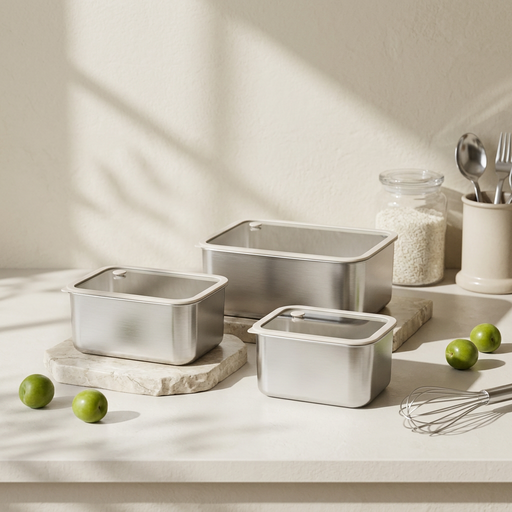
What sets it apart: This set cleverly combines a sturdy 304 stainless steel base with a transparent borosilicate glass lid. Its silicone seal (EU standard) ensures a perfectly tight closure, ideal for preventing leaks and preserving food freshness. We also appreciate their deep shape, which offers generous storage volume.
Key features:
Who is it for? For families and meal prep enthusiasts looking to store large volumes while keeping their fridge perfectly organised.
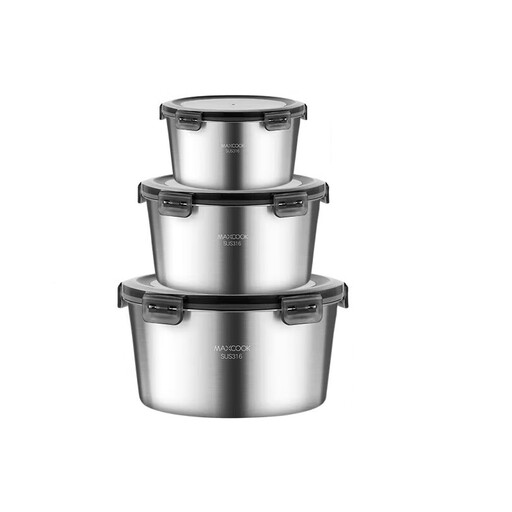
What sets it apart: The main advantage of this Maxcook set is its 316 stainless steel. This premium quality gives it superior corrosion resistance, making it unbeatable against acidic or very salty foods. Its fitted lids ensure optimal preservation.
Key features:
Who is it for? For those who demand the highest quality materials, and for anyone who often cooks saucy dishes, marinades, or other acidic or salty preparations.
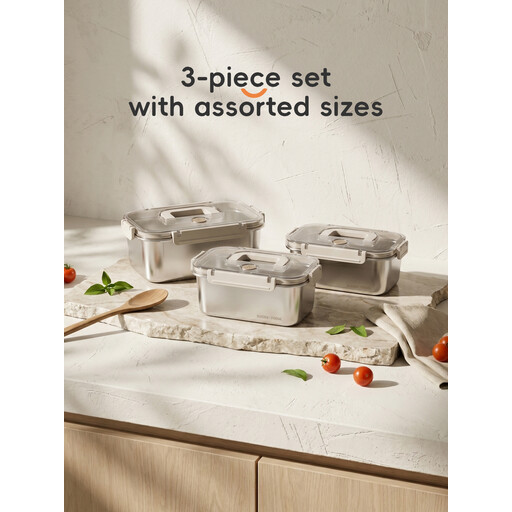
What sets it apart: Clearly designed for transport, this PURE COOK set combines a 304 stainless steel base with plastic lids (BPA-free PP) equipped with robust locking clips on all four sides. The integrated handle on the lid turns it into an excellent, easy-to-carry leak-proof stainless steel bento box.
Key features:
Who is it for? The ideal solution for employees, students, or picnic lovers looking for a reliable and practical stainless steel lunch box for their on-the-go lunches.
None of these models tick all your boxes? Are you looking for a specific size or feature? Feel free to explore our full catalogue.
? Discover our full range of stainless steel food containers
1. Can you put a stainless steel food container in the microwave? Absolutely not! You should never place metal, including a stainless steel container, in a microwave oven. Metal reflects microwaves, which can damage your appliance or even cause a fire. To reheat your food, simply transfer it to a microwave-safe plate or container (glass, ceramic).
2. How do you properly clean and maintain a stainless steel container? Stainless steel is a breeze to maintain. A simple hand wash with hot water, dish soap, and a soft sponge is all it takes. Most stainless steel bases are also dishwasher safe (be sure to check the instructions for the lid). To get rid of limescale or stubborn stains, a little white vinegar or baking soda will work wonders.
3. Is 304 stainless steel truly safe for food use? Absolutely. 304 stainless steel is a globally recognised food-grade standard. It is stable and inert, meaning it won't leach harmful substances into your food under normal use. It's an excellent everyday alternative to plastic. 316 stainless steel offers an extra layer of safety for very specific uses (acids, salts), but it isn't necessary for most people.