
Livraison le jour même ou le lendemain

Qualité garantie

Débloquez vos offres de bienvenue: Livraison GRATUITE | Jusqu'à -80 % | 30 jours d'essai gratuits à JoyPlus
Téléchargez l'application
Our smartphones have become true pocket-sized cameras, capable of shooting in 4K with stunning quality. But what good is such high resolution if the image is ruined by shaky footage? Whether you're a content creator, a travel vlogger, or simply love capturing beautiful family videos, a smartphone stabilizer is the accessory that will change everything.
The market is flooded with models, and it's easy to get lost. This guide is here to decode the marketing jargon, introduce the features that truly matter, and help you find the stabilizer that perfectly fits your needs.
Before diving into our selection, here are a few key points to consider to make the right choice.
The secret to a gimbal lies in its motors.
Recent models go far beyond simple stabilization. Among the most useful innovations is AI (Artificial Intelligence) tracking. The principle is simple: the stabilizer "locks on" to a target (a person, animal, or object) and automatically keeps it centred in the frame, even if it moves. This is a major advantage for vloggers filming themselves alone or for capturing an action scene without any hassle. Other features, like gesture control, allow you to start recording or take a photo remotely with a simple wave of your hand.
Beyond stabilization, it's the ergonomics that make a difference in daily use.
Here are a few models that stand out for their performance and design, catering to different uses and budgets.
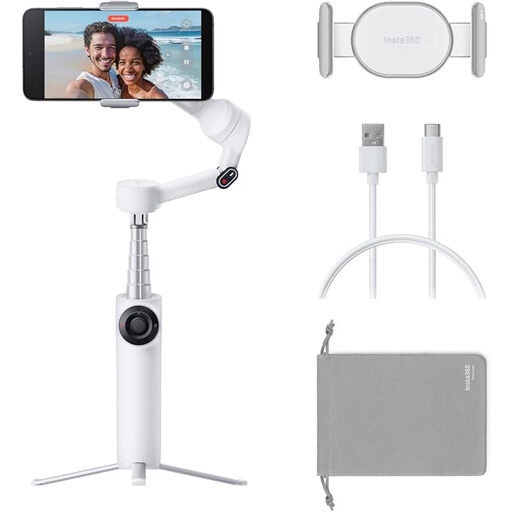
Why we love it: The Insta360 Flow is the Swiss Army knife for mobile content creators. It checks all the boxes: ultra-effective 3-axis stabilization, an integrated tripod, a selfie stick, and even a built-in power bank. Its AI tracking is incredibly powerful and easy to master, even for a beginner.
Key features:
Who is it for? For creators, travellers, and families who want an all-in-one, high-performance, and user-friendly solution for perfectly stable and framed videos in any situation.
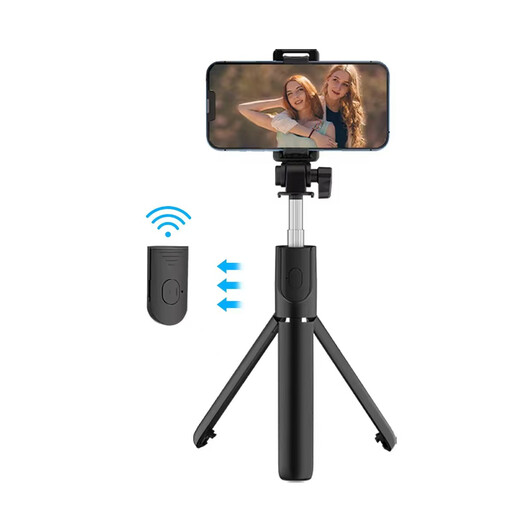
Why we love it: Note that the Verbex K50 is not a motorized stabilizer, but a smart and versatile vlogging accessory. It plays to other strengths: a giant telescopic pole (up to 1.9m!), a stable tripod, and, most importantly, dual LED lighting to perfect your look.
Key features:
Who is it for? For those who primarily shoot static shots (streaming, tutorials) or selfies and are looking for a simple solution with lighting and record-breaking reach, without the complexity of a motorized gimbal.
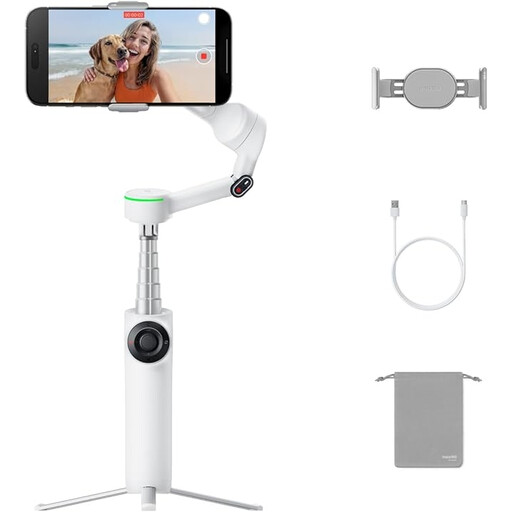
Why we love it: The Pro version of the Flow 2 is the ultimate choice for the most demanding users. It builds on the excellent foundation of the standard model and adds cutting-edge features. The biggest new feature is its compatibility with Apple's DockKit, which allows you to use AI tracking directly in over 200 third-party apps (TikTok, Instagram, etc.). No more being limited to the manufacturer's app!
Key features:
Who is it for? For content creators and semi-pros who want the best in technology, with maximum flexibility to integrate smart tracking into their social media workflow.
This selection highlights a few flagship models, but the market is full of options. If you're looking for a different type of accessory, feel free to browse our full catalogue.
Discover our complete collection of photo and video accessories to find the gear that's right for you.
A selfie stick is just a telescopic arm to move your phone further away and widen the field of view. A smartphone stabilizer, or gimbal, is a much more complex device: it uses motors and sensors to actively compensate for your movements in real time, guaranteeing perfectly smooth videos without the slightest shake.
The vast majority of stabilizers are universal, working with both iPhones and Android models. However, there are two crucial points to check before buying: the weight and width of your phone. Each gimbal has a maximum payload (supported weight) and a clamp range. Make sure your smartphone falls within these limits for optimal performance.
It's not essential, but it can be a game-changer. If you often film yourself alone (for vlogs, tutorials, or sports demos), AI tracking becomes your personal camera operator, ensuring you're always in the frame. If you're always behind the camera, the feature is less critical, but it's still a real asset for tracking a fast-moving subject (like a running child or your pet).