
Livraison le jour même ou le lendemain

Qualité garantie

Débloquez vos offres de bienvenue: Livraison GRATUITE | Jusqu'à -80 % | 30 jours d'essai gratuits à JoyPlus
Téléchargez l'application
Looking to give your 3D prints a smooth, glossy, almost luxurious finish?? That's the promise of Silk PLA filament (or Silk PLA). With its striking visual appeal, it can turn any object into a standout piece. But with single-colour, dual-colour, and even tri-colour options available, it can be tough to navigate the choices and select the right spool.
This guide is here to help. As the Head of Product Curation at Joybuy, I'm sharing my expert advice and top picks to help you achieve flawless 3D prints with a satin, metallic effect.
Before diving into our selection, let's review the key criteria to ensure you make the right choice and that the filament is compatible with your machine.
The main appeal of Silk PLA is its appearance, so your colour choice is crucial?:
The vast majority of consumer-grade 3D printers use filament with a 1.75?mm diameter. Therefore, 1.75?mm Silk PLA is the standard. Always remember to check your printer's specifications before ordering. A diameter mismatch (choosing 2.85?mm, for example) will render your spool of PLA completely unusable.
This is an often-overlooked detail, but the quality of the filament winding on the spool is critical. A poorly wound filament is a recipe for tangles, which lead to interrupted or completely failed prints. Opt for brands that guarantee neat and consistent winding. You'll save yourself a lot of headaches, especially on long prints that last for hours.
After scouring the market, here is our selection of filaments that stand out for both their visual finish and their popularity within the maker community.
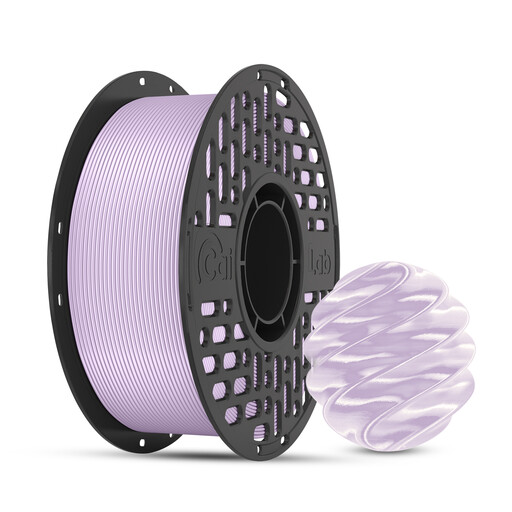
Why it stands out?: This Taro Purple is an elegant and original alternative to more traditional metallic shades. It delivers a deep satin finish that enhances the finest details of your prints.
Highlights?:
Who is it for?? For creators who want to produce parts with a unique and sophisticated touch of colour?: jewellery, custom cases, decorative items, and more.
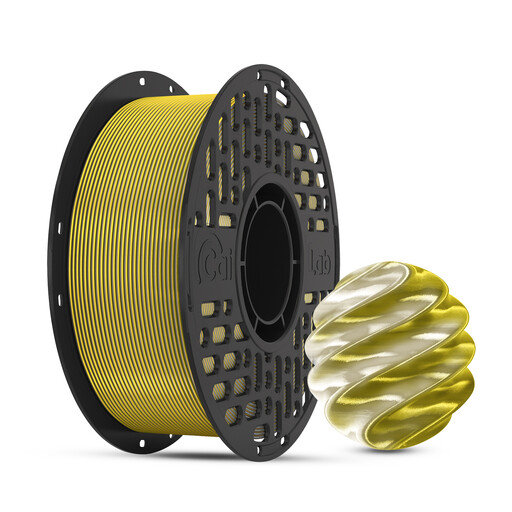
Why it stands out?: This dual-colour 3D filament combines the two most sought-after metallic shades?: gold and silver. The result is stunning?: the object appears to shift from one precious metal to another depending on the angle, all without needing a dual-extruder printer.
Highlights?:
Who is it for?? Perfect for makers printing trophies, medals, collector's items, or any object that deserves a shifting precious metal effect.
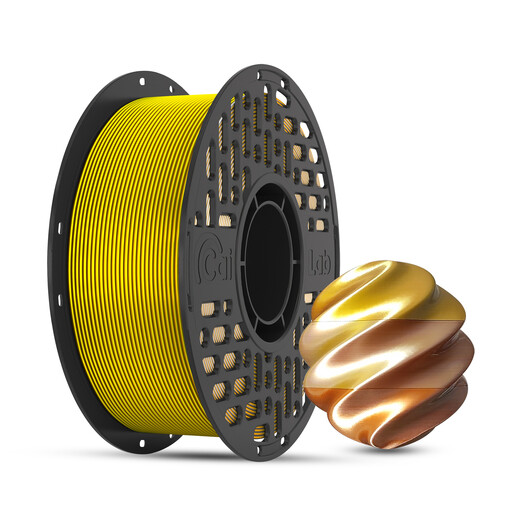
Why it stands out?: This tri-colour PLA filament is the pinnacle of visual effects. By blending gold, silver, and copper, it brings objects to life with a complex, iridescent finish that plays with light in a unique way.
Highlights?:
Who is it for?? For artists, designers, and creators (on Etsy, for example) who want to offer high-end products and stand out with a spectacular multi-colour metallic finish.
Our selection highlights versatile and popular filaments, but the world of Silk PLA is much broader. If you're looking for other shades (ruby red, emerald green, sapphire blue...) or simply want to compare other options, feel free to browse our full catalogue.
? Discover our full range of colour silk filaments to find the perfect shade for your next project.
1. Is Silk PLA harder to print with than standard PLA?? No, as a general rule, Silk PLA prints with settings very similar to those for classic PLA. To get the best glossy finish, it's sometimes recommended to slightly increase the nozzle temperature (usually between 205 and 220?°C) and reduce cooling fan speed. The best approach is to follow the manufacturer's guidelines and print a temperature tower to find the perfect setting.
2. How do I get the best glossy finish with Silk PLA filament?? For a maximum satin effect, several parameters matter. An extrusion temperature at the higher end of the manufacturer's recommended range helps the layers fuse better for a smoother finish. A moderate print speed (e.g., 40-50?mm/s) and a low layer height (0.12 or 0.16?mm) also help achieve a more vibrant sheen by hiding the layer lines.
3. What's the difference between Silk PLA and Metallic PLA?? The difference mainly comes down to composition and finish. Silk PLA filament contains additives (often elastomers) that give it an ultra-smooth, reflective surface, creating a metallic effect simply through the play of light. Metallic PLA filament, on the other hand, is infused with fine metal particles (bronze, copper, aluminium, etc.). These filaments are heavier, more abrasive to the nozzle, and can be polished after printing to reveal a true metallic shine. In short, Silk PLA offers the look without the technical challenges of metal-filled PLA.