
Livraison le jour même ou le lendemain

Qualité garantie

Débloquez vos offres de bienvenue: Livraison GRATUITE | Jusqu'à -80 % | 30 jours d'essai gratuits à JoyPlus
Téléchargez l'application
The back-to-school season is approaching, and with it, the endless list of school supplies. Among the essentials, the school compass becomes a must-have starting in middle school. Yet, this seemingly simple tool can quickly become a source of frustration. A compass that slips, a point that bends, a width that changes mid-circle... it's a nightmare many students (and their parents) know all too well.
To avoid falling into these traps, here are a few common issues that can turn a simple purchase into a bad experience.
To equip your child properly, focus on three features that make all the difference.
This is THE number-one criterion for ensuring precision. Entry-level models often rely on a simple tightening screw that tends to loosen. For a stress-free experience, opt for a compass with a dedicated locking system. This usually takes the form of a small lever or a wheel that freezes the leg width. Once the radius is set and locked, nothing will move. Get ready for perfect circles every time!
The choice of material directly impacts the tool's lifespan and stability.
There are two main types of compasses:
A good compass kit often includes both: a lead holder and a universal ring. Also, check for a protective case to ensure nothing gets lost.
To help you make the right choice, here is our selection of reliable and practical models, suited for every need.
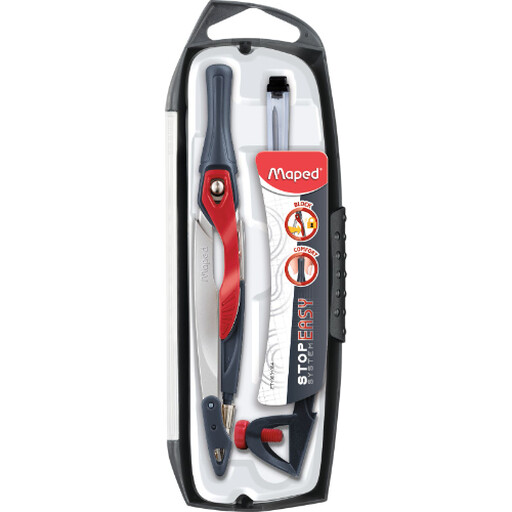
Why this model? Perfect for starting middle school. Its locking system is incredibly intuitive, and its retractable safety cap is a reassuring detail for parents: no more points piercing the pencil case!
Its patented "Stop Easy" system locks the legs for a width that won't budge a millimetre. The integrated safety cap protects both the point and the lead. Thanks to the included universal ring, it adapts to any pencil.
Its super-simple locking lever. Enhanced safety with the retractable cap. Its sturdy protective case to keep everything together.
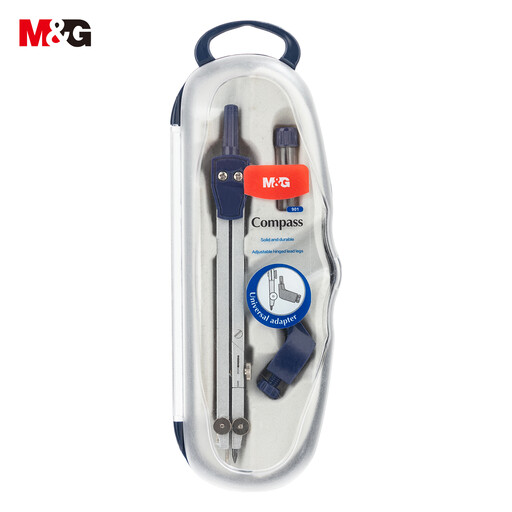
Why this model? Its all-metal construction provides the weight and stability essential for geometry or technical drawing work that demands high precision.
Its sturdy metal body prevents any flexing or instability in the legs. The standard lead adapter frees you from the constraint of proprietary refills. Its storage case protects the entire set.
Rock-solid stability and durability thanks to the metal build. A smooth hinge for precise, millimeter-perfect adjustments. Comes with its own compact protective case.
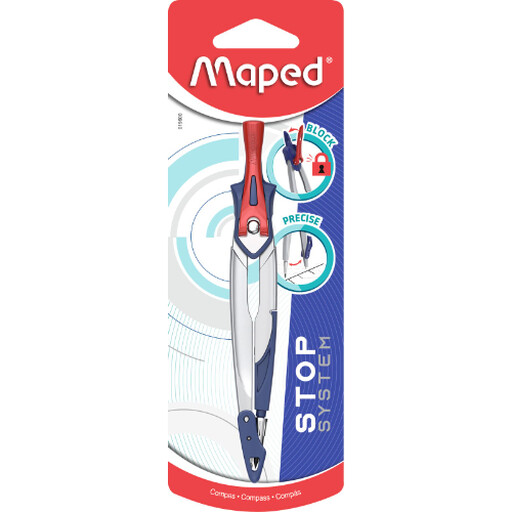
Why this model? It combines the robustness of an aluminium body with the efficiency of a lever-based locking system. A versatile tool built to last, perfect for the demands of high school and higher education.
The aluminium body and "Stop System" ensure flawless rigidity and locking. The cap protects the point, and the included universal ring guarantees total compatibility.
The combination of metal durability and locking innovation. Its excellent versatility (lead and universal ring). Its optimal safety and protection.
Explore our complete, up-to-date selection of compasses that meet our criteria for reliability and safety standards.
How do I stop the compass legs from spreading while drawing a circle? The most reliable solution is to choose a compass with a mechanical locking system. Look for models with a small lever or wheel that freezes the leg width. This guarantees a fixed radius and perfect circles every time.
What's the difference between a lead compass and a universal ring compass? A lead compass uses a graphite lead (often 2?mm) for a fine, consistent line. A universal ring compass is equipped with a clamp that lets you use any pencil, pen, or marker. Its main advantage is versatility: you'll never be stuck without a refill! The best kits often include both systems.
Is a metal compass always a better choice? Not necessarily. A metal compass offers greater stability and durability, making it the ideal choice for precision drawing or heavy use. However, for a young middle school student, a good quality plastic compass can be a smarter choice: it will be lighter, easier to handle, and often equipped with built-in safety features (like a point cover), which is safer and more practical for middle school supplies.