People who add toppings to their rusks
For breakfast and everyday accompaniments, the recipe, allergens, pack weight and number of slices are more useful guides than an assumed thickness.


For everyday rusks to spread, start by choosing a recipe that suits your priorities: wholemeal or multigrain, a brioche flavour, or particular attention to salt. Then compare the ingredients, allergens and nutritional values per 100 g. The pack weight and number of rusks alone can’t confirm that they are ‘medium sliced’.
For breakfast and everyday accompaniments, the recipe, allergens, pack weight and number of slices are more useful guides than an assumed thickness.
A wholemeal recipe and a multigrain recipe don’t meet exactly the same criteria. Check which flours and seeds are used, then compare fibre and salt per 100 g.
Check the ‘no added salt’ claim against the ‘salt’ value in the nutrition table. Also check the ingredients and allergens for the specific product.
To compare recipes, start with how you’ll use them, then compare the nutritional values on the same per-100 g basis, as shown in the nutrition declaration described by the DGCCRF.
| Criterion | What to check | Who is it for? |
|---|---|---|
| Versatility | Recipe and allergens; number of rusks and net weight. The latter two don’t tell you how thick the slices are. | If I want to top my rusks with different spreads, I’ll first look for a recipe that suits the way I usually eat them. Around 37% of consumers would make versatility their priority. |
| Wholemeal flour and grains | Proportion of wholemeal flour, where stated; fibre per 100 g; grains and seeds included. | If I want to choose based on the flours or vary the grains, the ingredients matter more than a brioche flavour. Around 27% of consumers would prioritise their choice of grains. |
| Salt | ‘No added salt’ claim, salt per 100 g and ingredients list. | If my main aim is to limit salt, I can’t rely on the recipe name alone. This would be a priority for around 27% of consumers. |
| Brioche flavour | Ingredients and the sugar, fat and salt values per 100 g. | For a breakfast where brioche flavour matters most, I’m happy to compare this recipe separately from wholemeal versions. Around 9% of consumers would prioritise this flavour. |
This claim doesn’t mean the product is free from wheat or gluten. Nor does it tell you, by itself, how much sugar the recipe contains.
Check the ingredients list, highlighted allergens and nutrition table on the exact pack. The DGCCRF reminds consumers that allergenic ingredients must be highlighted on food labels.
Auchan’s product pages list 1,4 g of salt per 100 g for the Heudebert wholemeal wheat rusks reviewed and 1,6 g for the 6-grain version. The Heudebert Pleine Vie no-added-salt version lists less than 0,01 g.
If salt matters more to you than the grain content, compare the salt per 100 g.
The net weight and number of rusks describe what’s in the pack, not the dimensions of each slice.
If you need medium-thickness slices for your toppings, check their dimensions on the pack or ask before you buy.
Documented products include wholemeal wheat, 6-grain, no-added-salt and brioche-flavoured rusks.
Carrefour offers, among other options, plain, multigrain and no-added-salt recipes.
E.Leclerc’s catalogue includes 6-grain rusks under this brand.
The E.Leclerc product reviewed combines an organic wholemeal wheat recipe with ‘no salt’ and ‘no added sugars’ claims.
The retailer’s documented recipes include wholemeal wheat rusks with no added sugars.
These two products are 300 g packs of Heudebert rusks for breakfast or toppings. Their descriptions don’t confirm a ‘medium sliced’ thickness; for the second product, also check the salt information on the pack.
 Image unavailable
A plain option to consider for breakfast toppings. The pack states 300 g; the listed ingredients include wheat, gluten and soya lecithin. If slice size is important to your choice, check the dimensions before ordering.
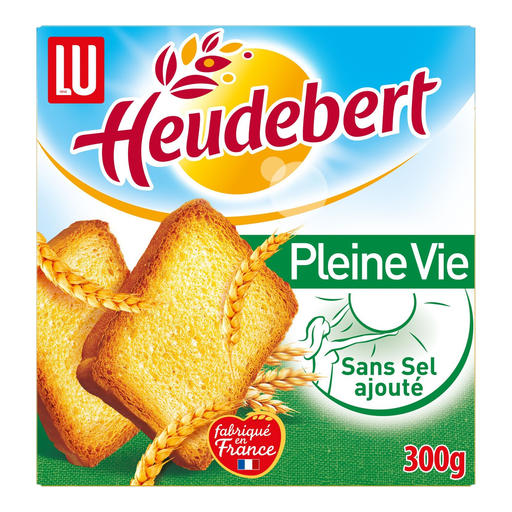 Image unavailable
Another option for breakfast and toppings, but check the exact variety before choosing. The pack states 300 g. The available information is contradictory about whether salt is added, so don’t choose it on that basis without checking the ingredients and nutrition table on the pack. The ingredients include gluten and there may be traces of sesame; slice dimensions should also be checked.
No. It doesn’t replace checking the ingredients or comparing the nutritional values that matter to your choice. For salt, sugars, fat or fibre, use the per-100 g values in the nutrition declaration, as set out in the guidance described by the DGCCRF.
Start with the ingredients for the product you’ve chosen: the rusks reviewed list wheat and gluten, while other ingredients or possible traces vary by recipe and may include milk, sesame, egg or soya. Check the highlighted allergens on the pack; highlighting them is part of the labelling rules outlined by the DGCCRF.
No. The Heudebert and Carrefour Classic' no-added-salt products reviewed contain wheat. Check the ingredients list, sugar claims and salt value separately for the variety you’re buying.