
Livraison le jour même ou le lendemain

Qualité garantie

Débloquez vos offres de bienvenue: Livraison GRATUITE | Jusqu'à -80 % | 30 jours d'essai gratuits à JoyPlus
Téléchargez l'application
Does your desk or TV area look like a tangled mess of cables? Between the computer, monitor, lamp, smartphone charger, and gaming console, wall outlets are quickly overwhelmed. Beyond simple clutter, this accumulation of permanently plugged-in devices is a source of energy waste (the infamous standby power consumption!) and exposes your valuable equipment to the whims of the electrical grid.
The solution? A power strip with individual switches. Simple, yet incredibly effective for regaining control. It allows you to cut power to each device independently, secure your setup, and tidy up your space. This guide is here to help you see things more clearly and choose the model that's truly right for you.
Before you jump on the first model you see, let's review the few technical points that make a real difference in daily use.
This is the non-negotiable criterion. The first thing to check for is the CE marking, which certifies that the product complies with European standards. To protect your most valuable devices, a surge protector power strip is a smart investment. It acts as a shield by absorbing power surges (caused by a storm or grid instability) that could fry the circuits of your computer, TV, or console. Finally, for families, the presence of child safety features (shutters on the outlet openings) is simply essential.
Here, it all depends on your setup. A power strip with a long 5m cable will give you comfortable room to maneuver to reach a distant wall outlet, a real plus in a large living room or workshop. For a clean and stable installation, a wall-mountable model (wall-mounted power strip) with mounting holes is the best solution. Don't overlook the orientation of the outlets: those angled at 45° or 90° are a real blessing for plugging in large power adapters without blocking adjacent outlets.
Modern models often go beyond simple power distribution. A power strip with built-in USB ports has become an almost essential standard for charging smartphones and tablets without sacrificing a 230V outlet. As for the individual switches, often illuminated to show what's on at a glance, they are the heart of the system. It's thanks to them that you can hunt down every last bit of standby consumption and make a simple gesture for both your wallet and the planet.
Our editorial team has sifted through the available models to select only those that excel in safety, practicality, and smart features.
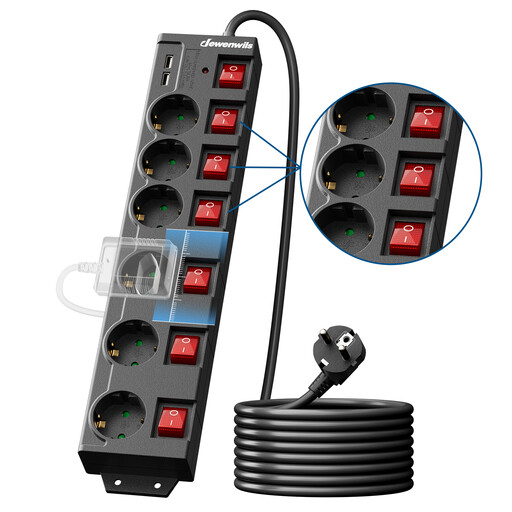
Key Feature: This is the Swiss Army knife of power strips, a complete solution that checks all the boxes for both home and office. Its massive 5-metre cable is its main asset, perfect for large rooms or complex setups.
Pros:
Who is it for? For anyone who needs to power devices far from a wall outlet: a complete TV corner, a large desk, or a workbench in a garage.
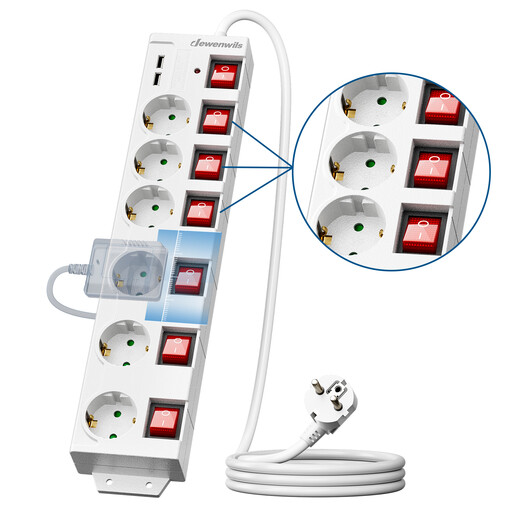
Key Feature: Compact and well-designed, it's ideal for organizing a workspace without being cluttered by unnecessary cable lengths. Its white, understated design blends into any decor.
Pros:
Who is it for? The perfect choice for a desk, a kitchen counter, or a bedroom where the outlet is nearby and you want a clean, neat result.
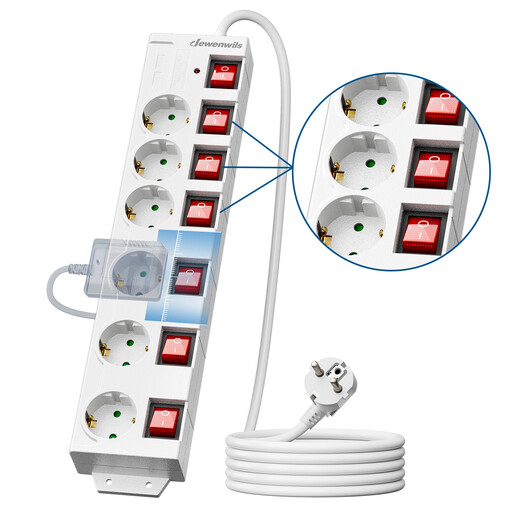
Key Feature: It gets straight to the point by combining maximum reach with flawless security. This is the non-USB version of the first model, a pragmatic choice for those who simply don't need it.
Pros:
Who is it for? Ideal for hi-fi and home cinema setups, aquariums, or any electrical equipment that doesn't require USB charging but demands a long cable and serious protection.
Our selection covers the most common scenarios, but every setup is unique. Do you need more (or fewer) outlets? A different cable length? Advanced features like a remote control? There's bound to be a solution for you.
? Explore our full range of Power Adapter Extension Cords to find the perfect solution.
For two main reasons: energy savings and convenience. With a single flick, you cut power to devices that consume power in standby mode (TV, internet box, console...) without having to unplug everything. It's practical, and it also extends their lifespan by protecting them from micro-outages and grid fluctuations.
A standard power strip simply distributes power. A surge protector power strip goes further: it integrates electronic components capable of detecting and absorbing a sudden voltage spike (due to lightning, for example). It sacrifices itself to save the circuits of your most expensive devices. It's a life insurance policy for your equipment.
This is a classic bad idea and a practice to be avoided at all costs. "Daisy-chaining" power strips creates a major risk of overloading the first strip and the wall outlet. The result? Overheating that can lead to a fire. The golden rule: one power strip per wall outlet, and with a cable length sufficient for your needs.