
Livraison le jour même ou le lendemain

Qualité garantie

Débloquez vos offres de bienvenue: Livraison GRATUITE | Jusqu'à -80 % | 30 jours d'essai gratuits à JoyPlus
Téléchargez l'application
By Joybuy, Your Product Recommendation Expert
Does your office or living room look like a tangled mess of wires? Are you constantly juggling plugs for your computer, monitor, phone, and lamp? Beyond the visual clutter, your energy consumption is also at stake. That's right—devices on standby continue to draw power, quietly inflating your bill.
The power strip with individual switches is the simplest, most effective solution for taking back control. It not only helps you organise your connections, but more importantly, it lets you cut the power to each device with a single flick of a switch. Say goodbye to constant unplugging! This guide gets straight to the point, helping you find the perfect model for your needs by focusing on safety and practicality.
Before we dive into our top picks, let's review the key points to consider when making your choice.
A power strip isn't just an accessory; it's a guardian for your expensive electronic equipment. Two features are fundamental:
Think about how you'll use it every day. The number of outlets is a good starting point, but other details make all the difference:
This is the key advantage of a power strip with switches. Each switch controls a single outlet. This allows you to completely cut power to your TV, internet router, or console at night, while leaving your smartphone to charge. This individual control is the ultimate weapon against the "phantom load" of devices on standby, leading to real long-term savings.
We have selected three models that cater to distinct use cases, all chosen for their intelligent design and high level of safety.
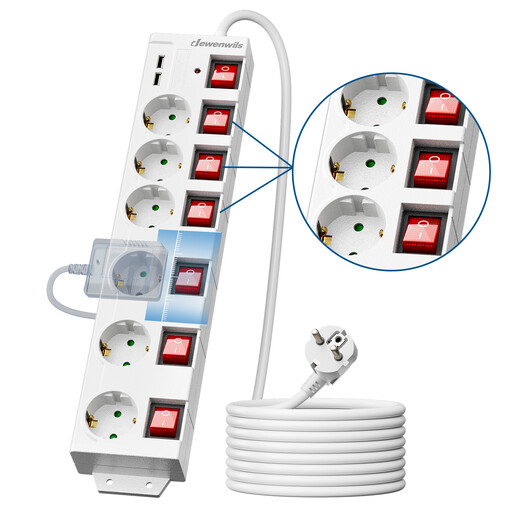
Why we love it: This is the quintessential all-rounder, equally at home in the office or the living room. It combines six independent outlets with two USB-A ports, offering a complete solution for powering and charging most everyday devices.
Advantages:
Who is it for? For those looking for an all-in-one solution for their desk or TV area, capable of managing both AC-powered devices and charging USB peripherals.
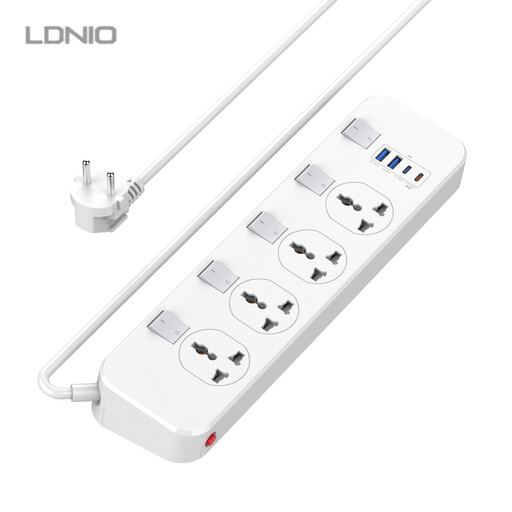
Why we love it: This power strip is future-proofed, thanks to its 20W USB-C Power Delivery (PD) port. It provides fast charging for compatible devices, making it the modern choice.
Advantages:
Who is it for? For tech enthusiasts with modern devices (smartphones, tablets, etc.) who want to take advantage of fast USB-C charging without the clutter of another adapter.
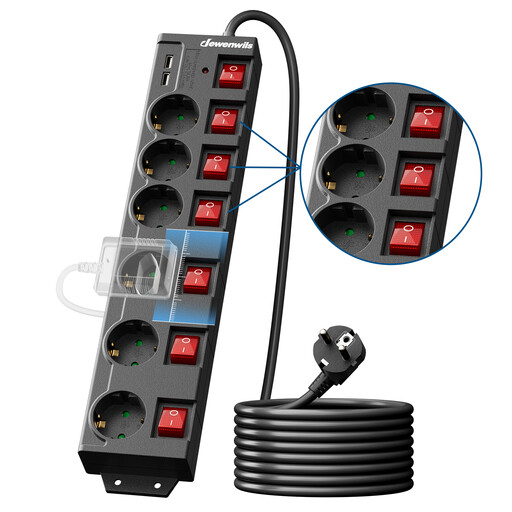
Why we love it: This model gets straight to the point with ruthless efficiency. Devoid of USB ports, it focuses on the essentials: providing six fully controllable outlets in a robust and secure format. Its black colour allows it to blend discreetly into dark or technical environments.
Advantages:
Who is it for? For those who don't need USB ports and are primarily looking for a maximum number of switchable AC outlets for a workshop, home studio, or an overloaded media centre.
Our selection highlights specific use cases. If you're looking for a different configuration (more compact, with more USB ports, a different design...), chances are you'll find the perfect fit in our full catalogue.
? To explore other models and find the one that will perfectly fit your setup, explore our full range of power strips.
The benefit is twofold. On one hand, convenience: you can turn off a device without having to unplug the cable, which is ideal for hard-to-reach outlets. On the other, energy savings: by completely cutting power to standby devices (TV box, console, chargers...), you eliminate their hidden consumption and lower your electricity bill.
Absolutely, especially when you're plugging in valuable electronics. A computer, a 4K TV, or a hi-fi system are sensitive to fluctuations in the electrical grid. A single power surge, even a brief one, can irreversibly fry their internal components. Surge protection acts as a shield that absorbs these current spikes to protect your equipment. It's a small insurance policy for a big investment.
In common parlance, these terms are often used interchangeably. They all refer to a unit with multiple outlets powered by a single cable. The term "power block" might suggest a more compact format, but there is no official technical distinction. What matters isn't the name, but the features: number of outlets, switches, protection, etc.