
Livraison le jour même ou le lendemain

Qualité garantie

Débloquez vos offres de bienvenue: Livraison GRATUITE | Jusqu'à -80 % | 30 jours d'essai gratuits à JoyPlus
Téléchargez l'application
Our homes and offices are overflowing with electronic devices, but wall outlets are not. For a home office setup, a gaming corner, or simply to charge the whole family's smartphones, a reliable and secure power solution is no longer a luxury, but a necessity. The problem? The market is saturated, and it's easy to get lost.
This guide is here to help you see clearly. We'll break down the essential criteria for choosing your power strip and present our top picks, from the simplest to the most sophisticated.
Before you buy, assess your needs. A good power strip is much more than a simple extension cord with multiple outlets; it's the guardian of your devices and the key to your daily comfort.
This is the non-negotiable point. You must check for the CE marking, which guarantees the product's compliance with European standards. For your valuable devices (computer, TV, gaming console), a surge protector power strip isn't an option—it's life insurance. It will shield them from power surges, whether from lightning or simple fluctuations in the power grid. And if you have young children, safety shutters (child protection) are essential for peace of mind.
A single master switch allows you to turn everything off with one press and say goodbye to phantom power consumption from standby devices. Some models take the concept further with individual switches for each outlet, giving you total control. Also, consider a detail that annoys everyone: outlet spacing. Well-spaced or 45°-angled outlets prevent the headache of bulky chargers blocking each other.
The design of your power strip should adapt to its environment.
To guide you, here are three models that caught our attention, each meeting a specific need.
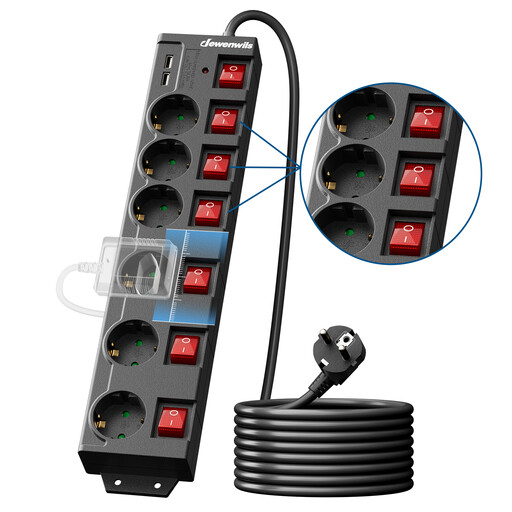
Why this model stands out: Because it offers total control. This DEWENWILS power strip doesn't just have a master switch; it provides one for each of its six outlets. It's ideal for managing your power consumption with precision. Add to that a very long 5-meter cable that gives you maximum placement flexibility, even in large rooms.
Key features:
Who is it for? For tech enthusiasts and home office pros who juggle numerous devices (PC, monitors, consoles, home cinema...) and want to cut power to standby devices without unplugging everything.
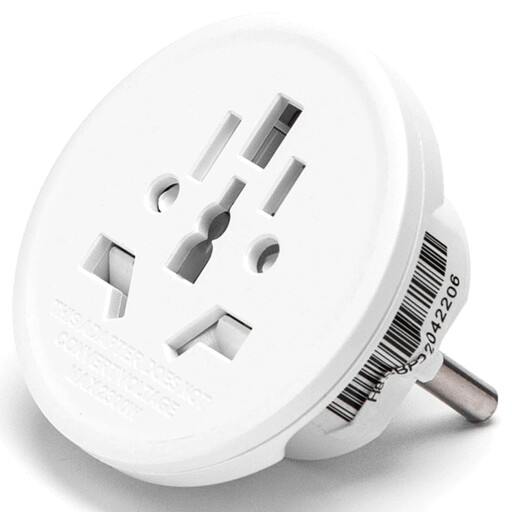
Why this model stands out: Zero cables, zero clutter. That's the promise of this Aigostar adapter. It plugs directly into a wall outlet to transform it into a power hub. Its simple, discreet cube format is perfect for adding connections in a kitchen without running an extension cord, or for becoming your best travel companion.
Key features:
Who is it for? For digital nomads and anyone looking for a discreet and effective secondary solution. It's the small accessory to slip into your suitcase or leave behind the kitchen counter.

Why this model stands out: Here, we're taking things to the next level. The Goneo track isn't a power strip you just set down; it's a power solution you integrate. It mounts to the wall and allows you to add, move, or remove outlet blocks at will along its 75?cm length. It's the ultimate in flexibility, with a brushed aluminum finish that exudes quality.
Key features:
Who is it for? For those renovating or wanting a flawless, custom-built electrical installation. It's the dream solution for a modern kitchen countertop, a TV wall with no trailing cables, or an architect's desk.
Our selection covers the most common needs, but the world of power strips is vast. Blocks with USB-C ports, smart models, corner formats... there's no shortage of options.
? Discover our full range of power strips to find the perfect model for you.
A standard power strip simply multiplies the number of connection points. A surge protector power strip goes further: it integrates an electronic shield that protects your devices from voltage spikes. This protection can save your computer or TV during a thunderstorm or a grid fluctuation.
Absolutely not! Plugging power strips into each other in a series (a practice known as "daisy-chaining") is the surest way to cause an overload and overheating, posing a very real fire hazard. This practice should be avoided at all costs. A power strip should always, and only, be plugged into a wall outlet.
Good models have a circuit breaker, often a small red or black button that "trips" when the current demand is too high. If this happens, it means the total power of your devices exceeds the power strip's limit (typically 3,680?W in Europe). Excessive heat from the block is also a very bad sign.