
Livraison le jour même ou le lendemain

Qualité garantie

Débloquez vos offres de bienvenue: Livraison GRATUITE | Jusqu'à -80 % | 30 jours d'essai gratuits à JoyPlus
Téléchargez l'application
The flashing red battery icon on your screen... It's a familiar anxiety, especially when there's no outlet in sight. Whether you're on a business trip, travelling, or just out and about, the power bank has become a digital survival tool. But with an overwhelming number of options, it's hard to know where to start.
As the Head of Product Recommendations at Joybuy, my mission is to help you cut through the noise. This guide gets straight to the point: breaking down the essential criteria and presenting a selection of portable chargers that will truly meet your needs in 2026.
Before diving into our selection, it's essential to understand the key technical criteria that make all the difference.
Capacity, measured in milliampere-hours (mAh), is the most crucial factor: it determines how many charges your power bank can provide.
The output power, measured in watts (W), determines how fast your devices will charge. To benefit from a fast-charging power bank, look for models compatible with the Power Delivery (PD) standard, ideally through a USB-C power bank port. This technology delivers full-speed power not only to smartphones but also to more power-hungry devices like a laptop power bank.
For iPhone owners, a MagSafe power bank for iPhone offers unmatched convenience with its magnetic attachment. The new Qi2 standard promises to extend this fast, magnetic wireless charging to a much wider range of devices.
Finally, if you're flying, be aware of the regulations. Most airlines restrict batteries in checked luggage and only allow those under 100 Wh (watt-hours)—approximately 27,000 mAh—in your carry-on. Be sure to check your airline's rules before choosing your travel power bank.
Let's get down to business: here are the models that caught our eye, each excelling in a specific area.
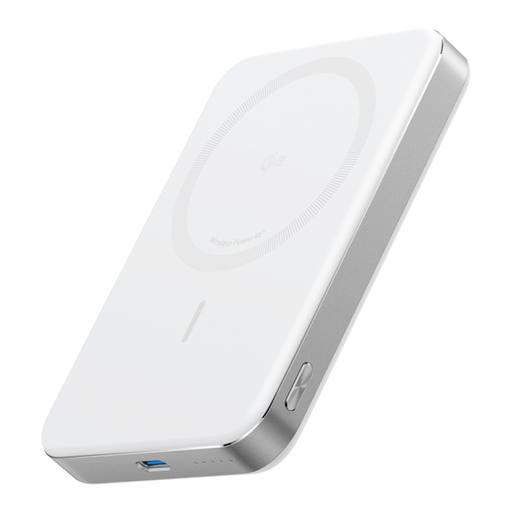
Why it stands out: Its key feature is its remarkable slimness (1.47 cm). It incorporates Qi2 certification, guaranteeing magnetic wireless charging up to 15W—a speed equivalent to official MagSafe chargers.
Pros:
Best for: Ideal for owners of iPhones (series 12 to 16) and Qi2-compatible devices who prioritise portability and wireless convenience for daily use.
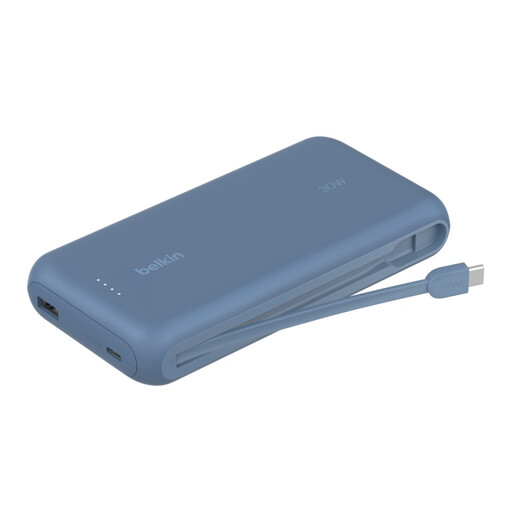
Why it stands out: This model is all about convenience, featuring a built-in USB-C cable that delivers up to 30W (with PPS technology for optimised charging). Its large 20,000 mAh capacity makes it the perfect travel companion.
Pros:
Best for: Perfect for travellers and those juggling multiple devices (smartphone, tablet, earbuds). The built-in cable and high capacity simplify life on the go.

Why it stands out: A true powerhouse built for raw performance. With a total output of up to 140W via its USB-C PD 3.1 ports, it rapidly charges even the most demanding laptops. Its 27,000 mAh capacity pushes the limit for what's allowed in an airplane cabin.
Pros:
Best for: The choice for digital nomads, creatives, and anyone who needs to power a high-performance laptop (like a MacBook Pro) away from an outlet, without compromising on speed.
Have unique needs? If the models featured here don't check all your boxes, other solutions are available.
? Explore our full range of travel power banks to discover more models.
1. What power bank capacity (mAh) should I choose? For daily use focused on your smartphone, 10,000 mAh is the ideal balance of weight and power. For travel, using multiple devices, or charging a tablet, aim for 20,000 mAh or more for peace of mind.
2. Can you take a power bank on an airplane? Yes, but only in your carry-on luggage. Most airlines set a limit of 100 Wh (watt-hours) per battery, which is about 27,000 mAh. We strongly advise you to check your airline's policy before your flight.
3. What is Power Delivery (PD) fast charging? Power Delivery (PD) is a universal charging standard over USB-C that intelligently negotiates the required power between the power bank and the device. The result is a much faster and safer charge than with a standard USB port. It's the technology to look for when you need to quickly charge modern smartphones and laptops.