
Livraison le jour même ou le lendemain

Qualité garantie

Débloquez vos offres de bienvenue: Livraison GRATUITE | Jusqu'à -80 % | 30 jours d'essai gratuits à JoyPlus
Téléchargez l'application
By the Joybuy Editorial Team, July 4, 2026
Who hasn't felt that sinking feeling as their smartphone's battery icon turns red at the worst possible moment? Whether you're commuting, travelling, or simply far from an outlet, a dead battery can quickly turn into a nightmare.
Navigating the jungle of portable chargers can be overwhelming. Our mission: to help you cut through the noise and choose the right model for your needs, without all the marketing jargon. This guide will walk you through the essential criteria and present our selection of the best options for 2026.
Before diving into specific models, it's crucial to understand the three criteria that define a great power bank: capacity, power, and connectivity.
Capacity, measured in milliampere-hours (mAh), determines how many charges your power bank can provide.
The output power, measured in Watts (W), dictates how fast your devices will charge. To take advantage of a fast-charging power bank, look for models compatible with Power Delivery (PD) technology. This standard ensures fast and safe charging for a wide range of devices, including a power bank for iPhone or the latest Android models. A power output of 30W is an excellent starting point for smartphones, while a power bank for a laptop will require 60W or more.
Today, USB-C has established itself as the standard. This versatile port is used for both charging your devices and recharging the power bank itself, all in a fast, bidirectional manner. Some models take convenience even further by integrating a USB-C cable directly. No need to carry an extra one!
With these criteria in mind, we've selected three models that cater to distinct user profiles, from the urban nomad to the hyper-connected professional.
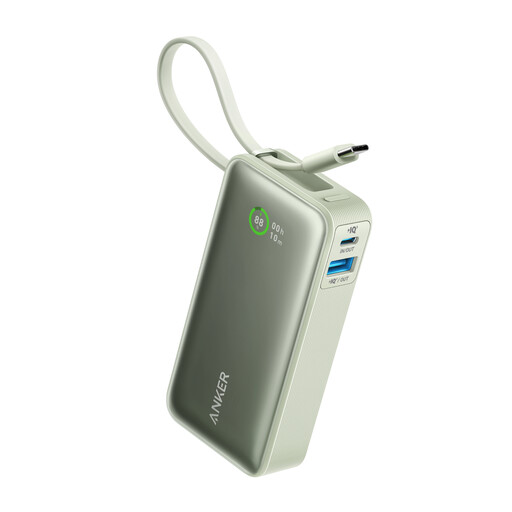
This Anker portable charger is an all-in-one solution that focuses on simplicity and everyday efficiency.
Its star feature: the built-in USB-C cable, which is used for both charging your devices and recharging the power bank. No more forgotten or tangled cables. Its 30W bidirectional charging ensures lightning-fast power-ups in both directions.
For the everyday user seeking a reliable, compact, and ready-to-use solution for their smartphone or earbuds, without the hassle of extra cables.
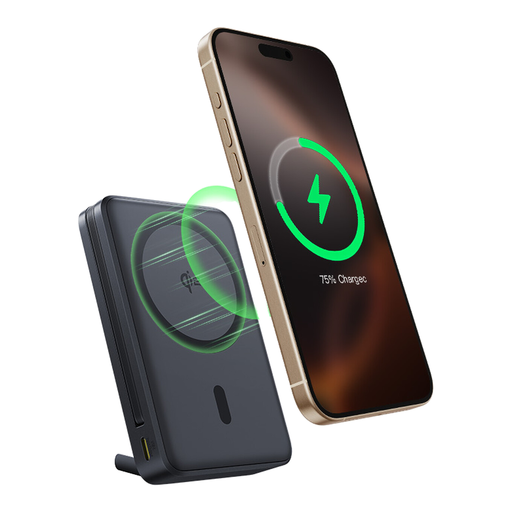
This model from Baseus combines fast wired charging, next-gen wireless charging, and a clever built-in stand.
The Qi2 certification provides magnetic wireless charging up to 15W, rivalling the performance of Apple's MagSafe. In addition to its built-in USB-C cable that delivers up to 45W, it features a fold-out kickstand that holds your phone vertically or horizontally while charging. Perfect for watching videos.
For owners of smartphones compatible with magnetic charging (like recent iPhones) who value the convenience of wireless power and the versatility of an integrated stand for entertainment or video calls.
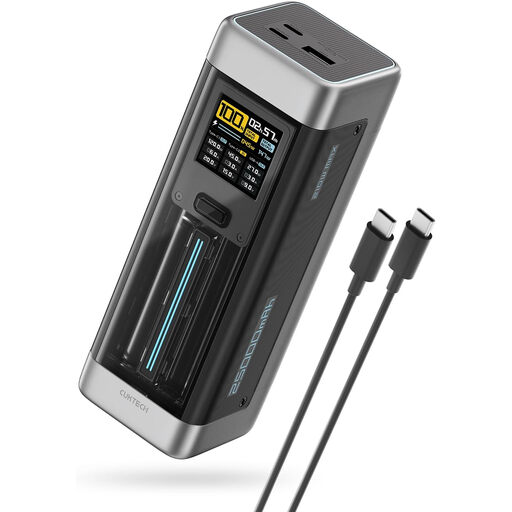
Designed for the most demanding users, this CUKTECH power bank is a powerhouse capable of fueling the most power-hungry devices.
With a maximum output of 140W via its USB-C port, it is fully compatible with the PD 3.1 protocol. This allows it to charge powerful laptops like a MacBook Pro at full speed. Its massive 25,000 mAh capacity and TFT screen displaying real-time charging info make it the ultimate tool for mobile professionals.
For professionals on the go, creatives, frequent flyers, and anyone who needs to rapidly charge a laptop, tablet, and smartphone simultaneously, without compromise.
The models featured here cover a range of uses, but your needs might be even more specific. If you're looking for a different capacity, a particular design, or other features, plenty of alternatives are available.
? Explore our full selection of USB-C power banks to find the perfect match for your gear.
For daily use focused on a smartphone, 10,000 mAh is an excellent balance of autonomy and portability. To charge multiple devices, a tablet, or a laptop, look for models with 20,000 mAh or more.
Yes, but with restrictions. Most airlines limit lithium batteries to 100 Wh (watt-hours) in carry-on luggage. Power banks are prohibited in checked baggage. To calculate watt-hours, the formula is: (mAh / 1000) x V = Wh. For example, the 25,000 mAh CUKTECH power bank (or 25 Ah) with a nominal voltage of 3.7V is equivalent to 92.5 Wh, which complies with regulations. Always check your airline's specific rules before you fly.
Most modern power banks using USB-C ports and the Power Delivery (PD) standard are compatible with nearly all recent smartphones (iPhone, Samsung, Google, etc.). For optimal fast charging, make sure the power bank's output (in Watts) is equal to or greater than the maximum power your phone can accept. This information can usually be found in your device's technical specifications.