
Livraison le jour même ou le lendemain

Qualité garantie

Débloquez vos offres de bienvenue: Livraison GRATUITE | Jusqu'à -80 % | 30 jours d'essai gratuits à JoyPlus
Téléchargez l'application
We all know the anxiety of a low battery. Whether you're on a business trip, in the middle of a class, or capturing a travel memory, seeing that battery icon turn red on your laptop or smartphone is a universal source of stress. Faced with a jungle of models, capacities, and formats, it's hard to find your way.
As the Head of Product Selection at Joybuy, my mission is to guide you. This guide breaks down the essential criteria for a good portable charger and presents our selection of the best models, whether you're a digital nomad or a busy city dweller.
Before you buy, a few technical criteria deserve your attention. These are what will make all the difference in daily use.
Expressed in milliampere-hours (mAh), capacity determines how many charges your power bank can provide.
Expressed in watts (W), power determines how fast your devices will charge. For the most power-hungry devices, a high power output is not an option—it's a necessity. For an effective fast-charging power bank, check the power of the ports, especially the USB-C port. While a 5W model will take forever to charge your smartphone, a power output of 65W (or more) is essential for a laptop power bank. Make sure the power bank's output is compatible with the power required by your device.
Remember to check the number and type of available ports (USB-C, USB-A) if you need to charge multiple devices at once. If you're flying, be aware: the regulations are strict. Power banks are only allowed in carry-on luggage, with a capacity generally capped at 100 Wh (watt-hours). Most power banks under 27,000 mAh comply with this limit, but it's wise to do a quick calculation before you pack.
Here are three options that cater to very different needs, from the most demanding user to the most mobile.
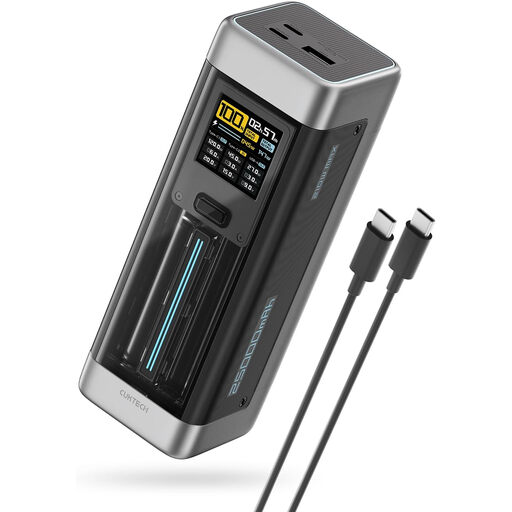
Why it stands out: The CUKTECH NO.20 is a true pocket-sized powerhouse. Its 140W output via the PD3.1 protocol allows it to effortlessly power the most demanding laptops, like the MacBook Pro. Its smart TFT screen is a real bonus, displaying real-time power, voltage, and remaining capacity, putting total control at your fingertips.
Highlights:
Who is it for? Digital nomads, content creators, and tech enthusiasts who juggle power-hungry devices (laptops, drones, cameras) and for whom running out of power is not an option.
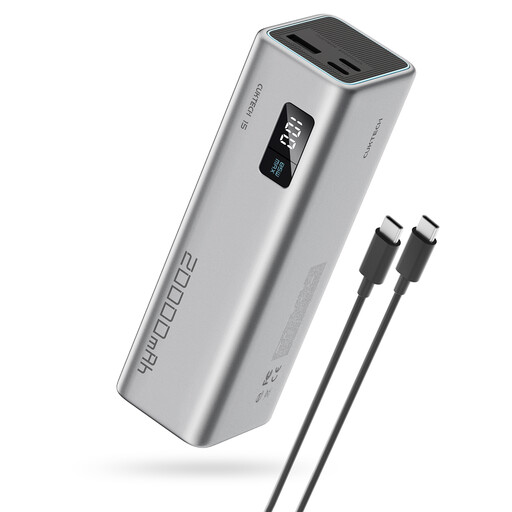
Why it stands out: This model offers the perfect balance of power, capacity, and portability. With 65W of two-way power, it charges a laptop (like a MacBook Air) just as quickly as it recharges itself—all at top speed. Its compact, cylindrical design makes it especially easy to slip into a bag for a 20,000mAh power bank.
Highlights:
Who is it for? Frequent travellers, students, or anyone looking for an all-in-one solution capable of powering both a laptop and a smartphone, without the bulk of a heavier model.
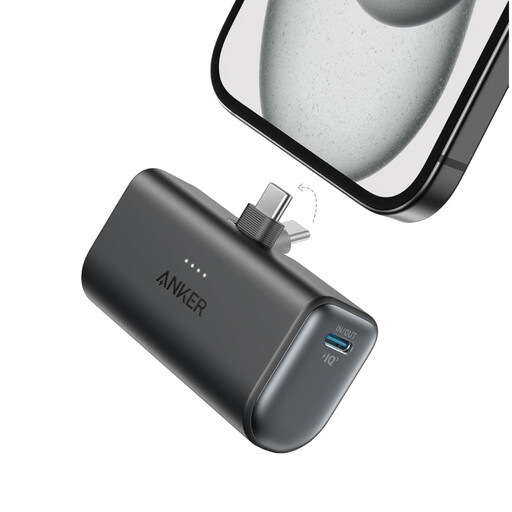
Why it stands out: The key word for this mini power bank? Convenience. Its masterstroke: a built-in, foldable USB-C connector. No more cables getting lost at the bottom of your bag! Ultra-lightweight and compact, it's small enough to forget it's in your pocket or handbag, ready to help out at a moment's notice.
Highlights:
Who is it for? The city dweller, the daily commuter, or anyone who wants a discreet and effective backup solution for their phone, without the weight or bulk of a larger model.
If these models don't check all your boxes, or if you're looking for other accessories like wall chargers or specific cables, feel free to explore the rest of our catalogue.
Take a look at our full range of Black USB Adapters.
It all depends on your usage. For daily use and a top-up charge for your smartphone, a capacity of 5,000 to 10,000 mAh is sufficient. If you plan to charge multiple devices or a laptop, aim for 20,000 mAh or more.
Yes, but under certain conditions. They must be carried in your cabin luggage (never in checked baggage). Most airlines limit the capacity to 100 Wh (watt-hours). To convert mAh to Wh, the formula is: (mAh / 1000) x V = Wh. With an average voltage of 3.7V, a 25,000 mAh power bank is equivalent to about 92.5 Wh, which will pass through security without any issues.
No, not if you choose a reputable brand. These brands integrate multiple safety protections (against overcharging, overheating, and short circuits). As long as you use a product certified to European standards, the risk is virtually zero. Just remember to use high-quality cables for charging that is both safe and efficient.