
Livraison le jour même ou le lendemain

Qualité garantie

Débloquez vos offres de bienvenue: Livraison GRATUITE | Jusqu'à -80 % | 30 jours d'essai gratuits à JoyPlus
Téléchargez l'application
Choosing a PLA filament can quickly become a daunting task given the myriad of options on the market. Between the endless colour palettes, special finishes, and promises of high speed, it's hard to know where to start. Whether you're a passionate maker, a prototyping pro, or a school, finding the perfect spool is the key to successful 3D prints.
This guide is here to help you navigate the choices. As a product expert at Joybuy, I'm breaking down the market for you and offering practical advice to choose the 3D printer filament that will truly meet your needs, without the unnecessary marketing jargon.
Before diving into our selection, here are the essential criteria to keep in mind to make the right choice.
Nearly all consumer FDM 3D printers use a filament with a 1.75?mm diameter. But what really matters is the dimensional tolerance. A tolerance of ±0.02?mm, for example, guarantees that the filament's diameter will never deviate by more than 0.02?mm from its nominal value. A tight tolerance is a guarantee of consistency: it drastically limits the risk of nozzle clogging and ensures constant extrusion, resulting in a visibly superior finish with much more uniform layers.
Standard PLA is perfect for getting started, but the ecosystem is full of variants for more specialized uses:
The 1kg PLA spool is the most common packaging. It's the ideal compromise between a sufficient amount of material for significant projects and easy storage. It is also, quite often, the most cost-effective format per gram.
Let's move on to our selection. We have chosen three standout products, each meeting a specific need in FDM 3D printing.
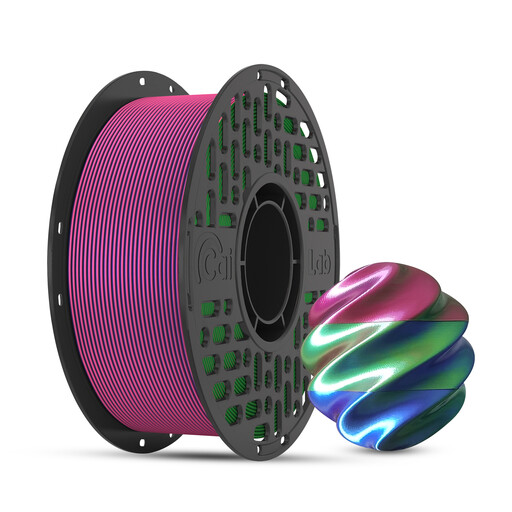
Why it stands out: Its secret is a co-extruded tri-colour effect (red, green, blue). Each print is unique, with reflections that subtly change depending on the object's orientation and the light. Its silk finish provides that glossy, smooth look that enhances details.
Key Strengths:
Who is it for?: Makers, artists, and creatives who want to give a unique touch to their objects (vases, figurines, decor...) without having to paint them.
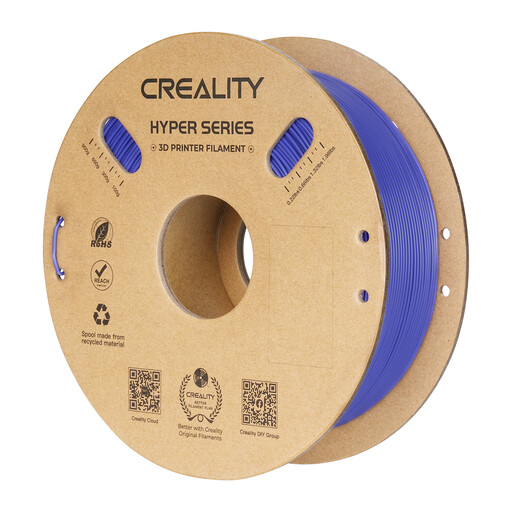
Why it stands out: This high-speed PLA filament was developed for one thing: to go fast, very fast. Creality claims compatibility up to 600?mm/s on suitable machines. Thanks to its high fluidity and optimized cooling, it maintains an excellent level of quality, even with print times cut in half or by a third.
Key Strengths:
Who is it for?: Owners of high-speed 3D printers (like the Creality K1, Bambu Lab, and similar models) who produce functional prototypes and design iterations at a rapid pace.
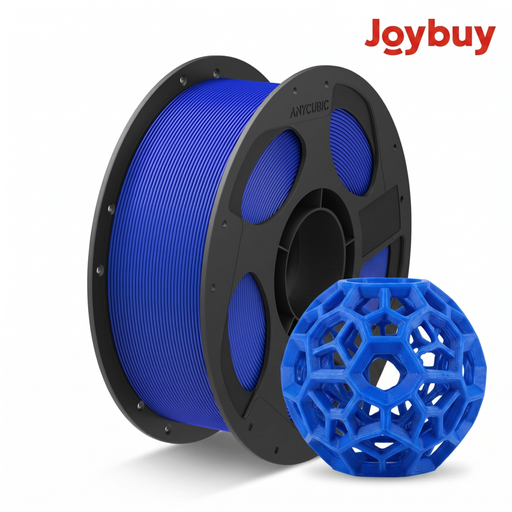
Why it stands out: Born from a collaboration, this blue PLA filament gets straight to the point: offering a reliable and accessible solution for everyday printing. With its ±0.02?mm tolerance and neat winding to prevent tangles, it focuses on the fundamentals: reliability and simplicity.
Key Strengths:
Who is it for?: Ideal for beginners, schools, fab labs, or anyone looking for an effective, no-frills 1kg PLA spool for their routine needs.
Does the blue of these filaments not quite match the shade you had in mind for your project? Don't worry, the colour palette is nearly infinite. From sky blue to midnight blue, in matte or translucent finishes, you'll surely find what you're looking for by exploring our dedicated category.
Discover our full range of blue 3d filament to find the perfect spool.
PLA is a hygroscopic material, meaning it absorbs moisture from the air. Filament that has absorbed moisture can cause stringing, bubbles, crackling sounds from the nozzle, and a degraded surface finish. The best practice is to store your spools in an airtight bag or box, along with a packet of silica gel (desiccant) to absorb any residual moisture.
The short answer is no. Standard PLA filament is not considered food-safe, especially for prolonged contact. Although raw PLA is plant-based, the pigments and additives it contains are generally not certified for food use. Most importantly, the surface of a 3D printed object is inherently porous (due to the successive layers), making it a breeding ground for bacteria that is difficult to clean. For food-related use, it is imperative to use a filament explicitly certified as "food-safe" by the manufacturer and, ideally, to apply a food-grade varnish or resin to seal the object's surface.
PLA+ (sometimes called PLA Pro or Tough PLA) is an improved version of classic PLA. Manufacturers incorporate additives to boost some of its properties, primarily its impact resistance and flexibility. This results in a less brittle material, better able to withstand light stress, making it suitable for simple mechanical parts. Be aware that its printing parameters (nozzle and bed temperature, speed) may vary slightly from standard PLA.