
Livraison le jour même ou le lendemain

Qualité garantie

Débloquez vos offres de bienvenue: Livraison GRATUITE | Jusqu'à -80 % | 30 jours d'essai gratuits à JoyPlus
Téléchargez l'application
Whether you're looking to organise your notes, get started with journaling, or bring an illustration to life, your choice of writing tools is critical. Faced with an overwhelming number of options on the shelf, it's easy to feel lost or make a purchase you immediately regret. As a Product Recommendation Manager at Joybuy, my mission is to help you make sense of it all. Let's review the most common pitfalls and the essential criteria for finding the perfect pens and markers for drawing and writing for your projects.
Marketing promises can be alluring, but the real-world experience is sometimes disappointing. Here are three classic letdowns that can be easily avoided.
To avoid these pitfalls, the solution is to focus on a few objective technical characteristics.
The tip determines the primary use of your pen or marker. It's crucial to choose the right one for your activity.
The ink's composition directly impacts the finish, drying time, and compatibility with your paper.
A good tool should remain comfortable, even during prolonged use. Look at the shape of the pen's barrel (triangular to guide your grip, or classic cylindrical), the presence of a grip, and the mechanism (retractable, capped). A silent click mechanism, for example, is a welcome feature in a quiet environment like an office or library.
Rather than an exhaustive list, here are a few gems that meet specific needs, based on the criteria we've just discussed.
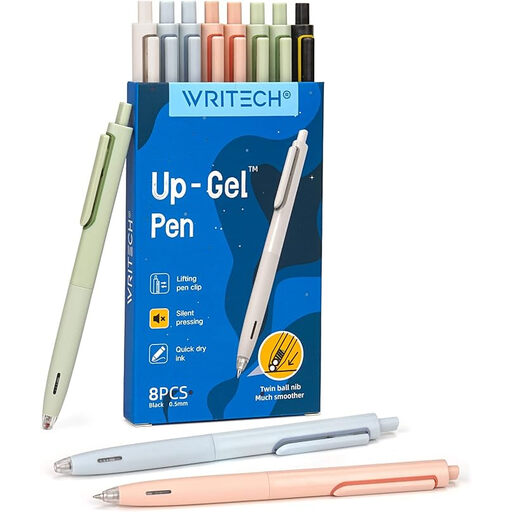
Why we chose it: Perfect for those who demand precision and cleanliness. Its triangular barrel ensures an excellent grip, and its silent click mechanism is a real asset in quiet places.
The quick-drying ink solves the smudging problem, making it a top choice for left-handers. The 0.5mm fine tip is designed not to bleed through standard paper.
The "twin-ball" tip technology ensures a consistent, skip-free ink flow for a clean and bold line every time.
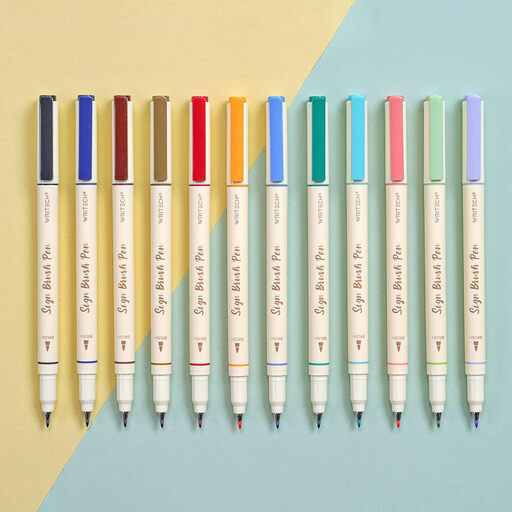
Why we chose it: Very easy to use, this set is a great entry point into the world of calligraphy and lettering. The brush tip is flexible and responsive to pressure.
The felt tip is designed to be durable, which is forgiving of beginners' pressure mistakes and prevents premature fraying. The 12 pastel colours are rich and well-saturated.
The water-based ink is blendable, allowing you to easily create gradient effects with a little water, offering great creative versatility.
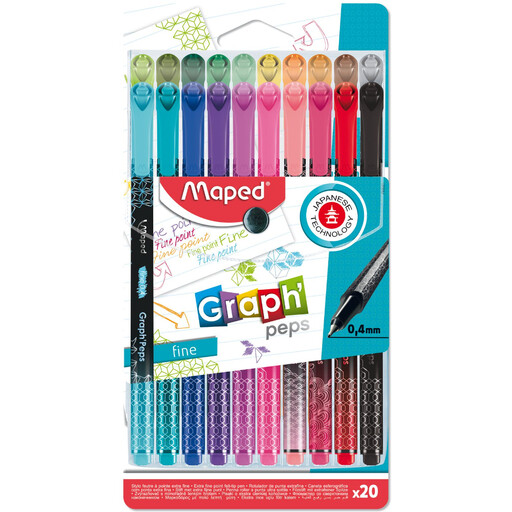
Why we chose it: A comprehensive set for those who love to colour-code their notes, draw, or do precision colouring. The triangular barrel ensures a comfortable grip.
The 0.4 mm fine tip is metal-clad, making it highly resistant to pressure and wear. The water-based ink dries quickly and won't bleed through most papers.
The set of 20 bright, intense colours provides a wide palette to illustrate and customise any creative or organisational project.
We have curated a complete range of products that meet our quality criteria and the expectations of the most demanding creatives.
The golden rule is to always cap your markers tightly after each use. To ensure the ink is distributed evenly, it's also advisable to store your markers horizontally. Some models, like those in the Stabilo Pen 68 range, include technology that allows them to be left uncapped for up to 24 hours without drying out.
A 0.4 mm tip is considered extra-fine. It's perfect for minute details, writing in small spaces (planners, margins), and technical drawings. A 0.7 mm tip is a more versatile medium point. It offers a smoother, more visible line, ideal for quick note-taking and colouring small to medium-sized areas.
Yes, as long as you choose a model with quick-drying ink. This is an increasingly common feature in quality gel pens. It's specifically designed to prevent ink from smearing as your hand moves across the page—a well-known problem for lefties. Pens from the WRITECH brand, for example, often highlight this benefit.