For a quick organic breakfast
If you want to make instant coffee with hot water, without a machine, check the packaging of the pre-packed product for the EU organic logo, the control code and details of the origin of the agricultural ingredients.


For weekday breakfasts, choose an organic instant coffee by first checking the EU organic logo and control details on the packaging, then the ingredients for the specific product. Pure coffee, a coffee and chicory blend, and decaffeinated coffee suit different needs. The pack size and local availability also matter when filling your basket.
If you want to make instant coffee with hot water, without a machine, check the packaging of the pre-packed product for the EU organic logo, the control code and details of the origin of the agricultural ingredients.
Net weight and ingredients help you compare the jars you’re considering. Also check that each product is available at your chosen shop or for delivery to your area.
Pure instant coffee, a coffee and chicory blend, and decaffeinated coffee are not the same thing. Organic certification alone doesn’t mean that a coffee is decaffeinated.
First, make sure the product is the organic instant coffee you’re looking for. Then choose its ingredients and pack size to suit your needs for the week.
| Criteria | What to check | Who is it for? |
|---|---|---|
| Certification and ingredients | For pre-packed products, check the EU organic logo, the control code, the origin of the agricultural ingredients and the ingredients list. | I want to be sure I’m choosing organic instant coffee and find out whether it’s pure coffee or a blend. Around 36% of consumers would make this their priority. |
| Pack size and availability | Compare the net weight of the jars and check that the product is available at your chosen shop or for delivery to your area. | To fill my weekly basket, I need a suitable pack size and a product I can actually order. Availability and pack size would come first for around 29% of consumers. |
| Taste and type of drink | Read the ingredients and, if the product provides one, its intensity rating. This scale isn’t necessarily comparable between brands. | If I’m looking for pure coffee rather than a drink containing coffee and chicory, the recipe matters more than the product name alone. Around 21% of consumers would prioritise this type of drink. |
| Preparation and caffeine | Check the recommended serving and storage instructions. If needed, look specifically for the word “decaffeinated” on the product. | I want something easy to prepare every day, or I specifically want to choose a decaffeinated coffee without confusing it with standard organic coffee. This would be a priority for around 14% of consumers. |
Organic certification and decaffeination are two separate characteristics. Organic instant coffee isn’t necessarily decaffeinated.
If you want both, check that the same product carries both claims.
Auchan’s product listing for the Naturela blend states that it contains 60% soluble chicory and 40% instant coffee. Its ingredients therefore differ from those of pure instant coffee.
Read the ingredients and their proportions before choosing between these two types of drink.
Products listed include pack sizes of 90 g and 100 g. A product shown online may also depend on which shop you’ve selected.
Check the net weight and local availability of the specific product you’re adding to your basket.
A brand’s range of organic whole-bean, ground, capsule or pod coffee doesn’t tell you whether its instant coffee is certified organic.
Check the label on the specific format and product you plan to buy.
NESCAFÉ describes Spécial Filtre BIO as a pure organic Arabica instant coffee, sold in a 90 g jar.
Carrefour offers 100 g jars of organic instant coffee, including an Espresso Bio described as being made from 100% organic instant coffee.
Auchan describes a 100 g jar of organic freeze-dried instant coffee made from 100% Arabica, with an intensity rating of 6/10.
Carrefour’s listing for an Alter Eco instant coffee describes a pure organic Arabica that is also Fairtrade / Max Havelaar certified.
Carte Noire offers an organic range as well as several coffee formats, including whole bean, ground, capsules and pods.
This selection features organic instant coffee in a jar, made with hot water for weekday breakfasts. If certification and the origin of the agricultural ingredients matter to you, check the details on the packaging.
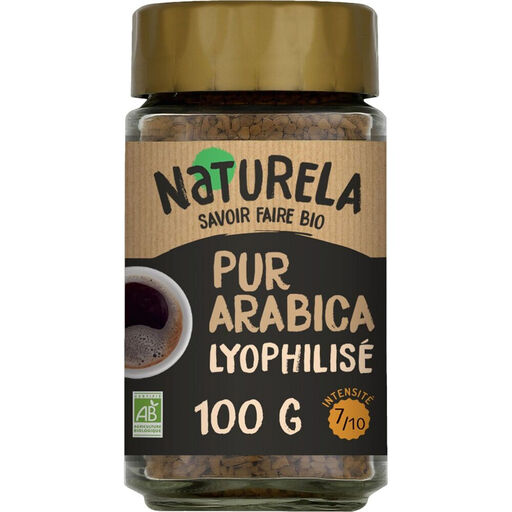 Image unavailable
A jar of organic instant coffee to make with hot water for everyday enjoyment. Joybuy’s product listing describes it as freeze-dried. To check the organic claims that matter to you, look at the logo, control code and origin of the agricultural ingredients on the packaging.
For a pre-packed product sold as organic, look for the EU organic logo and check the control body’s code, as well as details of the origin of the agricultural ingredients. The European Commission states that the logo may only be used on products certified by an authorised control body or authority.
No: “organic” doesn’t mean “decaffeinated”. If you want both, check for each claim on the same product rather than relying on the brand’s range as a whole.
Follow the instructions on the product you’ve bought, as serving sizes and water volumes can vary. NESCAFÉ recommends one teaspoon per 100 ml of hot, not boiling, water for Spécial Filtre BIO, while Joybuy’s NATURELA listing recommends one to two teaspoons with hot, non-boiling water.
Close the container after use and follow its storage instructions. The NATURELA and Auchan Bio listings recommend keeping the packaging tightly closed in a cool, dry place.
Look specifically for the word “decaffeinated” on the product you choose. Neither the organic logo nor the presence of chicory in a blend means that a product is decaffeinated. Anses notes that caffeine’s effects on sleep vary from person to person.