
Livraison le jour même ou le lendemain

Qualité garantie

Débloquez vos offres de bienvenue: Livraison GRATUITE | Jusqu'à -80 % | 30 jours d'essai gratuits à JoyPlus
Téléchargez l'application
Finding the perfect non-stick induction wok can revolutionise your cooking. Whether you're stir-frying, deep-frying, simmering, or steaming, this versatile tool is a true Swiss Army knife in the modern kitchen. But with a jungle of materials, coatings, and marketing claims, it's hard to know where to start. Are you looking for a durable, healthy option that's perfectly compatible with your induction hob?
This guide breaks down the essential criteria for choosing a wok that will truly meet your needs—without technical jargon or empty promises.
Before we get to our top picks, let's review the three key criteria that will guide your choice.
While non-stick performance is paramount, the durability and composition of the coating are just as important. For healthy cooking, the trend is clear: prioritise models guaranteed to be free of PFOA, PFOS, and other controversial compounds.
But classic Teflon is no longer the only option, and new technologies are a game-changer. This is the case with the honeycomb-structured wok, which combines an engraved stainless steel grid to protect the non-stick coating nestled in the cells. The advantage? You can often use metal utensils without fear of scratching the surface, a major plus for longevity. Other models go even further with a "physical" non-stick surface, achieved through a surface treatment of the steel, thus eliminating any added chemical coating.
Obviously, a non-stick wok for induction must have a flat, magnetic base to be recognised by the hob. Most quality models today are all-hob compatible wok pans, ensuring total versatility on gas, electric, or ceramic stovetops. The wok's composition (often a multi-layered alloy of aluminium and stainless steel) is also crucial: it ensures fast and even heat-up, the secret to perfectly controlled cooking.
The size of the wok should, of course, be suited to your household. A 32 cm wok is often the sweet spot for a family of 3 to 6 people. Also, consider ergonomics: a handle that stays cool and a helper handle are essential for easy manoeuvring, especially when it's heavy and full. Finally, don't underestimate the importance of a lid. A wok that comes with its own lid is a real bonus. A tempered glass model allows you to keep an eye on your cooking and is essential for simmering or steaming.
Here is our selection of three models that stand out for their design and features, catering to very different needs.
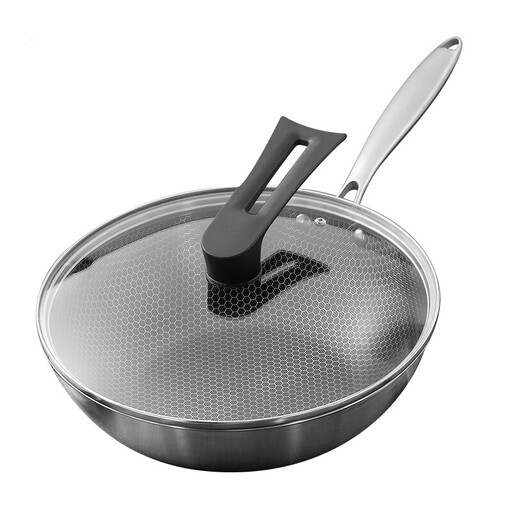
Why it stands out: This wok combines the sturdiness of stainless steel with innovative non-stick technology. Its honeycomb structure protects the coating, which, according to the manufacturer, allows for the use of metal utensils without damaging it. Its multi-layer construction ensures fast and uniform heat distribution.
Key features:
Best for: Those who want a wok built to last, combining the durability of stainless steel with the convenience of a protected non-stick surface that is compatible with metal utensils.
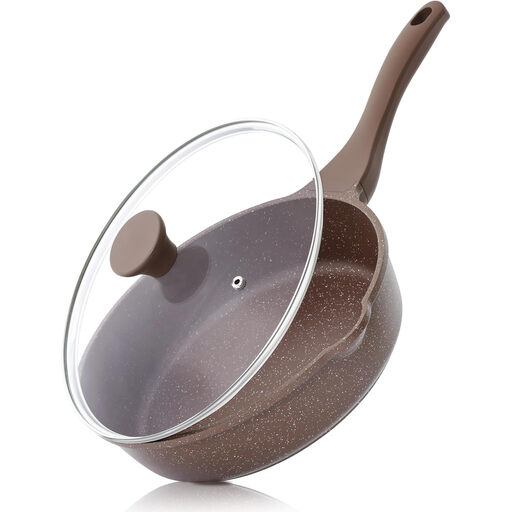
Why it stands out: This model from SENSARTE focuses on healthy cooking with its stone/granite effect non-stick coating. The manufacturer guarantees a coating free of PFOA, PFOS, lead, and cadmium. Its aluminium construction makes it lightweight and easy to handle, while its ergonomic handle stays cool to the touch.
Key features:
Best for: Those primarily looking for an effective and easy-to-clean non-stick surface, with the peace of mind of a healthy composition.
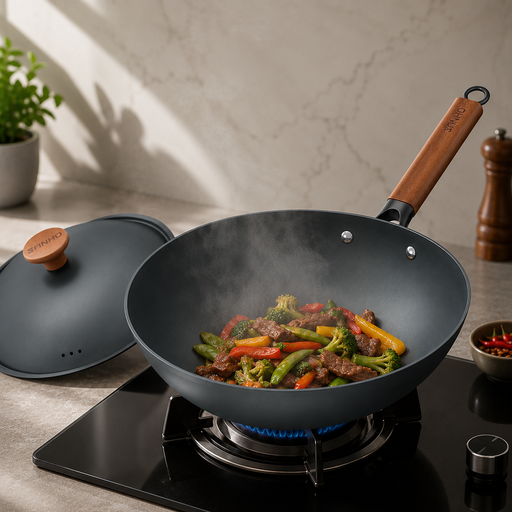
Why it stands out: The Sanho wok is a game-changer with its "physical" non-stick technology: there is no chemical coating; the effect is achieved by the very structure of the steel. The manufacturer guarantees it is 100% free of PFAS, PFOA, and PTFE. Its ultra-robust design allows for the use of metal utensils without any fear.
Key features:
Best for: Health-conscious families who want to eliminate chemical coatings and invest in a utensil made to last for years.
Our selection highlights specific models, but the world of cookware is much broader. To explore other sizes, materials, or types of pans, feel free to browse our full catalogue.
? Explore our full collection of Non-Stick Cookware to find the model that's right for you.
To preserve its coating, hand washing with a soft sponge and a little washing-up liquid is always best. Avoid abrasive scouring pads and never overheat it while empty. Opt for a gradual temperature increase. Finally, although some models are more tolerant, it's still ideal to use wooden, silicone, or nylon utensils to preserve most coatings.
It all depends on your wok's technology. On a traditional non-stick coating, it's a definite no-go: you risk scratching and irreversibly damaging the surface. However, new-generation models like the honeycomb-structured wok or those with a physical non-stick surface are specifically designed to be compatible with metal utensils. Always check the manufacturer's recommendations.
PFOA (perfluorooctanoic acid) is a compound from the PFAS family, long used in the manufacturing of Teflon-type non-stick coatings. Due to health and environmental concerns, its use is now banned in the European Union, and most reputable manufacturers have eliminated it from their production processes for years. Choosing a PFOA-free wok (which is the case for almost all new products today) is therefore a safety guarantee, signifying that the product complies with current standards. It's an essential precautionary principle for many consumers concerned about the composition of their cookware.