
Livraison le jour même ou le lendemain

Qualité garantie

Débloquez vos offres de bienvenue: Livraison GRATUITE | Jusqu'à -80 % | 30 jours d'essai gratuits à JoyPlus
Téléchargez l'application
A pan that sticks, a coating that flakes off after a few months, cooking that's never even... Choosing a new non-stick induction pan can quickly become a headache. The market is saturated with marketing promises that rarely stand up to the test of daily use. To avoid turning a sound investment into a disappointment, let's break down the three most common pitfalls.
This guide is here to help you see things more clearly and choose THE pan that won't stick and will be a long-lasting companion in your kitchen.
To make the right choice, focus on a few technical points that make all the difference.
The coating is the heart of your pan. Its job is to prevent food from sticking, even with minimal oil or fat.
The choice therefore depends on your priorities: the proven non-stick performance of PTFE or a composition perceived as more "natural" with ceramic.
For an induction hob, the pan's base is crucial. It must contain a ferromagnetic material so the hob's magnetic field can generate heat. But that's not all.
A thick, encapsulated base is a hallmark of quality. It ensures fast and even heat distribution across the entire surface, preventing the infamous "hot spots" that burn food in the centre while the edges are barely cooked. A quality base also prevents the pan from warping due to thermal shock, guaranteeing a flat, stable cooking surface over the long term. A good all-hob pan must be flawless on induction.
A good pan should adapt to your kitchen and your cooking style.
Because every cook is unique, here is our selection designed for different profiles and uses.
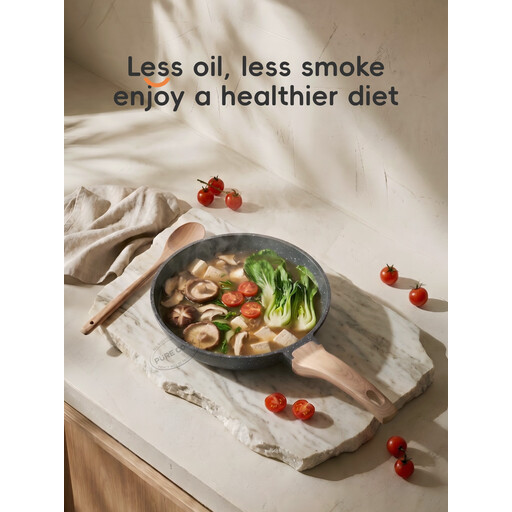
Who is it for? Ideal for a single person or for small meals: fried eggs, pancakes, etc. Its light weight and cool-touch handle make it very easy to manage for frequent and quick use.
Its aluminium alloy body and composite base are designed for rapid, even heating on induction, bypassing the "false compatibility" pitfall.
Ultra-lightweight design for one-handed use; wood-effect handle that stays cool to the touch during cooking.
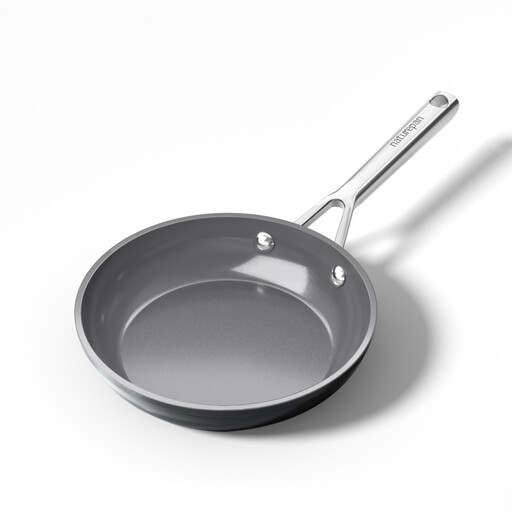
Who is it for? Perfect for health-conscious cooks and families who want to move on from PFAS. The reinforced ceramic coating ensures healthy cooking and increased longevity.
It addresses the confusion around materials by being guaranteed PTFE/PFOA/PFAS-free. Its diamond and titanium-reinforced coating counteracts the weak point of some ceramics: their fragility over time.
Maximum versatility: compatible with all hobs (including induction), oven-safe up to 260°C, and dishwasher-safe.
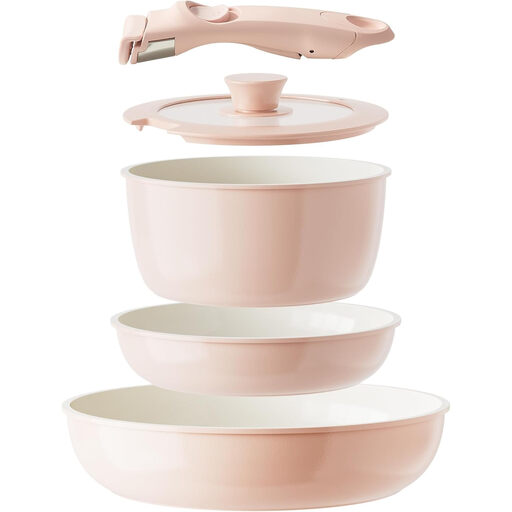
Who is it for? The perfect solution for optimising space in small kitchens. The removable handle system and stackable pans free up precious cupboard space while offering maximum flexibility.
This set bypasses the pitfall of limited versatility. Thanks to the removable handle, you can move the same pan from the hob to the oven, then to the table, and even into the fridge.
XXL space-saving (up to 75% more free space); healthy ceramic coating (PFAS/PTFE/PFOA-free).
We have selected a full range of pans that meet our quality criteria and European safety standards.
To preserve the coating, opt for hand washing with a soft sponge and soapy water. Avoid metal utensils and choose wood, silicone, or nylon instead. Never overheat your pan when empty, and let it cool down before running it under cold water to prevent thermal shock.
As long as they are high-quality and comply with European standards, both types of coatings are considered safe for food contact. PTFE pans sold in Europe are required to be PFOA-free. Ceramic pans are an alternative for those who wish to completely avoid the family of PFAS compounds. The choice is therefore more a matter of personal preference.
There are several possible reasons: a pan base that is too thin, a diameter that doesn't match your cooking zone, or a low-quality ferromagnetic material. For optimal performance, choose a pan with a thick base and ensure its diameter corresponds to your induction cooking zone.