
Livraison le jour même ou le lendemain

Qualité garantie

Débloquez vos offres de bienvenue: Livraison GRATUITE | Jusqu'à -80 % | 30 jours d'essai gratuits à JoyPlus
Téléchargez l'application
3D printing has democratized creation, but let's be honest: achieving an aesthetic and unique part straight off the print bed is still an art form. The matte or slightly dull finishes of standard PLA often require tedious post-processing for a truly stunning result. This is where multicolor silk PLA filament comes in, with its glossy finish and dynamic color transitions that transform a simple object into a true work of art.
This guide is here to help you navigate the options and choose the perfect filament for your artistic 3D printing projects. We'll break down the different types of multicolor filaments and present our top picks for creating prints with striking visual effects.
Before you fill your cart, there are a few criteria to consider to ensure the result lives up to your expectations.
The term "?multicolor?" actually covers several different technologies. It's crucial to distinguish between them to anticipate the final look of your print:
The main appeal of this filament is its lustrous appearance. A good shiny PLA filament should offer a smooth, highly reflective surface that enhances the curves and details of your model while skillfully hiding layer lines. The consistency of this shine across the entire spool is a hallmark of quality that should not be overlooked.
The good news is that most of these specialty filaments are designed to be as easy to print as standard PLA. Just verify that the diameter matches your machine (with 1.75mm PLA filament being the most common). "Silk" filaments may sometimes require a slightly higher extrusion temperature (about 5-10?°C higher than standard PLA) to reveal their full shine. A pro tip: always print a small temperature tower to find the optimal setting for your 3D printer.
To get you started, here are a few standout options known for their visual effects and reliability.
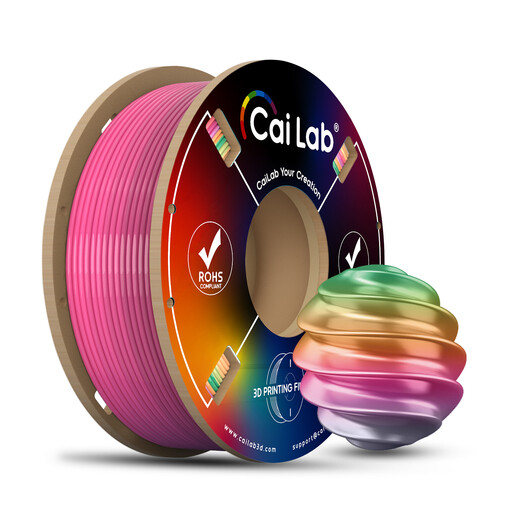
Key feature: This filament offers a long, harmonious color gradient with pastel shades reminiscent of candy. The transition is slow enough to create subtle and elegant effects on medium to large-sized objects.
What we love:
Ideal for: Creators printing decorative objects like vases, flower pots, statuettes, or toys large enough for the gradient to be fully expressed.
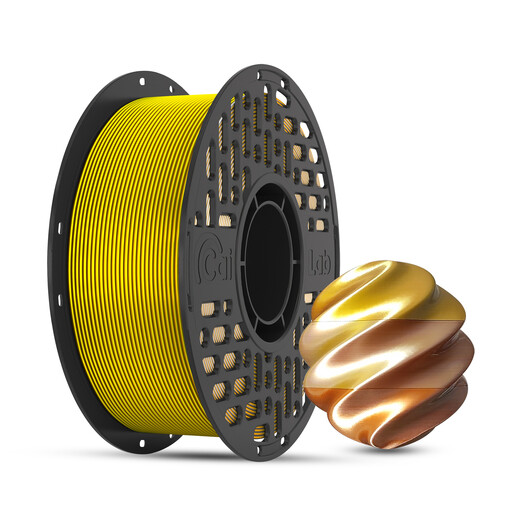
Key feature: This tri-color filament co-extrudes three metallic colors (gold, silver, copper) into a single strand. The result is stunning: the object appears to change metallic color depending on the viewing angle, creating a dynamic and very high-end effect.
What we love:
Ideal for: Perfect for printing figurines, jewelry, trophies, or any part where a sophisticated, shifting visual effect is desired. Small objects with complex geometries are particularly enhanced.
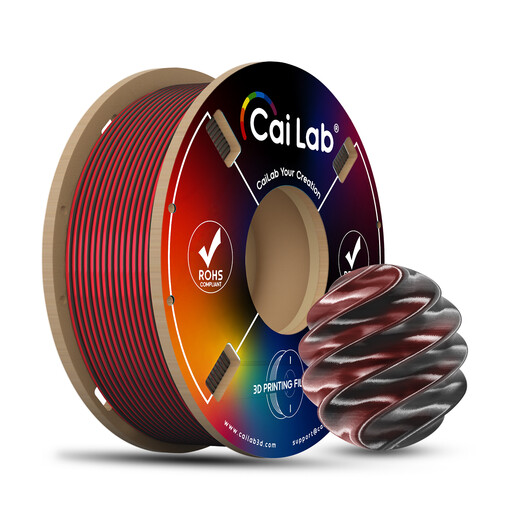
Key feature: This dual-color PLA filament combines an intense red and black for a striking contrast. Each face of the printed object will take on a different dominant hue, creating a play of sharp lines that depends entirely on the model's geometry.
What we love:
Ideal for: Recommended for objects with sharp edges, logos, lettering, or decorative pieces where the color separation can emphasize the shape.
Our selection is just a taste of the possibilities offered by artistic 3D printing. If you want to discover other color combinations, different finishes, or simply find inspiration, many other options await you.
Discover our complete collection of silk filaments for 3D printers and bring your next project to life.
Browse the full collection on Joybuy.fr
To maximize the shiny effect, it's often recommended to print a bit hotter (around 215-225?°C) and slightly slower than with standard PLA. This allows the material to melt more evenly and solidify with a perfectly smooth, reflective surface. Also, consider slightly reducing the part cooling fan speed.
Generally, the additives that create the "silk" effect can make the filament slightly less resistant to impact and tension than standard PLA or PLA+. It is therefore perfect for decorative and artistic applications but less recommended for functional parts subject to high mechanical stress.
The difference is simple: it's how the colors are distributed. A rainbow PLA filament changes color along its length (for example, from red to yellow over several meters of filament). The final look therefore depends on the amount of filament used, and thus the size of the object. Conversely, a dual-color PLA filament has two colors extruded side-by-side along its entire length. The color-shifting effect is visible from any viewing angle, regardless of the object's size.