
Livraison le jour même ou le lendemain

Qualité garantie

Débloquez vos offres de bienvenue: Livraison GRATUITE | Jusqu'à -80 % | 30 jours d'essai gratuits à JoyPlus
Téléchargez l'application
3D printing has evolved from a simple gadget into an indispensable tool for production and prototyping. For professionals, workshops, and demanding creators, the focus has now shifted to machines capable of printing complex, large-format parts with multiple colours or materials. Faced with an ever-denser technical landscape, identifying the right equipment can quickly become a daunting task.
Our goal: to break down the key selection criteria and present the best current options for the most advanced applications. Cutting through the marketing hype, this guide provides a factual analysis to help you make a truly informed decision.
Before diving into model comparisons, it's essential to understand the three pillars that define a modern professional 3D printer: volume, speed, and multi-colour capability.
A large-volume 3D printer is essential for fabricating large single parts or mass-producing smaller objects. But a large print bed isn't everything. Execution speed is just as crucial for rapid prototyping. The latest models combine high printing speeds (often exceeding 500 mm/s) with vibration compensation systems and reinforced frames to ensure a flawless surface finish. The balance between these three factors—volume, speed, and precision—is the key to an efficient workflow.
The arrival of the multi-colour 3D printer at an accessible price point has opened up new possibilities. Far more than a simple aesthetic advantage, this technology allows you to:
Modern systems, like external filament management units (AMS or ACE), make the task incredibly easy by automatically managing colour changes and filament purging.
For intensive use, reliability is non-negotiable. Features like automatic bed levelling, filament runout detection, and AI-powered monitoring to predict print failures are now standard. A well-integrated software ("slicer") and hardware ecosystem ensures a seamless experience and minimises time lost on adjustments and maintenance.
We have selected models that excel in volume, speed, and multi-colour capability, each with its own unique strengths.
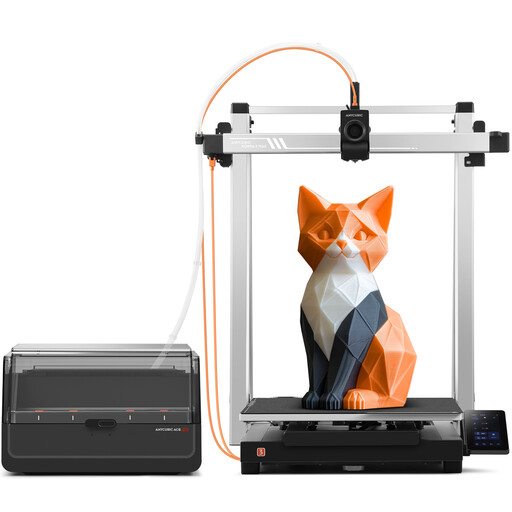
Why It Stands Out
The Anycubic Kobra 3 Max Combo stands out as the ultimate solution for large-format FDM 3D printing without compromise. Its colossal 88-litre print volume, combined with the ACE Pro multi-colour system, enables projects of a scale rarely seen on machines in this category. The ACE Pro system manages up to 8 filaments and includes a drying function, a major advantage for preserving the quality of moisture-sensitive materials.
Advantages
Who Is It For?
Designers, architects, and workshops that need to produce very large-scale models, prototypes, or final parts. Its ability to produce in batches also makes it ideal for small-batch production.
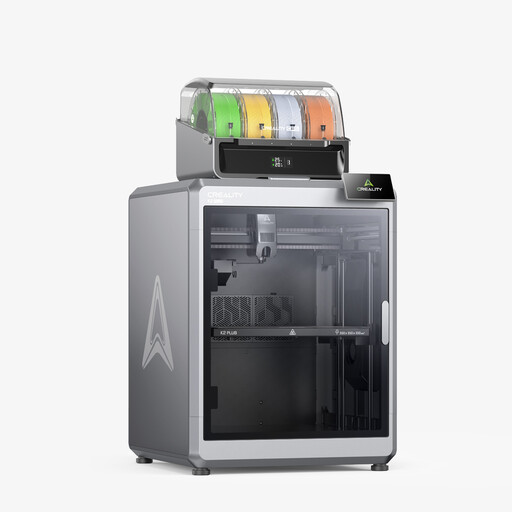
Why It Stands Out
The Creality K2 Plus Combo focuses on versatility. Its CFS (Creality Filament System) allows for combining up to 4 units for 16-colour printing, a record in its class. Its fully enclosed chassis, with a temperature-controlled chamber (up to 60°C), enables it to print technical materials (ABS, ASA, PA-CF) that are prone to warping on open-frame machines. The dual AI-powered cameras provide remote monitoring and real-time error detection.
Advantages
Who Is It For?
Engineers, small businesses, and prosumers seeking maximum flexibility in both colours and material types to create functional prototypes and technical parts.
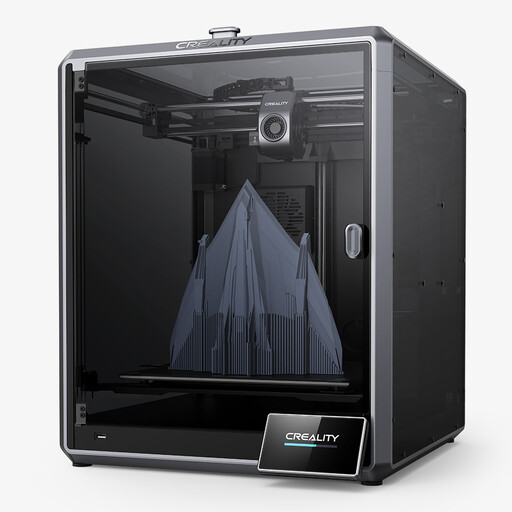
Why It Stands Out
Although the Creality K1 MAX is not a native multi-colour 3D printer, it earns its place in this selection as a speed specialist. This is a machine designed for pure productivity. With a maximum speed of 600 mm/s and impressive acceleration, it drastically reduces print times. Its rigid frame and fully automatic levelling make it a reliable tool, ready to produce right out of the box.
Advantages
Who Is It For?
Users and businesses for whom production time is the number one criterion. It is perfect for rapid design iteration or small-batch production of single-colour parts.
Our selection focuses on models that meet specific needs for volume, colour, and speed. If your criteria are different or if you simply want to explore a wider range, feel free to browse our complete category.
Discover All Our High-Speed 3D Printers
External systems, like Anycubic's ACE Pro or Creality's CFS, are modules that connect to a single-extruder printer. They manage the selection, cutting, and feeding of multiple filaments to the print head. This modular approach is the most common today and often proves easier to maintain than multi-extruder printers, which can be a nightmare to calibrate.
Not necessarily. Modern high-speed printers use technologies like "input shaping" (resonance compensation) and "pressure advance" to counteract vibrations and ensure a consistent material flow. This allows them to maintain excellent print quality, even at full speed. However, for parts requiring extreme precision, it is still advisable to reduce the speed.
It all depends on the printer's design. An open-frame model, like the Kobra 3 Max, is ideal for standard filaments like PLA and PETG. For more technical materials like ABS, ASA, or nylon, which are sensitive to temperature fluctuations and can warp, a printer with an enclosed and heated chamber, like the Creality K2 Plus, is essential to ensure good layer adhesion and the dimensional stability of the part.