
Livraison le jour même ou le lendemain

Qualité garantie

Débloquez vos offres de bienvenue: Livraison GRATUITE | Jusqu'à -80 % | 30 jours d'essai gratuits à JoyPlus
Téléchargez l'application
Driving at night or in bad weather can be a nightmare when your vehicle's lighting is subpar. Dim, yellowish halogen headlights don't just reduce your field of vision?— they slash your reaction time to unexpected hazards. Upgrading to an LED headlight bulb is a clear choice for many drivers who are serious about safety and want to modernise their car.
But with an overwhelming number of options on the market, how do you choose? This guide is here to break down the essential criteria and help you select the perfect automotive LED kit without getting lost in technical jargon.
Before making the switch, there are a few technical points to check. These will guarantee the compatibility, performance, and longevity of your new lighting system.
This is the essential starting point: compatibility with your vehicle. Every car uses specific bulb socket types for its low beams, high beams, or fog lights. The most common models are the H11 LED bulb or the 9005 LED bulb (also known as HB3), but dozens of others exist (H1, H4, H7...).
To identify the model you need, the easiest way is to consult your vehicle's owner's manual or check the markings on the original bulb. Prioritise models described as "plug-and-play", which are designed with the same dimensions as a halogen bulb. They allow for a direct replacement without needing to modify the headlight housing or break out the toolbox.
On modern vehicles, there's one last thing to check: the need for a CANbus-ready LED bulb. This integrated system prevents dashboard error messages or flickering that the on-board computer (OBC) might trigger, as it can be fooled by the low power consumption of LEDs.
The output of an LED headlight is judged on two key criteria?:
Heat is the number one enemy of LEDs. A good cooling system is therefore non-negotiable. The best models combine an aircraft-grade aluminium body (for passive dissipation) with a fan or turbo-fan (for active heat removal). Proper thermal management can extend a bulb's lifespan to 50,000 hours, significantly increasing the time between replacements.
To guide you, we have scrutinised several models based on their technical specifications, ease of installation, and compatibility.

Why it stands out?: This 9005 LED bulb kit focuses on massively increased brightness and a design geared for longevity. The manufacturer promises up to 500% more illumination than a halogen bulb thanks to its CSP chips, all in a 6500K hue that replicates daylight for optimal visual comfort.
Highlights?:
Who is it for?? For drivers of cars, SUVs, or trucks with 9005/HB3 headlights who are looking for a radical boost in brightness for their daily and nighttime journeys.
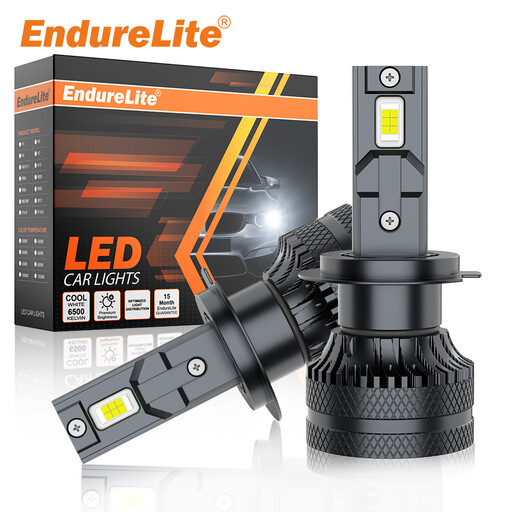
Why it stands out?: This H11 LED bulb kit (also compatible with H8/H9) goes all-in on raw power, with a stated 20,000 lumens per pair. It promises a sharp beam pattern that respects the original cutoff line to avoid dazzling other drivers.
Highlights?:
Who is it for?? For drivers with H8, H9, or H11 fittings who want maximum light output without sacrificing simple installation and reliability.
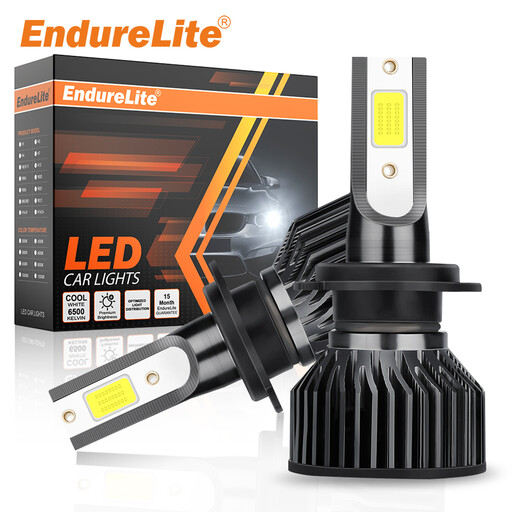
Why it stands out?: This alternative from ENdureLite for H8/H9/H11 sockets offers the perfect balance of performance, longevity, and precision. With 13,000 lumens and a 6000K pure white colour, it's a significant upgrade from halogen, with particular attention paid to beam quality.
Highlights?:
Who is it for?? For discerning drivers who want more light but prioritise beam quality and respect for other road users, all while enjoying a straightforward installation.
If these models don't match your vehicle's socket type or if you simply want to explore more options, we've got you covered. Explore our complete selection to find the perfect bulb for your car.
Discover Our Range of White Light Bulbs
Regulations can be very strict on this topic. For aftermarket (or "retrofit") LED bulbs to be used legally on public roads, they often need to have a specific certification (like an ECE approval in Europe) for your exact vehicle model. Be aware: the vast majority of LED kits sold online are not certified for road use and are therefore intended for off-road or track use only. Before purchasing for on-road use, it is crucial to verify that the kit is certified for your car.
The CANbus (Controller Area Network) is the system that allows your car's various electronic units to communicate with each other. An LED bulb consumes far less power than a halogen one. The on-board computer (OBC) can interpret this low consumption as a fault (a burnt-out bulb) and display a dashboard error message. A CANbus-ready LED bulb (or "error-free" bulb) integrates a resistor that "tricks" the computer by simulating normal power consumption. This system is generally essential for European vehicles manufactured after 2005-2010 and many modern cars from other regions.
There are several ways, from the easiest to the most reliable: check your vehicle's owner's manual, which lists all the part numbers. You can also remove the original bulb; the model number is usually printed or engraved on its base. Finally, many specialised websites can provide the information if you simply enter your car's make, model, and year.