
Livraison le jour même ou le lendemain

Qualité garantie

Débloquez vos offres de bienvenue: Livraison GRATUITE | Jusqu'à -80 % | 30 jours d'essai gratuits à JoyPlus
Téléchargez l'application
Night driving can be stressful, especially when your vehicle's factory lighting is underwhelming. Underperforming headlights not only reduce your field of vision but also your reaction time to unexpected events. For many drivers, upgrading to an LED bulb is the ideal solution to boost safety while modernising their car's appearance.
But with a saturated market, finding the right product can be overwhelming. This guide is here to shed some light (no pun intended) and help you make the right choice, offering practical advice and a selection of the best kits currently available, tailored to your needs and your vehicle.
Before you make the switch, there are a few technical criteria to check to ensure the compatibility and performance of your future LED kit.
Your first step should be to check the socket type of your original bulbs. The most common types are H7, H4 (which handles both low and high beams in a single bulb), H1, and 9005. Be aware that an H7 LED bulb can never replace an H4. To avoid any mistakes, consult your vehicle's owner's manual or, even simpler, remove a bulb to check its reference number.
Next, pay close attention to modern vehicles (generally those made after 2005). Almost all are equipped with an on-board computer monitoring system (CAN Bus) that checks the status of the bulbs. Since an LED consumes far less power than a halogen, the computer may interpret this as a bulb failure and display a dashboard error. To prevent this, you must choose a Canbus LED bulb (or "error-free" bulb), which is specifically designed to trick the system.
The performance of a powerful LED bulb isn't just about its lumen count (lm), which only measures raw light output. The quality of the beam pattern is just as, if not more, crucial. A good LED headlight must perfectly replicate the beam pattern of the original halogen bulb. The goal is to illuminate the road with precision, without ever dazzling other drivers. So-called "1:1 design" models are excellent in this regard, as their LED chips are positioned to mimic the filament of a traditional bulb.
Contrary to a persistent myth, LEDs do get hot—very hot. Proper heat dissipation is therefore essential to guarantee their performance and lifespan, which can reach tens of thousands of hours. Quality kits feature either active cooling (a mini-fan) or a passive system (an aluminium heat sink). Efficient cooling ensures consistent brightness and prevents premature degradation of the chips. This is a critical factor not to be overlooked when you replace a halogen bulb with an LED.
To guide you, we've scrutinised several models available on the market. Here is our selection of kits that stand out for their performance and design.
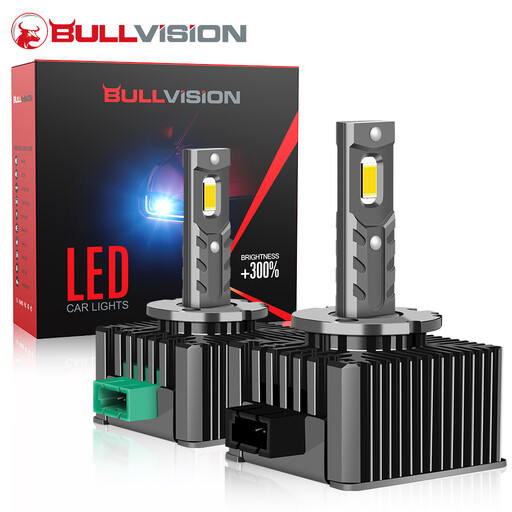
Key Feature: The Bullvision D2S/R bulbs are all about their 1:1 design. In practical terms, they perfectly match the size and geometry of the original bulbs. This is a major advantage that simplifies installation and, most importantly, guarantees a clean, precise beam pattern with no risk of dazzling others.
What We Like:
Who is it for? For discerning drivers who want a significant improvement in visibility without altering their headlights' original beam pattern.

Key Feature: Roadsun focuses on maximum brightness. With a colour temperature of 6500K, these bulbs produce a pure white light that's close to daylight. This is ideal for improving contrast and visibility on poorly lit country roads.
What We Like:
Who is it for? For those who frequently drive on poorly lit roads and are primarily seeking maximum light output to anticipate hazards.
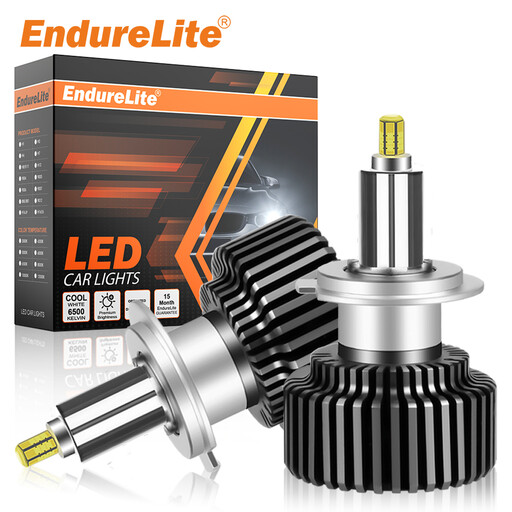
Key Feature: The strength of the ENdureLite range is its versatility. Available in a multitude of socket types (H1, H4, H7, H11, etc.), it fits the vast majority of vehicles on the road. Its design is engineered for 360-degree light distribution, ensuring perfectly uniform illumination.
What We Like:
Who is it for? The ideal option for drivers looking for a reliable solution for a specific socket type, or for those who manage multiple vehicles with different needs.
Our selection highlights popular models that meet the most common needs. However, the automotive lighting market is vast, and every vehicle has its own specific requirements. If these products don't match what you're looking for, feel free to explore our full catalogue.
? Explore our complete collection of LED bulbs and kits to find the perfect solution for your vehicle.
1. Is it legal to replace halogen bulbs with LEDs? Regulations can be very strict depending on your region. For use on public roads in many areas (like the EU), replacement bulbs must have specific certifications (e.g., ECE approval). However, most LED conversion kits on the market are sold with a disclaimer like "for off-road use only." It is therefore crucial to check the product's compliance and your local laws before driving on public roads with a non-certified kit.
2. How do I install an LED kit? The vast majority of modern kits are "Plug & Play." Installation is a breeze:
3. Do I have to choose a Canbus LED bulb? If your car was made after 2005, the answer is almost certainly yes. These vehicles are equipped with an on-board computer (Canbus) that will detect the low power consumption of LEDs as an error. Using a "Canbus Ready" or "error-free" model is therefore essential to avoid a dashboard warning light or an annoying flicker from the headlights. For older vehicles, a standard LED kit is usually sufficient.