By the Joybuy Team, Your Product Experts
Driving at night or in the rain with stock halogen headlights?? It's often an uncomfortable experience. Between their yellowish light and limited range, both visibility and safety are compromised. Upgrading to LEDs is the solution for crystal-clear vision and a modern look for your car.
This guide is here to enlighten you (no pun intended?!) on choosing your next LED car bulbs. We'll review the key technical criteria to consider and present our selection of today's top products.
Buyer's Guide?: How to Choose the Right LED Bulbs??
Before you start replacing your halogen bulbs with LEDs, a few technical checks are essential to ensure perfect compatibility and optimal performance.
1. Identify the Correct Base?: H7, H4, W5W... One for Every Need
The base is the part of the bulb that fits into the headlight assembly. It's the number-one compatibility factor. The two most common types for main headlights are?:
- H7 LED Bulb?: This type is dedicated to a single function?: either low beams or high beams. Your car will therefore use two separate pairs of bulbs for these two lighting functions.
- H4 LED Bulb?: More versatile, this bulb integrates two filaments to handle both low and high beams within a single unit.
For secondary lighting (parking lights, license plate, interior), formats like the W5W LED bulb (sometimes called T10) are the most common. The easiest way to be sure?? Check your vehicle's manual or an online database to find the exact part numbers you need.
2. The Anti-Error Canbus System?: A Game-Changing Detail
Most modern cars, especially European models, have an on-board computer (OBD) that constantly monitors the status of the bulbs. Since an LED bulb consumes far less power than a halogen one, the on-board computer might mistake it for a fault (a burnt-out bulb) and trigger a dashboard warning.
To prevent this minor inconvenience, choose a car LED kit that features an anti-error Canbus function. These bulbs are specifically designed to "communicate" correctly with the vehicle's electronics. On some particularly sensitive vehicles, an external Canbus decoder may be required as an add-on.
3. Power and Colour?: The Quest for Perfect White
There are two units of measurement you need to know to judge the effectiveness of a powerful LED bulb?: lumens (lm) for intensity and kelvins (K) for colour.
- Lumens (lm)?: These measure the total luminous flux. Simply put?: the more lumens, the brighter the light.
- Kelvins (K)?: This is the unit for colour temperature. A standard halogen bulb emits a yellowish light around 3200?K. To get a pure, crisp white light for a modern look, aim for models between 6000 and 6500?K.
A good LED headlight isn't just powerful?: it must produce a precise beam pattern to illuminate the road effectively without dazzling other road users. The best models replicate the geometry of the halogen filament to ensure a sharp beam cut-off.
Recommended Car LED Bulb Picks
Here are the models that caught our eye, chosen for their design, performance, and ease of installation.
Bullvision H7 LED?: High-Efficiency for Low Beams
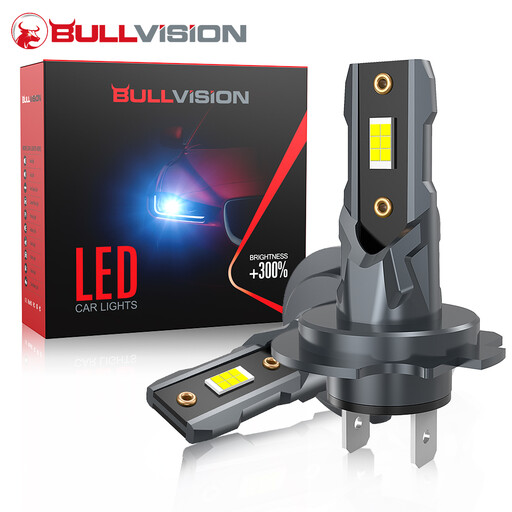
- Key Feature?: Their 1:1 design, identical to a halogen bulb, makes installation a breeze. The integrated cooling fan is a major bonus for longevity, as it actively dissipates heat.
- Advantages?:
- Installation?: Plug-and-play format identical to the original bulb.
- Brightness?: A pure, white light at 6000?K.
- Durability?: Aluminium alloy body and active ventilation (10,000 RPM) for a rated lifespan of over 50,000 hours.
- Beam Pattern?: Engineered geometry to replicate the original beam and prevent glare.
- Who is it for?? For drivers who want a simple, high-performance solution to upgrade their low or high beams with an H7 base. Please note, on certain vehicles (especially Volkswagen, Mercedes-Benz, BMW), an additional Canbus decoder may be required.
Bullvision H4 LED?: The All-in-One Solution
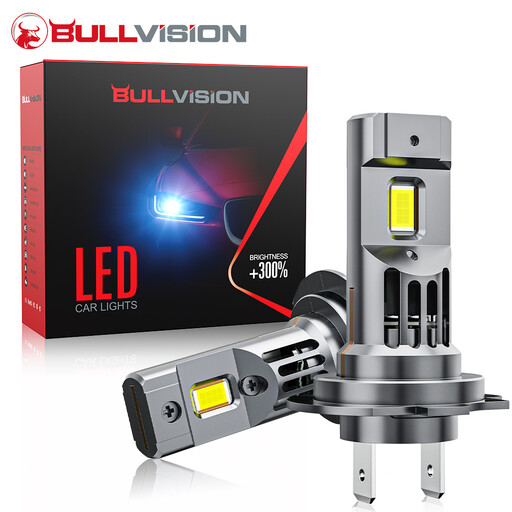
- Key Feature?: This H4 model handles both low and high beams. It shares the same strengths as the H7 version, such as the compact design and active cooling.
- Advantages?:
- Dual Function?: A single bulb for both main lighting modes.
- Compatibility?: The integrated smart driver ensures Canbus compatibility with most vehicles.
- Performance?: A cool white 6000?K light and a precise beam for optimal visibility.
- Cooling?: The fan guarantees efficient heat dissipation.
- Who is it for?? For drivers whose cars use stock H4 bulbs and who are looking for a complete solution to switch to LED. The same caution applies regarding Canbus on certain German brands.
KATUR W16W/T15 LED?: High Power for Reverse Lights
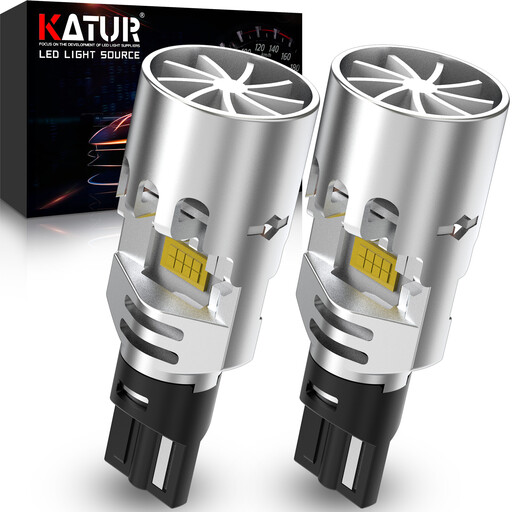
- Key Feature?: Impressive light output, specifically for reverse lights. The presence of a fan on a bulb of this size is a sign of high performance and longevity.
- Advantages?:
- Manoeuvring Visibility?: The intense 6500?K white light and high power output transform your view when reversing.
- Active Cooling?: The turbo fan prevents any risk of overheating.
- Canbus Compatibility?: Designed to prevent error messages on most cars.
- Easy Installation?: 1:1 design, identical to the T15/W16W halogen bulb.
- Who is it for?? Essential for those who want maximum visibility when reversing. Especially useful on large vehicles (SUVs, vans) or for manoeuvring in poorly lit car parks.
OUSHI W5W/T10 LED?: Versatility for the Finishing Touches
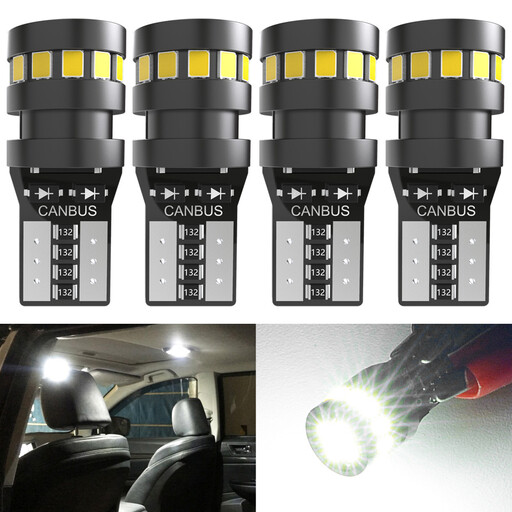
- Key Feature?: Their absolute versatility. These W5W (T10) bulbs can be installed anywhere?: dome lights, map lights, license plate lights, parking lights...
- Advantages?:
- Versatility?: One bulb type to modernise and harmonise all your car's auxiliary lighting.
- White Light?: A pure, xenon-effect white at 6500?K for a modern and uniform look.
- Integrated Canbus?: Advertised as compatible with 99% of vehicles, with no error messages.
- Low Consumption?: Very energy-efficient, providing much greater brightness than halogen.
- Who is it for?? For the perfectionists who want to complete their 100% LED transition and achieve a consistent lighting colour, both inside and out.
Can't Find What You're Looking For??
Compatibility is key. If the models in our selection don't match your vehicle's bulb base or if you have other needs, many other options are available.
To explore a wider range and find the perfect bulb for your car, browse our complete car lighting category.
Frequently Asked Questions (FAQ)
1. Is it legal to replace halogen bulbs with LEDs??
Legislation on this subject is often very specific. For road-legal use, replacement bulbs must typically have a specific certification, such as the ECE approval in Europe. However, many aftermarket LED kits are sold for off-road or track use only. Before purchasing, it is crucial to verify that the product is certified for on-road use in your region to avoid violating traffic laws.
2. My on-board computer is showing an error message after installation. What should I do??
This is a classic Canbus system issue. The on-board computer interprets the low power consumption of LEDs as a burnt-out bulb. The simplest solution is to choose bulbs that are "Canbus Ready" or "error-free". If the warning persists, installing an external Canbus module (a small resistor connected between the bulb and the socket) will permanently resolve the issue.
3. Can a powerful LED bulb damage my headlights??
The real issue isn't power, but heat. Unlike a halogen bulb, which radiates heat forward (through the glass), an LED generates heat at its base. This is why high-quality LED bulbs, like those in our selection, are equipped with high-performance cooling systems (aluminium heat sinks, fans). These systems protect both your headlight assembly and the bulb's electronic components.


