
Livraison le jour même ou le lendemain

Qualité garantie

Débloquez vos offres de bienvenue: Livraison GRATUITE | Jusqu'à -80 % | 30 jours d'essai gratuits à JoyPlus
Téléchargez l'application
Planning a winter sports holiday is often exciting, but choosing the right gear for your children can quickly become a headache. As parents, we all want the same thing: reliable, protective, and durable products, without falling for marketing hype. Good gear isn't necessarily the most expensive, but rather what meets specific quality and safety criteria. This is especially true for kids' ski gloves, an essential accessory for keeping a day on the slopes fun.
As a Product Recommendation Manager at Joybuy, my role is to help you see things more clearly. I review the information available on the market to offer you practical and objective advice, so you can make an informed choice for your children.
Before looking at specific models, it's helpful to know the three fundamental criteria that distinguish a good ski glove from a simple winter glove.
Wet hands get cold very quickly. It is therefore crucial to choose waterproof ski gloves. Be careful not to confuse a "water-repellent" treatment (which makes water bead up on the surface) with true "waterproofing". Effective protection relies on a waterproof and breathable membrane, often made of TPU (thermoplastic polyurethane), inserted between the outer layer and the insulation. This membrane blocks water from entering while allowing sweat to escape, thus keeping your child's hands dry, whether they're skiing, snowboarding, or just playing in the snow.
Thickness isn't everything. A glove's performance depends on the quality of its insulation. Modern synthetic insulations offer an excellent warmth-to-weight ratio. One of the best-known is 3M Thinsulate, which traps air to retain body heat even in damp conditions. A thick cotton lining can also provide additional warmth and comfort. For warm and effective ski gloves, check the type of insulation rather than relying solely on the glove's thickness.
The choice between kids' ski gloves and kids' ski mittens depends on your child's age and activity.
After analysing the features of several available models, here are two options that stand out for their functional design and materials suited for winter activities.
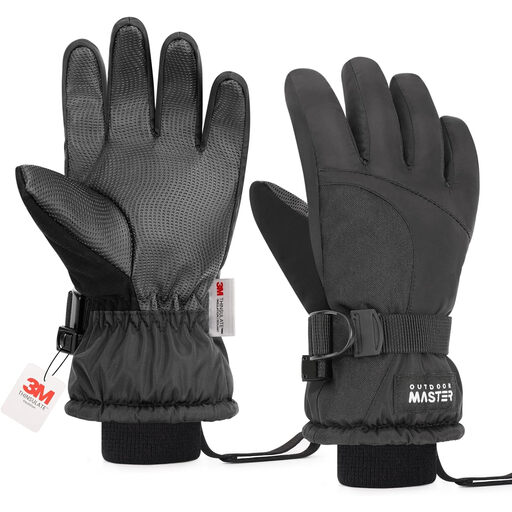
Why We Recommend It
This model of boys' and girls' ski gloves combines several relevant technologies for complete protection. The integration of 3M Thinsulate C40 insulation and a 120g thickened cotton lining ensures excellent heat retention. Double protection against the elements is provided by a durable polyester outer surface and a waterproof TPU membrane. Practical details, like the adjustable wrist buckle and anti-loss straps, are significant assets for avoiding hassles on the slopes.
Pros
Who Is This Product For??
These gloves are a great option for children aged 7 to 9 who are actively skiing or snowboarding and need good dexterity to handle their equipment.
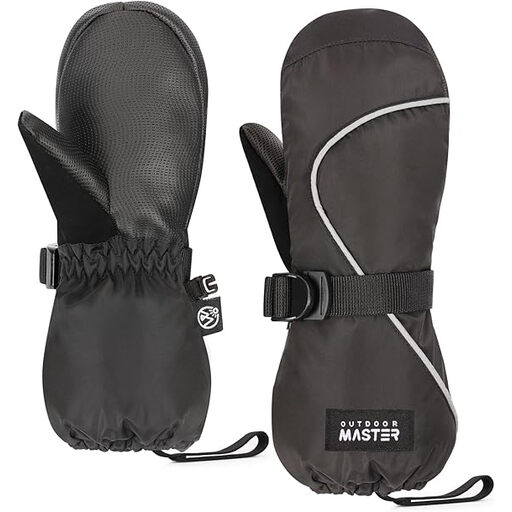
Why We Recommend It
For children who are particularly sensitive to the cold or for freezing days, mittens are often the solution. This model focuses on effective thermal insulation with a 120g thick cotton lining. Like the gloves above, these kids' snow mittens feature a waterproof TPU membrane to ensure hands stay dry. Added features, such as reflective strips for visibility and a soft fabric thumb for wiping a runny nose, show a design focused on children's comfort and safety.
Pros
Who Is This Product For??
These mittens are recommended for children aged 10 to 12 who prioritise warmth over dexterity. They are perfect for skiing, snowboarding, and also for all other activities like sledging or building snowmen.
The models presented are solid starting points for equipping your child. However, if they don't exactly match the size, style, or specific needs you're looking for, a wider range is available. You can explore other models of sports gloves to find the most suitable pair.
Ski gloves are specifically designed for winter sports. They have technical features that city gloves generally lack: a waterproof membrane, high-performance thermal insulation, reinforced and anti-slip palms for a good grip on poles, and long cuffs to prevent snow from getting inside.
The wrong size can compromise comfort and insulation. Gloves that are too tight compress the insulation and restrict blood flow, while gloves that are too large reduce dexterity and the ability to retain heat. Most manufacturers provide a size guide based on hand circumference or hand length. Measure your child's hand and compare it to the brand's guidelines.
To preserve their technical properties, it is advisable to follow the manufacturer's instructions. Generally, hand washing with mild soap and lukewarm water is recommended. Avoid wringing them out. Let them air dry, away from a direct heat source like a radiator, which could damage the waterproof membrane and synthetic materials. Make sure they are completely dry before storing them.