
Livraison le jour même ou le lendemain

Qualité garantie

Débloquez vos offres de bienvenue: Livraison GRATUITE | Jusqu'à -80 % | 30 jours d'essai gratuits à JoyPlus
Téléchargez l'application
The dreaded click-click-click of an engine that refuses to start… It's a mishap every driver fears. Whether it's due to cold weather, leaving your headlights on, or an old battery, being stranded is always a source of frustration. Fortunately, the jump starter is here to save the day. This compact, self-contained device puts you back in control, without having to rely on a good Samaritan or a tow truck.
Here, we'll explain the essential criteria to consider before you buy and present our selection of standout models to help you make the right choice.
Navigating the jungle of options isn't easy. Here are the key points to check to find the car starter that perfectly matches your vehicle and your needs.
This is THE number one criterion: power, expressed in amps (A). There are two values to distinguish:
For a compact gasoline car, a 600A to 1000A booster may be sufficient. For an SUV, a utility vehicle, or a diesel vehicle, which requires more torque to start, it's recommended to look for models offering 1500A or more. Always check the compatibility with your engine's displacement (expressed in litres), information that is usually highlighted by manufacturers.
Much more than a simple rescue device, the modern jump starter is a true Swiss Army knife. Its capacity, measured in milliampere-hours (mAh), determines its battery life. A higher capacity will allow you to perform multiple starts or recharge your electronic devices.
Most models also double as a power bank, equipped with USB ports to charge smartphones and tablets. Some go even further by integrating a jump starter with a compressor, a very practical tool for adjusting your tyre pressure anywhere. Other useful features include an LED torch with different modes (light, strobe, SOS).
To guide you, we've scrutinised several models, focusing on their technical specifications, versatility, and their target audience.
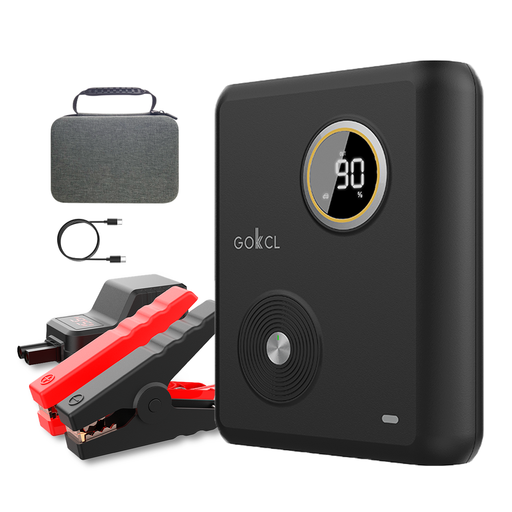
Its standout feature? The GOKKCL GK03 stands out with its sodium-ion battery technology. Unlike traditional lithium batteries, it offers enhanced stability and safety. Its operating temperature range is exceptionally wide (-40°C to 80°C), so you can leave it in your car all year round with peace of mind. According to the manufacturer, its very low self-discharge allows it to remain operational for up to 5 years on standby—a major advantage for those who want a device that's always ready to use.
Advantages:
Who is it for? For the driver who prioritises peace of mind and long-term reliability. It's ideal if you live in a region with harsh winters or scorching summers and are looking for a 'set it and forget it' solution.
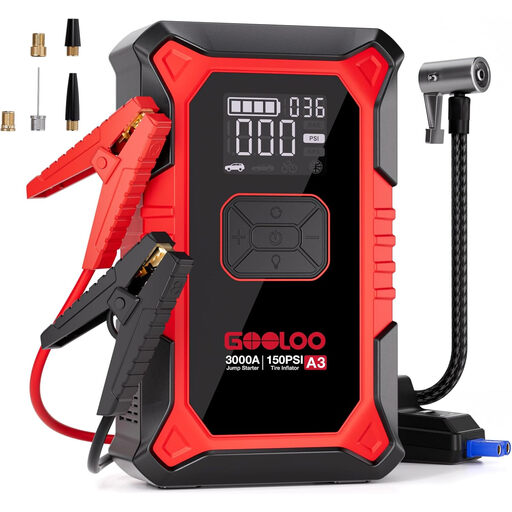
Its standout feature? The GOOLOO A3 is much more than just a jump starter: it's a true portable toolkit. Its secret weapon? A built-in 150 PSI air compressor, capable of re-inflating a car tyre in minutes. With its 5 preset inflation modes and digital display, it's just as easy to use for a bicycle tyre as it is for a football. Its 3000A peak power makes it capable of starting a very wide range of vehicles.
Advantages:
Who is it for? For families, frequent travellers, and anyone who loves versatile tools. If you're looking for a single device to handle both battery failures and regular tyre pressure maintenance, the A3 is a very smart choice.
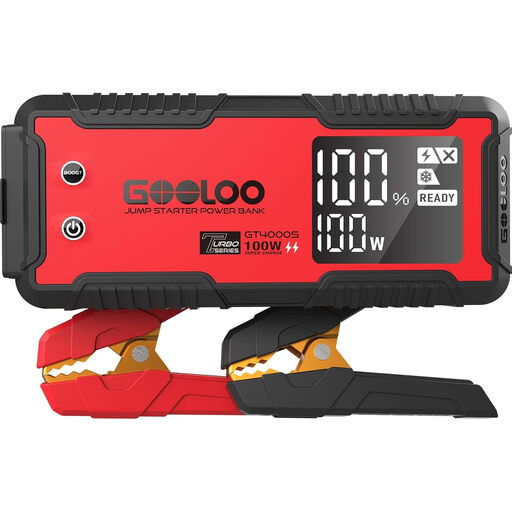
Its standout feature? The GOOLOO GT4000S is built for raw performance. With a peak current of 4000A, it can handle almost any 12V vehicle, including large pickup trucks and RVs. Its other secret weapon: 100W two-way fast charging technology. Not only does it fully recharge in just over an hour (with the appropriate charger), but it can also charge a laptop via its USB-C port, as fast as its original charger.
Advantages:
Who is it for? For owners of large vehicles (4x4s, vans, RVs, boats) who need maximum starting power. It's also an excellent choice for professionals and tech enthusiasts who will appreciate its fast-charging capability for all their devices.
Our selection highlights models with distinct profiles. If your needs are different or if you simply want to broaden your horizons, the market is full of other options.
To discover a wider range and find the model that precisely matches your needs, check out our complete category of battery car starters.
1. What power rating do I need for my jump starter? It all depends on your vehicle's engine. For a compact gasoline car, 600A to 1000A is sufficient. For sedans, SUVs, and diesel engines, aim for at least 1500A to 2000A. For very large engines (trucks, RVs), opt for 3000A or more. Always refer to the manufacturer's recommendations regarding engine displacement (L).
2. Can I leave my jump starter in the car permanently? Yes, but under certain conditions. It depends on the battery technology and the device's operating temperature range. Models like the GOKKCL GK03, with its sodium-ion battery and resistance from -40°C to 80°C, are specifically designed for this. For conventional lithium boosters, it's wiser to avoid leaving them in scorching summer heat or extreme cold, as this can degrade the battery and shorten its lifespan.
3. Can a jump starter recharge my car battery? No. The role of a jump starter is to provide an intense burst of current to start the engine when the battery is too weak. It does not recharge it. Once the engine is running, the vehicle's alternator takes over to recharge the battery while you drive. Some multi-function devices may offer a slow-charging mode, but that is not their primary function.