
Livraison le jour même ou le lendemain

Qualité garantie

Débloquez vos offres de bienvenue: Livraison GRATUITE | Jusqu'à -80 % | 30 jours d'essai gratuits à JoyPlus
Téléchargez l'application
A flat battery or a deflated tyre at the worst possible moment: it's the worst-case scenario every driver dreads. A jump starter with a compressor is the all-in-one solution to get you back on the road with peace of mind. However, with an overwhelming number of options on the market, it's easy to fall for marketing traps and invest in a device that will fail you when you need it most.
As a product expert at Joybuy, my job is to help you decode the spec sheets to make an informed decision. Here are the 3 most common pitfalls and our advice on how to avoid them.
To avoid buyer's remorse, focus on objective features that meet a real-world need. Here are the three essential checkpoints.
Forget the peak current marketing figure for a moment. The crucial information is the device's compatibility with your engine's displacement (expressed in litres). A good 12V emergency starter should clearly state which engine size it's designed for. A booster for a diesel engine typically requires more cranking power than a model for a petrol engine of the same size, due to a higher compression ratio. Make sure the model you choose covers your vehicle's displacement, with a little safety margin to spare.
For the compressor, two values are key:
A good modern jump starter must also function as a car power bank with reliable safety features. Check for essential protections: reverse polarity, overcharge, short-circuit, and overheating. The clamps should be sturdy and well-insulated. While USB ports for charging your devices have become standard, a 45W PD (Power Delivery) Power Bank port is a real bonus. It allows you to not only rapidly charge your compatible devices (smartphones, tablets) but also the jump starter itself.
Rather than an endless list, we've chosen to match user profiles with products that meet their specific needs, all while avoiding the pitfalls mentioned earlier.
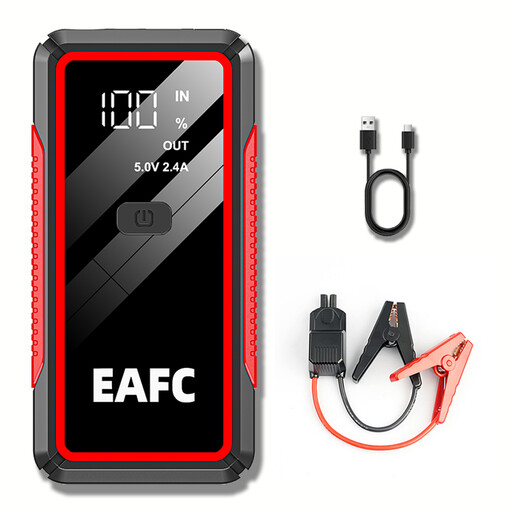
Why we chose it: A comprehensive and affordable solution for dealing with the unexpected in a city car, saloon, or mid-size SUV. It offers sufficient power for the majority of vehicles on the road, without superfluous features that drive up the price.
It focuses on real starting power (up to 6.0L petrol / 4.0L diesel) rather than an unrealistic peak current figure. Its 10,000 mAh capacity is honest and sufficient for multiple starts.
Its power-to-price ratio makes it an essential piece of safety equipment that won't break the bank. It includes indispensable safety protections and an LED light, enough to handle 90% of common breakdowns.
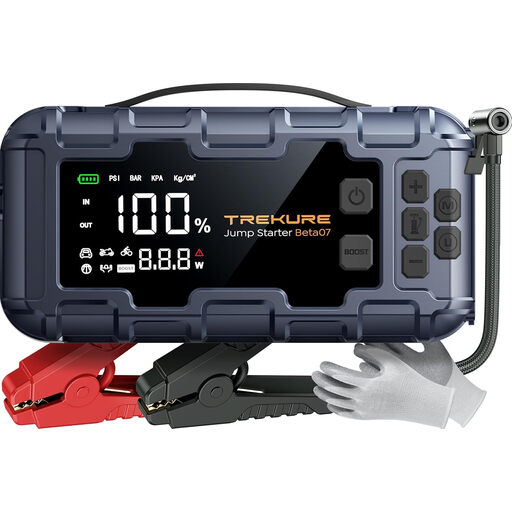
Why we chose it: Ideal for owners of large SUVs, motorhomes, vans, or boats. Its starting power is suitable for large-displacement diesel engines (up to 12L), and its compressor is designed for heavy-duty use.
Its 160 PSI compressor with a 45 L/min flow rate is not just a gimmick. It reinflates a tyre quickly and without overheating, unlike low-end models that struggle with large volumes.
Colossal starting power and fast 45W PD charging for both the booster itself and your devices. The 3.3-inch smart screen displays all data clearly for complete peace of mind.
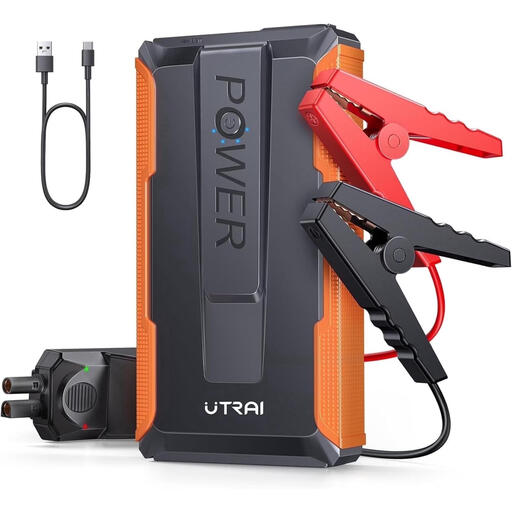
Why we chose it: An excellent compromise for those looking for a reliable device year-round, including in regions with harsh winters. It's compact, robust, and offers good power for most cars and SUVs.
It is rated to operate down to -20°C, a temperature at which many lithium batteries lose significant efficiency. It doesn't promise the moon, but it delivers stable performance when the temperature drops.
The smart clamps with an audible alarm for polarity errors make it particularly safe for novices. Recharging via a simple USB-C cable is also a practical advantage.
We have compiled a complete, up-to-date list of products that meet these strict selection criteria and safety standards.
On average, a good quality jump starter has a lifespan of 3 to 5 years. To preserve it, we recommend fully recharging the device every 3 to 6 months, even if you don't use it. Avoid storing it when completely discharged.
Yes, it's even recommended so you always have it within easy reach. However, avoid leaving it in direct sunlight on the dashboard in summer or exposed to deep frost in winter. Extreme temperatures can damage the battery and reduce its performance. The boot or the glove box are generally more suitable locations.
It depends on the engine displacement. For most diesel passenger cars (up to 4.0L or 5.0L), a 2000A peak current is generally adequate, provided the starting current is sufficient. For larger engines (vans, 4x4s, motorhomes), it's safer to opt for models specifically designed for higher displacements, like the TREKURE Beta07 mentioned above. Always check the compatibility specified by the manufacturer.