
Livraison le jour même ou le lendemain

Qualité garantie

Débloquez vos offres de bienvenue: Livraison GRATUITE | Jusqu'à -80 % | 30 jours d'essai gratuits à JoyPlus
Téléchargez l'application
A dead battery first thing in the morning, a flat tyre far from any service station… scenarios every driver dreads. To get out of these tight spots, the jump starter with air compressor has established itself as the ultimate all-in-one solution. But be warned: faced with an overwhelming number of options, marketing traps are numerous and can make your purchase useless, or even dangerous.
As Head of Product Recommendations at Joybuy, my mission is to help you decode the spec sheets to make a truly informed choice. Let's cut the jargon and get straight to the point: what really matters for your safety and peace of mind. Here are the crucial points to check before you invest.
The market is flooded with products making tempting promises, but critical weaknesses often hide behind the marketing gloss.
To avoid making a mistake, focus on three fundamental parameters that define the performance and reliability of a portable car starter with an inflator.
Don't rely solely on peak current. Check the device's compatibility with your vehicle's engine. A good diesel and petrol jump starter will clearly specify the maximum engine displacements it can handle (e.g., "up to 9.0L petrol / 8.0L diesel"). For most passenger cars in the UK, a device capable of starting petrol engines up to 6.0L and diesel engines up to 3.0L offers a comfortable safety margin.
The capacity, expressed in milliampere-hours (mAh), gives an indication of the total stored energy, which is useful for the car power bank function. But the battery's technology plays an even more crucial role.
Beyond the maximum pressure (usually 150 PSI, or about 10.3 bar, which is more than enough for all light vehicle tyres), two elements should be monitored:
Rather than an exhaustive list, here are a few models that meet the needs of different user profiles, taking into account the reliability criteria we've just discussed.

Why we chose it : Ideal for families with an SUV, an MPV, or multiple vehicles. Its starting power is compatible with large petrol and diesel engines, offering great versatility.
This 5-in-1 model doesn't sacrifice essential functions. It clearly states its compatibility (up to 9.0L petrol / 8.0L diesel), which is far more meaningful than a simple "peak current" figure. The compressor has preset modes and an automatic shut-off, avoiding the trap of a gimmicky, non-functional feature.
A complete and powerful solution that covers the majority of a household's needs, from starting a large engine to inflating tyres and charging electronic devices.

Why we chose it : For those who seek maximum reliability and minimum maintenance. Perfect for being left in a vehicle all year round, regardless of weather conditions, without having to worry about it.
It directly tackles the self-discharge trap. Its sodium-ion battery has a very low self-discharge rate (~1% per month compared to 5-10% for lithium), allowing it to remain operational for years on a single charge. Its wide temperature range (-40°C to 80°C) makes it impervious to summer heat and winter frost.
Unmatched peace of mind thanks to a battery technology designed for durability, safety, and virtually zero maintenance.
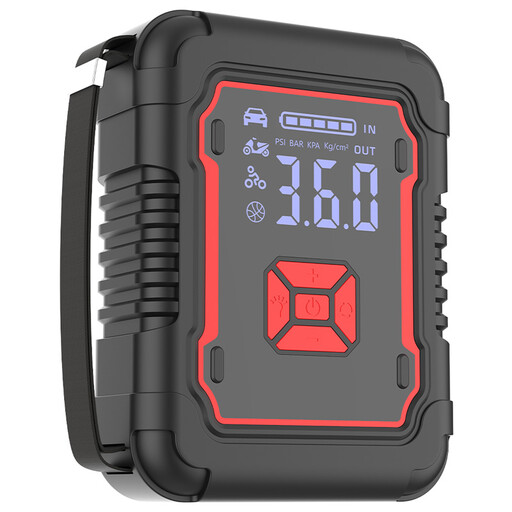
Why we chose it : A compact format and an excellent balance of functions for drivers of city cars or compact saloons. It offers a complete emergency solution without being oversized for urban or suburban use.
It doesn't try to impress with extreme numbers. Its power is tailored for common passenger vehicles. Its compressor with automatic shut-off is a practical and safe feature, a far cry from a useless gimmick. It's a pragmatic tool.
An excellent balance of compactness and functionality. It stores easily in the glove box or under a seat, while still offering the essential functions of starting, inflating, and charging.
If these models don't exactly match your needs, we have selected other products that meet our strict requirements for reliability and safety.
It all depends on the battery technology and its self-discharge rate. A standard lithium-ion model generally needs to be recharged every 3 to 6 months to ensure it's ready when you need it. Newer models, especially those with sodium-ion batteries, can hold their charge for several years, which greatly simplifies maintenance.
Yes, but always check the operating temperature range specified by the manufacturer. Lithium batteries are sensitive to extreme heat (above 60°C) and extreme cold (below -20°C), which can degrade their performance and lifespan. If you plan to leave it in your car all year round, a model designed to withstand wide temperature variations is essential.
The 1500A figure most likely refers to the peak current. For a diesel engine, which requires more power to start than a petrol engine, it is crucial to rely on the compatibility stated by the manufacturer (e.g., "for diesel engines up to 3.0L"). A 1500A peak jump starter may be sufficient for a small diesel engine in mild weather, but it might not be up to the task for a larger engine or in freezing conditions. Always trust the engine displacement recommendations.