
Livraison le jour même ou le lendemain

Qualité garantie

Débloquez vos offres de bienvenue: Livraison GRATUITE | Jusqu'à -80 % | 30 jours d'essai gratuits à JoyPlus
Téléchargez l'application
A cold winter morning, the key turns but the engine is silent… Or worse, a tire slowly deflating on a remote country road, far from the nearest service station. It's the nightmare scenario every driver dreads. Fortunately, there's a solution to ensure you're never caught off guard again: the jump starter with an air compressor. This all-in-one device is the ultimate Swiss Army knife for the prepared motorist.
At Joybuy, our mission is to guide you through the jungle of car accessories. In this guide, we'll break down the essential criteria for choosing the right jump starter and present a selection of models that have caught our eye—all without the unnecessary marketing jargon.
Before diving in, let's review the key technical specifications that will make all the difference when you need it most.
Starting power, measured in amps (A), is the most critical factor. The peak current (or Peak Amps) is the maximum burst of energy the jump starter can deliver in an instant to start the engine. For most passenger cars (petrol or diesel), a 12V jump starter with a peak current of 1500 to 2000A is more than enough. However, larger vehicles (SUVs, vans, large diesel engines) will require a more powerful model. Therefore, always check for compatibility with your vehicle's engine.
The compressor function is the real bonus of these devices. Its performance is measured by its maximum pressure, expressed in PSI (Pounds per Square Inch). A 150 PSI air compressor is the standard today, which is plenty to reinflate a car or motorcycle tire, or even a football. For added convenience and safety, look for models with an automatic shut-off at the desired pressure and multiple included nozzles.
A good multifunction car starter does more than just jump-start and inflate. It should also serve as a power bank to charge a smartphone or tablet via its USB ports in an emergency. The inclusion of an LED light (with lighting, strobe, and SOS modes) is an essential safety feature for any nighttime operation. Finally, pay attention to the internal battery type. Recent technologies like sodium-ion batteries promise far greater safety and lifespan than conventional lithium batteries.
We have selected three models that stand out from the crowd, each with its own unique strengths.
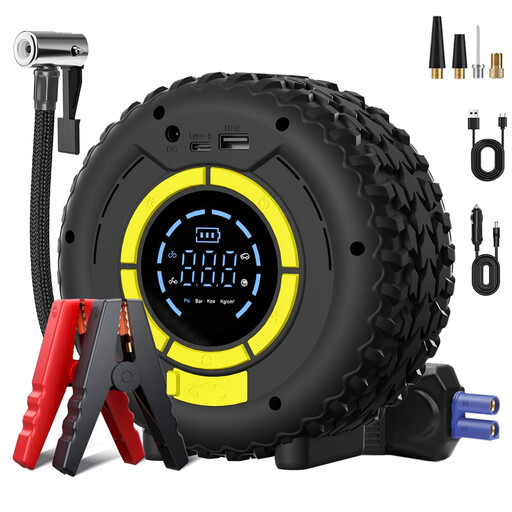
Why it stands out: This is the well-balanced model. Compact yet comprehensive, it's the perfect ally for light vehicles to handle the most common breakdowns.
Key features:
Who is it for? For drivers of city cars, sedans, or motorcycles who want a complete, simple, and portable emergency solution for daily commutes and weekend trips.
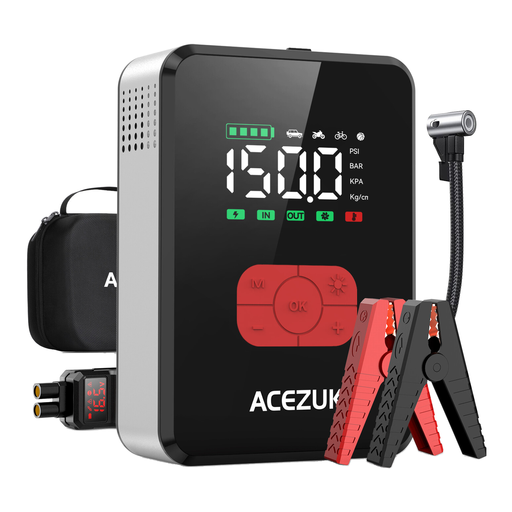
Why it stands out: Its raw power. With a peak current of 7000A, this beast can tackle almost any 12V vehicle, including the largest diesel engines up to 12L.
Key features:
Who is it for? For owners of SUVs, vans, motorhomes, or vehicles with large diesel engines who demand massive power reserves and rock-solid reliability.
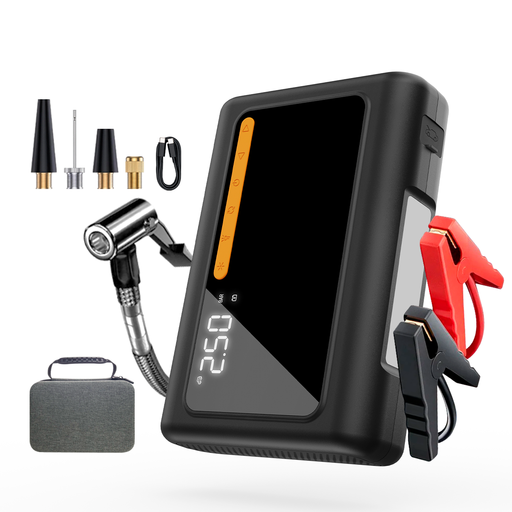
Why it stands out: Technological innovation. It's one of the first models to feature a sodium-ion battery, a game-changing technology in terms of safety and longevity compared to conventional lithium.
Key features:
Who is it for? For those who prioritise safety and durability above all else. It's the ultimate "zero-hassle" device, perfect for leaving in your car without worrying about frequent recharging or extreme temperatures, whether in the scorching sun or the dead of winter.
If these three models don't check all your boxes, or if your priority is an emergency lighting solution, feel free to explore our LED Battery Light category. There you'll discover a wider selection of equipment dedicated to your vehicle's safety and autonomy.
1. Can you leave a jump starter in your car permanently? It all depends on its battery technology. Conventional lithium models do not handle extreme temperatures well (heatwaves or frost), which can degrade their performance and lifespan. In contrast, new sodium-ion batteries are designed to withstand a much wider temperature range, making them ideal candidates for being left in a vehicle year-round.
2. What power (in amps) is needed for my vehicle? Here are a few guidelines:
3. Can a jump starter with a compressor really replace a dedicated inflator? For top-ups and emergencies, absolutely. It's the perfect tool for adjusting tire pressure before a long trip or for reinflating a slowly leaking tire to get you safely to the nearest garage. For quickly and fully inflating four flat tires, a dedicated compressor (powered by a wall outlet or cigarette lighter) will still be more effective. But for on-the-go situations, the versatility of the starter and inflator combo is unbeatable.