
Livraison le jour même ou le lendemain

Qualité garantie

Débloquez vos offres de bienvenue: Livraison GRATUITE | Jusqu'à -80 % | 30 jours d'essai gratuits à JoyPlus
Téléchargez l'application
A dead battery or a flat tyre at the worst possible moment: it's the nightmare scenario that turns any trip into a disaster. To mitigate this risk, a jump starter with an air compressor is the ideal all-in-one solution. But be warned: the market is flooded with misleading marketing claims. To avoid ending up with a useless gadget on the day you truly need it, it's crucial to know how to decipher spec sheets.
As the Head of Product Recommendations at Joybuy, my role is to help you see things more clearly. I'm here to break down the key factors that separate a disappointing device from a true ally for your car.
Manufacturers often misuse and exaggerate certain technical specs to inflate their products' performance. Here are the three things to watch out for before choosing your equipment.
The Illusion of Peak Amps (A)?: Many manufacturers advertise staggering peak amp figures, like 3000A or 4000A. This number represents the maximum current the device can deliver for a fraction of a second. However, what really matters for starting a stubborn engine, especially a diesel jump starter, is the cranking amps—the current sustained for several seconds. An impressive peak number guarantees nothing if the internal battery is of poor quality.
Overstated Capacity (mAh)?: A large milliamp-hour (mAh) capacity is often presented as a guarantee of performance. While essential for the car power bank function, this value isn't everything. A low-quality battery with a high self-discharge rate will drain on its own, even when stored in the boot. You could find your device at 20% charge after a few months, making it incapable of starting your vehicle.
The Gimmicky Air Compressor?: The portable air compressor feature is a major plus, but only if it's genuinely effective. Some entry-level models are extremely slow, noisy, and have inaccurate pressure gauges. Worse, they can overheat after inflating just one tyre, making it impossible to check the pressure on all four wheels in one go.
To make an informed choice, focus on concrete data that guarantees performance and safety.
Don't rely solely on peak amps. Check the device's compatibility with your engine's displacement (in litres), specified for both petrol and diesel engines. A portable car starter for a small petrol city car won't have the same requirements as one for a 3.0L diesel SUV. As a general rule:
The quality of the internal battery is the heart of your emergency starter. Lithium-ion (Li-ion) batteries are the most common, but their quality varies. Pay close attention to the built-in safety protections. A quality device must include:
Here are a few options that meet specific needs, taking into account the performance and safety criteria we've just discussed.
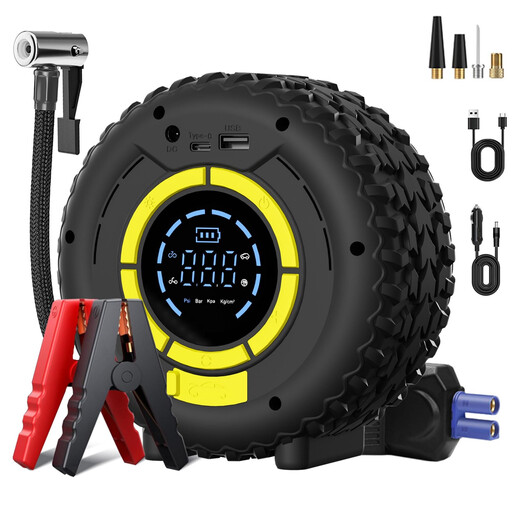
Why we love it : Perfect for city cars and compacts, this is the all-in-one solution that fits right in your glove box. Its light weight and ease of use make it an excellent first-time buy.
Its compressor, featuring an auto-shutoff function and a clear LCD screen, elevates it far beyond a simple gadget. It offers realistic specs without overpromising.
Ultra-compact and lightweight (barely 600g), it's easy to store anywhere. The 8000 mAh power bank function is a welcome bonus for emergency smartphone charging.

Why we love it : Built for SUVs, vans, and large diesel engines. Its high peak current and compatibility with large-displacement engines (up to 8.0L diesel) provide true peace of mind.
It doesn't fall for the "peak amps" marketing trap: its 4500A power is genuinely calibrated for large engines. Its cooling technology mitigates the risk of the compressor overheating.
Colossal starting power, suitable for diesel engines up to 8.0L. It features an arsenal of 10 safety protections, including a crucial anti-spark system.
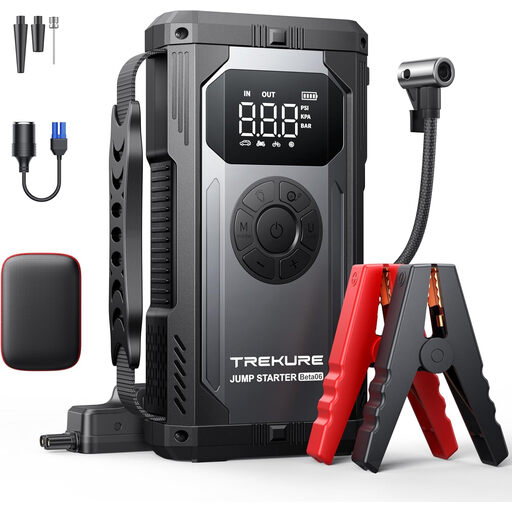
Why we love it : Much more than just a jump starter. Thanks to its 12V DC output (cigarette lighter style), it can power a portable cooler, a car vacuum, and many other accessories, making it the perfect road trip companion.
It avoids the trap of overstated capacity: its 23800 mAh Li-Polymer battery isn't just for show, as proven by its versatility (USB and DC outputs).
Its 12V DC output makes it incredibly versatile, going far beyond simple roadside assistance. 5500A peak power, compatible with all petrol and diesel engines up to 10.0L.
Explore our full selection of jump starters that meet our performance criteria and European safety standards.
The lifespan of a jump starter is typically between 3 and 5 years, depending on the quality of its internal battery and how it's used. To maximise its longevity, remember to recharge it to 100% every 2 to 3 months, even if you don't use it. Store it in a cool, dry place, away from extreme temperatures (the boot or glove box is perfect).
It mainly depends on your engine's displacement. For most modern diesel SUVs up to 3.0L, a 2000A peak may be sufficient in mild weather. However, in freezing temperatures, the vehicle's battery is under much more strain. For safety, and especially for larger engines, it's better to opt for a model with at least 3000A peak power and always check the engine compatibility specified by the manufacturer.
Yes, quality models are designed for this. Always check the operating and storage temperature range indicated by the manufacturer. Generally, it ranges from -20°C to 60°C (-4°F to 140°F), which covers most weather conditions. The only precaution: don't leave it in direct sunlight behind the windscreen, where temperatures can soar well beyond the recommended limits.